

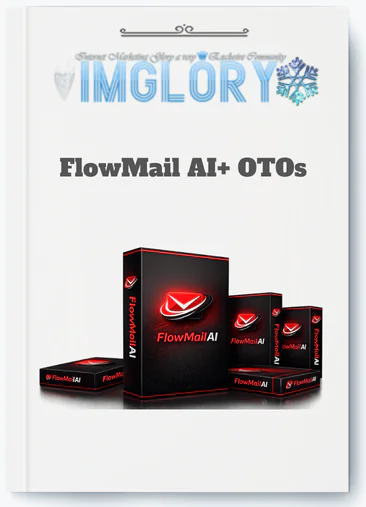
[Group buy] FlowMail AI+ OTOs
$47.00
FlowMail AI is an AI-powered email marketing platform that turns a product URL into a complete promotional email sequence automatically.
At some point, almost every serious affiliate marketer or launch-focused business owner sits down and adds up what their email campaigns actually cost to produce.
Not in money, necessarily. In time.
A 7-email launch sequence for a WarriorPlus offer. Subject lines, hooks, story-driven body copy, benefit bullets, objection handling, the offer reveal, the urgency closer. Done properly, that is 10 to 15 hours of focused writing work across three to five days. For one campaign. For one offer.
Now multiply that by how many strong offers came and went last month that deserved a proper promotional sequence but got a two-email effort instead because the writing time simply was not available. That gap between the campaigns you ran and the campaigns you could have run is the real cost of the manual email writing workflow. It shows up not as an invoice but as the revenue column that never got filled.
FlowMail AI was built specifically to close that gap. It is an AI-powered email marketing platform that converts any product URL or sales page into a complete, ready-to-send email sequence in minutes. Subject lines, hooks, body copy, OTO integration, calls to action, all generated from one URL, all structured around proven funnel logic, all customizable to your brand voice before you send a single email.
What Is FlowMail AI?
FlowMail AI is a purpose-built sales and affiliate email sequence generator that converts a product URL into a complete multi-email promotional campaign. Paste a link to any sales letter, ecommerce product page, funnel page, or affiliate offer, and the system analyzes the page, extracts the offer details and audience characteristics, and generates a structured sequence with every email component already drafted.
A clarification worth making upfront: FlowMail AI is not Shopify FlowMail, which handles transactional store automation for order confirmations and shipping updates. It is not Mailflow AI, which focuses on customer support reply automation. It is not ConvertKit AI, which assists with creator newsletter content. FlowMail AI sits in a specific and distinct category: a multi-email sales sequence generator for marketers who run launches, promote affiliate offers, and operate evergreen promotional funnels.
The platform was created by a team with more than 10 years in software and marketing technology to address the production bottleneck that prevents most affiliates and marketers from running consistent, complete email campaigns at the pace their business model requires. Early users rate it around 4.8 out of 5, with time savings cited as the primary advantage. The front-end entry is $47 one-time with a refund guarantee.
What FlowMail AI Specifically Solves
The writing time constraint. Most marketers are not short of strong offers to promote. They are short of the 10 to 15 hours required to produce a complete sequence for each one. FlowMail AI compresses that to one to two hours of focused review and personalization work.
The campaign quality compromise. When writing time is limited, campaigns get shortened. Seven-email launches become two-email blasts. Complete funnel sequences become single offer emails. FlowMail AI removes the incentive to compromise because producing a complete sequence no longer costs disproportionate time.
The consistency problem. Maintaining tone, messaging, and offer alignment across a 7-email sequence written manually over several days is harder than it sounds. FlowMail AI maintains consistency by design across the full sequence because all emails originate from the same coordinated generation.
The OTO execution gap. Most marketers understand upsell and OTO email strategy in theory but rarely implement it fully because writing the copy for each upsell layer requires additional time and funnel strategy expertise. FlowMail AI builds OTO integration into the sequence automatically.
Main Features of FlowMail AI

AI Email Sequence Generator
The core engine converts a single URL into 5 to 15 ready-to-edit emails, each with subject line options, a preheader, a hook, structured body copy with story, benefit, and objection-handling sections, a call to action, and a PS line. Consistency across the full sequence is maintained by design.
Output quality scales with source page quality. A complete sales letter with detailed benefit bullets, specific audience language, and structured pricing produces a richer sequence than a sparse product page. The manual notes field supplements what the page does not contain with audience context and offer-specific angle information the user provides directly.
OTO, Upsell, and Bump Offer Builder
Identifies complementary offers and higher-tier packages from the source page and integrates them into the sequence at natural conversion points. Dedicated upsell emails after the main offer, bump offer mentions in PS lines, and post-purchase cross-sell follow-ups are all generated automatically. For marketers who know funnel strategy but lack the writing capacity to execute it consistently, this is the feature that closes the gap between theoretical knowledge and actual implementation.
Tone Presets and Brand Voice Customization
More than 10 presets cover the range most marketers need: casual, professional, hype-free, storytelling, authority, friendly, high-energy, and minimalist. Each preset rewrites the full sequence to match the selected voice without requiring regeneration. The same URL can produce dramatically different output across presets, which is what makes multi-client agency production viable within one platform.
Template Library and Swipe Vault
Over 100 proven email frameworks organized by funnel type provide structural starting points for the most common campaign scenarios. Launch sequences, evergreen promos, cart abandonment, webinar funnels, affiliate promo sequences, and flash sales are all represented. The most effective workflow combines AI-generated copy with template structural references, capturing both generation speed and proven campaign architecture.
Bulk Processing for Agency Scale
Multiple campaigns generate simultaneously rather than sequentially, enabling agencies to run a parallel generation session across all active client campaigns and apply brand-specific refinements in a subsequent review phase rather than producing each campaign sequentially from start to finish.
Analytics-Ready Export and ESP Integration
Sequences export as plain text or CSV and import cleanly into Mailchimp, ActiveCampaign, AWeber, ConvertKit, and other major ESPs. A/B testing is supported through export-ready variants that test inside the ESP across split list segments.
Pricing Plans and OTOs detailed
Front-End – FlowMail AI ($47 one-time)
- AI-powered email campaign generation platform
- Includes core FlowMail AI campaign creation features
- Helps create marketing emails faster with less manual work
- Suitable for beginners, marketers, affiliates, and business owners
- Designed to simplify email campaign production and workflow management
OTO 1 – Advanced FlowMail AI
- Unlocks additional campaign types and advanced flexibility
- Includes one full year of unlimited credits
- Adds 50 writing styles for varied campaign creation
- Supports higher campaign generation capacity and scaling
- Ideal for heavy email marketers and large promotional schedules
OTO 2 – Agency Edition
- Built for agencies, freelancers, and service providers
- Manage multiple client accounts and projects simultaneously
- Create campaigns for different businesses from one platform
- Offer email marketing services as a recurring business model
- Suitable for consultants, VAs, and marketing agencies
OTO 3 – Social Proof Training
- Training focused on improving conversions with social proof strategies
- Learn trust-building email structures and persuasion techniques
- Covers buyer psychology, skepticism removal, and offer positioning
- Helps increase open rates, clicks, and overall conversions
- Complements FlowMail AI campaign generation features
OTO 4 – 100% Reseller License
- Includes reseller rights with 100% profit retention
- Sell FlowMail AI as your own product
- Provides an additional software-based income opportunity
- Suitable for digital marketers, product sellers, and list owners
- Turns the platform into a potential standalone business model
How to Use FlowMail AI
Configure the Campaign Input
Paste the product URL, select the sequence length appropriate for your list warmth and campaign window, choose a tone preset that fits your brand voice, and add manual context notes about your audience or offer angle where the source page does not provide sufficient detail. The configuration phase is the highest-leverage moment in the production session because every subsequent output quality decision traces back to the quality of this initial input.
Review Structure Before Copy
Before reviewing individual email copy, evaluate the campaign blueprint structure the AI has generated. Confirm the sequence logic is appropriate for your campaign type, with introduction, value nurture, offer reveal, OTO integration, and urgency closer in the right positions. Adjust structural elements through follow-up instructions before proceeding to copy-level review.
Personalize Stories and Add Authentic Voice
The most impactful customization step is replacing generic story placeholders with authentic personal examples, specific proof elements, and genuine brand language. This is the step that determines whether a structurally sound AI sequence becomes a genuinely engaging campaign. List audiences respond to specific, authentic voice more reliably than to polished but impersonal copy.
Export, Deploy, and Test
Export in the appropriate format for your ESP, import with scheduling and segmentation logic applied, and deploy according to your campaign calendar. Use ESP-native split testing for any variants generated during the customization phase.
Pros and Cons
Pros
- URL-to-sequence automation that compresses a multi-day writing process into a single session is the most directly valuable capability for the affiliates, agencies, and launch marketers FlowMail AI serves.
- Built-in funnel architecture produces structurally sound campaigns without requiring users to design sequence logic from expertise they may not have.
- OTO and upsell integration closes the gap between understanding funnel strategy and consistently executing it.
- 10-plus tone presets make multi-client and multi-niche production viable within one platform without separate per-brand workflows.
- Template library provides proven structural reference alongside AI generation capability.
- Bulk processing enables parallel agency production rather than sequential single-client workflows.
- One-time pricing replaces recurring subscription overhead.
- Refund guarantee provides practical evaluation protection.
Cons
- Source page quality determines output quality. Sparse pages produce less detailed sequences. The AI works with what the page provides.
- Human personalization is required for effective deployment. AI output is a first draft, not a final campaign.
- No native sending or analytics. A separate ESP handles all deployment and performance measurement.
- Regulated industry content requires significant additional review regardless of generation quality.
- Not designed for transactional email automation which belongs in platform-native tools.
Who Is FlowMail AI For?
- Affiliates promoting digital and physical offers who need complete promotional sequences for every campaign without the writing overhead that currently limits their promotion volume.
- Ecommerce brands running promotional campaigns for product spotlights, bundle promotions, and seasonal sales that go beyond transactional automation.
- Agencies managing multiple client email campaigns who want to produce complete first drafts efficiently and focus human expertise on refinement and strategy.
- Course creators, coaches, and SaaS vendors who need launch, onboarding, and follow-up sequences with consistent funnel logic and brand voice.
Less suited for: Transactional email automation, regulated industry communications requiring compliance review, and complex CRM workflows with multi-branch logic.
FlowMail AI vs. Key Alternatives
| Factor | FlowMail AI | ChatGPT | ConvertKit AI | ESP Native AI |
| URL-to-sequence automation | Yes, automated | Manual prompting | No | No |
| Built-in funnel logic | Yes | User-defined | Partial | No |
| OTO and upsell builder | Yes | Manual | No | No |
| Tone presets | Yes, 10+ | Prompt-based | Limited | Limited |
| Template library | Yes, 100+ | No | Limited | Varies |
| Bulk processing | Yes | No | No | No |
| Best for | Launches, affiliates, agencies | Flexible writing | Creator newsletters | Single email polish |
| Pricing | One-time $47 | Subscription | Monthly | Included with ESP |
Frequently Asked Questions
- What is the most important thing to understand about FlowMail AI before deciding to use it?
The most important framing is understanding what FlowMail AI contributes versus what remains the marketer's responsibility. The platform reliably delivers a structurally sound, offer-aware, tone-consistent multi-email sequence in minutes from any product URL. What it does not deliver is a guarantee of campaign performance, which depends on offer strength, list quality, warmth, and the quality of personalization applied during the review phase. Users who approach FlowMail AI as a high-quality first-draft generator that enables running more complete campaigns more frequently will experience the value the platform delivers. Users who expect autonomous, brand-perfect, conversion-guaranteed output without editorial investment will consistently be disappointed.
- How does FlowMail AI handle the situation where two affiliates promote the same offer using the same source URL?
When multiple users generate sequences from the same product URL, the base analysis extracts the same offer information from the same page. The differentiation between sequences comes from the tone presets applied, the manual audience and angle notes added during configuration, and the personalization each marketer adds to the story elements during the review phase. Two affiliates generating from the same URL with different tone presets, different audience notes, and different personal story insertions produce sequences that are recognizably different in voice and approach. The structural foundation may be similar, but the deployed campaign reflects each marketer's unique voice and relationship with their list.
- What is the realistic open rate and click rate expectation for FlowMail AI generated sequences?
FlowMail AI generates copy. Open rates and click rates are determined by a combination of factors including sender reputation and deliverability, list quality and engagement history, subject line relevance to the specific audience, offer fit with the list's interests, and the personalization quality of the deployed sequence. The platform does not guarantee specific performance metrics and no honest review of any copy generation tool should. Marketers who use FlowMail AI to deploy more complete, better-structured campaigns than their previous two-email promotions typically see engagement improvements relative to their baseline, but the absolute performance depends on variables outside the platform's control.
- How does the platform handle the production of evergreen email sequences compared to time-bound launches?
Both evergreen autoresponder sequences and time-bound launch campaigns are supported. For evergreen sequences, the generation process is identical to launch sequences, and the output is structured for ongoing autoresponder deployment where urgency and deadline elements are replaced with value-forward nurture content and soft offer reminders. For time-bound launches, the sequence includes deadline-specific urgency in the closing emails and can be adjusted for specific cart open and close windows through the configuration phase. The tone preset selection typically differs between the two formats, with evergreen sequences benefiting from warmer nurture presets and launch sequences benefiting from higher-energy urgency-forward presets in the closing emails.
- Can FlowMail AI generate sequences for coaching or service-based offers where the value is primarily relationship-based?
Yes. Service-based and coaching offers are supported, particularly where the offer has a structured sales page or landing page that communicates the core promise, target client profile, and transformation or outcome delivered. The most effective configuration for coaching and service sequences adds manual notes covering the specific client transformation stories and the coach's personal methodology, since these elements are unlikely to appear in sufficient detail on the offer page alone. The storytelling and authority tone presets typically produce the strongest output for coaching and consulting offers where personal credibility and transformation proof are the primary conversion drivers.
- How does the bulk processing feature work in practice for an agency running multiple simultaneous client campaigns?
Bulk processing allows submitting multiple URL inputs simultaneously rather than running one campaign at a time. The practical agency workflow runs the generation phase for all active client campaigns in a single session, submitting each client's offer URL with appropriate sequence length and tone preset selections and allowing all campaigns to generate in parallel. The review and personalization phase then proceeds client by client in priority order, applying brand-specific language, client-specific proof elements, and compliance requirements to each sequence before export. This parallel generation followed by sequential personalization approach captures the throughput efficiency of bulk AI generation while maintaining the quality review standard that professional client delivery requires.
- What is the most effective use of the template library for a marketer who primarily generates sequences with the AI engine?
The template library is most effectively used as a structural benchmarking reference rather than a replacement for AI-generated copy. After generating a sequence from the offer URL, comparing the generated structure to the most relevant template for the same campaign type identifies any structural gaps or misalignments between the AI output and proven campaign architecture. Where the generated sequence's structure matches the template closely, use the template's specific email elements like subject line formulas and CTA structures to supplement AI-generated copy in emails that need additional polish. Where the generated structure deviates meaningfully from proven architecture, use the template as a restructuring reference through follow-up instructions.
- How should a marketer who has never run a multi-email promotional sequence before approach using FlowMail AI?
For marketers new to multi-email promotional sequences, FlowMail AI's automated funnel logic is particularly valuable because it implements proven campaign architecture that they would otherwise need to research and design from scratch.
The most productive approach for first-time users is to generate a 5-email sequence for an offer they are already planning to promote, review each email in the context of the overall sequence to understand how the structural logic flows from introduction through offer reveal through urgency closer, and use that understanding to inform how they personalize and deploy the campaign. Running the first sequence through to deployment, even if the personalization is light, gives a concrete educational experience about multi-email promotional campaigns that reading about them never provides.
- Can the output from FlowMail AI be used in platforms other than traditional email service providers?
Yes. The exported plain text or CSV format is compatible with any platform that accepts email content, including traditional ESPs, SMS marketing platforms where the copy is adapted for shorter format, social media ad copy where individual email sections translate well to ad formats, and sales page copy where benefit bullets and objection handling sections from emails can be repurposed directly. The most common secondary use is extracting subject lines as social media hooks and benefit bullets as ad copy headlines, which extends the value of each FlowMail AI generation session beyond the email channel.
- What is the most underused FlowMail AI feature that new users typically overlook?
The manual notes field in the configuration phase is consistently the most underused feature among new users who focus on the URL input and tone preset selection without adding the audience and angle context that the field supports. Users who add three to five sentences of audience context, covering the specific pain points the offer addresses, the transformation the buyer experiences, and any relevant objections the audience typically raises, consistently produce sequences that require significantly less personalization during the review phase than users who rely solely on what the AI extracts from the source page.
The notes field is where your knowledge of your specific audience supplements the AI's knowledge of the offer, and the output quality difference reflects how much of that combined context informs the generation.
- How does FlowMail AI perform for seasonal or holiday promotional campaigns specifically?
Seasonal and holiday promotional campaigns are a strong fit for FlowMail AI because the time pressure of seasonal promotions is precisely the situation where writing capacity is most likely to be the limiting factor. A Black Friday promotion that needs a complete 7-email sequence ready two weeks before the sale opens is exactly the scenario where compressing production from days to hours is most valuable. The configuration for seasonal campaigns adds the holiday context and deadline specificity to the manual notes field, and the high-energy urgency preset typically produces the most effective output for time-bound seasonal campaigns. Post-seasonal follow-up sequences and cross-sell campaigns for customers who purchased during the sale are equally supported through the same workflow.
- What is the single most effective practice for getting consistently strong results from FlowMail AI across all campaign types?
Developing a personal configuration template for each major campaign type you produce regularly is the practice that most consistently compounds the quality of FlowMail AI output over time. For each campaign category, document the URL type, sequence length, tone preset, and standard manual notes structure that produces the strongest output for your specific audience and niche.
For example, a template for JVZoo affiliate promotions might specify a 7-email sequence, casual-storytelling preset, and a standard notes structure covering the primary audience pain point, the proof type most relevant to the audience, and the main objection the offer addresses. Reusing this template as the starting configuration for every new JVZoo promotion produces more consistently strong first drafts than approaching each campaign configuration fresh, and the template improves over time as you identify which configuration elements produce the strongest outputs for your specific deployment context.
Be the first to review “FlowMail AI+ OTOs”
You must be logged in to post a review.
Related products
GB Spy Tools
GB SAAS Tools
GB SAAS Tools

GB SAAS Tools
GB SAAS Tools
Reviews
There are no reviews yet.