
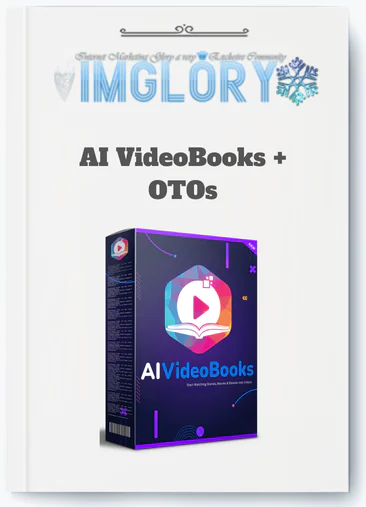
[Group buy] AI VideoBooks + OTOs
$17.00
AI VideoBooks is a cloud-based AI platform that transforms keywords, text, PDFs, and images into interactive video books and flipbooks with narration, visuals, and multimedia elements.
Digital publishing in 2026 presents a paradox that most aspiring creators never fully resolve. The marketplaces are vast and the demand is real. Amazon KDP alone processes millions of digital book purchases every day across categories ranging from children's picture books and educational workbooks to niche topic guides and interactive activity books. The infrastructure for publishing, selling, and earning royalties from digital content is more accessible than at any point in the history of publishing.
And yet most people who have ideas for books that would genuinely sell on these platforms never publish a single one. The barrier is not opportunity. It is production. Creating a book that meets marketplace quality standards, stands out visually, delivers an engaging reading experience, and can be produced at a volume that makes a publishing business financially viable requires a combination of writing skill, design capability, illustration access, narration talent, technical formatting knowledge, and consistent time investment that most individual creators cannot sustain across all the other demands on their attention and energy.
AI VideoBooks, developed in 2026 by Yogesh Kashyap, is the most direct answer to this paradox currently available. It replaces the multi-discipline production chain with a single automated workflow that turns a topic into a finished, narrated, animated video book ready for marketplace publication in a single guided session. This review is a complete guide to how it works, who it serves, and what it honestly delivers.
What Is AI VideoBooks?
AI VideoBooks is a cloud-based AI video book and flipbook creation platform by Yogesh Kashyap that generates complete narrated video books from keyword inputs, text, PDFs, and images, with AI-produced scene content and visuals, read-aloud narration with synchronized text highlighting, background music, design customization, affiliate link embedding, 21-category niche support, multilingual production, MP4, PDF, and ZIP export, DFY templates, built-in social sharing, and commercial rights, all at a $14.95 one-time front-end price with a 30-day money-back guarantee.
The platform sits at the intersection of three converging trends in digital content creation. First, the AI content generation revolution that has made text and image creation accessible to non-specialists. Second, the digital publishing gold rush on Amazon KDP, Etsy, and Google Books that has created enormous demand for quality niche digital products. Third, the growing consumer preference for interactive, multimedia reading experiences over static text documents, particularly in the children's content and educational materials categories where the platform's most valuable features create the most direct commercial advantage.
What AI VideoBooks adds to these converging trends is a production system that handles the specific combination of capabilities required to create the premium video book format, narration, synchronized text, scene visuals, audio, and multi-format export, within a single accessible workflow that does not require any of the technical skills those capabilities would individually demand.
The Specific Problem AI VideoBooks Solves
Digital publishing tools have historically addressed parts of the production problem. AI writing tools help with content. Design platforms help with layout. Text-to-speech services help with narration. Video editing software helps with assembly. But requiring creators to navigate, subscribe to, and coordinate between four or more separate specialist tools creates a workflow complexity that is itself a barrier, particularly for creators who want to produce multiple titles across multiple categories without building a sophisticated multi-tool production operation.
The specific problem AI VideoBooks solves is not making any one of these individual steps easier. It is eliminating the coordination problem entirely by consolidating all of them into a single platform where a keyword goes in and a finished video book comes out. The user's contribution to the process is creative direction, topic selection, and quality review. Every technical production step, from content generation through visual creation through narration through assembly through export, happens within the same session without requiring separate tool access or technical skill.
This consolidation changes not just the efficiency of individual book creation but the economics of digital publishing as a business model. When each title takes days across multiple tools and skill sets, a publishing business that requires catalog depth to become financially significant is practically out of reach for an individual creator. When each title takes one guided session in a single platform, a catalog of thirty or fifty titles becomes operationally achievable within a realistic timeframe for a solo publisher.
Walking Through Every Feature

The Core Generator: From Idea to Video Book
The creation workflow begins in the Create Video Books section of the dashboard. Users enter a book title and story concept or topic description, select from 21 content categories, and specify the number of scenes. The AI generates complete scene-by-scene content immediately, applying the writing style, narrative conventions, and structural approach appropriate to the chosen category. Children's story content is generated with age-appropriate vocabulary and narrative pacing. Educational content is structured with clear instructional progression. Niche guide content is organized with logical topic coverage appropriate to the subject.
The generated content is displayed for review before proceeding to visual production, giving users the opportunity to adjust, correct, or expand any scenes that need refinement. This edit-before-generation approach ensures that content quality issues in the text do not propagate through to the final video output, where correction would require regenerating the visual and audio elements associated with the affected scenes.
Read-Aloud Narration With Synchronized Highlighting
The read-along feature is worth discussing at length because it is the most commercially significant capability of the platform and the one most directly connected to the specific market demand that AI VideoBooks is best positioned to serve.
When the video book is compiled, the AI narration system reads the complete scene text aloud and the platform synchronizes each spoken word or phrase with a highlight display in the on-screen text, so viewers see the words they are hearing highlighted in real time as the narrator delivers them. This creates the guided reading experience that early literacy research identifies as the most effective format for supporting word recognition and reading comprehension development in young learners.
For parents buying digital books for children between the ages of two and eight, this feature is not a bonus enhancement. It is the defining quality of what they are looking for. A children's video book without read-along narration is a picture book video. A children's video book with synchronized read-along narration is an interactive reading experience that parents can justify as both entertainment and education. The difference in perceived value and justifiable price point between these two formats is significant, and AI VideoBooks produces the higher-value format as its default output.
For educational content creators, the same feature serves a different but equally valuable purpose. Students who consume educational video books with narrated, highlighted text receive information through simultaneous audio and visual channels, which is one of the most effective dual-coding learning approaches for retention and comprehension. An educator who produces AI VideoBooks content is providing a measurably more effective learning experience than one who provides static text worksheets or plain PDF documents.
AI-Produced Scene Visuals
Scene images generated by the platform create illustrated visual context for each scene's narrative or educational content, drawing from the scene text to produce contextually appropriate visuals rather than generic stock imagery. Users retain full control to replace any generated image with a custom upload, allowing selective visual personalization without sacrificing the speed advantage of full AI generation for scenes where custom visuals are not required.
For children's books specifically, visual quality and character consistency across scenes are the primary quality concerns that require user attention in the review phase. The more specific and consistent the character descriptions across scene texts, the more coherent the AI image generation across the full book.
21-Category Niche Coverage
The category framework provides structured production templates for the full range of commercially active digital book niches. Children's story books, educational books for multiple subjects, mathematics practice books, science exploration content, puzzle and maze activity books, game-style learning formats, niche informational guides, and affiliate promotional flipbooks each receive category-specific content generation treatment that reflects the conventions and audience expectations of that niche.
This category specificity is what prevents AI VideoBooks from producing generically formatted content that could belong to any book type. A science learning book generated by AI VideoBooks has the structure, vocabulary, and visual approach appropriate for the science education category rather than the generic narrative format of a story book applied to a science topic.
Text, PDF, and Image Conversion
The conversion engine transforms existing content assets into video book format. A written PDF guide becomes a narrated educational video book. An article or blog post series becomes an animated informational flipbook. An image collection becomes an illustrated visual story with AI-generated narrative context. This capability turns content that has already been created into new products without new content investment, which is one of the most financially efficient use cases the platform supports.
Multi-Format Export and Distribution
The three-format export system produces MP4, PDF, and ZIP deliverables from a single production session. The MP4 serves video distribution channels including YouTube, social media, and video-enabled digital product sales. The PDF serves document marketplace channels including Amazon KDP, Google Books, and direct download platforms. The ZIP packages all assets for comprehensive client delivery or archival. Each format opens a distinct revenue and distribution channel, meaning every video book produced with AI VideoBooks has three simultaneous paths to commercial deployment.
Multilingual Production
Language selection in the production settings generates narration and text display in the target language, covering major international markets including Spanish, French, German, Portuguese, and additional languages. Each language version is produced from the same content framework, making international catalog expansion a matter of additional production time rather than additional content development investment. For children's book publishers specifically, multilingual editions of successful English titles represent one of the highest-leverage catalog expansion strategies available, and AI VideoBooks makes the production of those multilingual editions accessible rather than prohibitively expensive.
Audio Enhancement: Music and Sound Effects
The integrated audio library adds ambient sound that elevates the production quality of finished video books from a well-structured narration to a fully produced multimedia experience. Appropriate background music for the content category and scene tone improves viewer engagement and the perceived professional standard of the finished product. Sound effects can be applied to specific scenes to punctuate key narrative moments or reinforce educational content points.
Design Customization and Professional Templates
Typography, color scheme, gradient, and styling customization apply a distinctive visual character to each video book that differentiates it from generic automated production. The DFY template library provides professionally designed production starting points for common book formats, reducing the creative decisions required before each new project begins. Professional mockup assets create marketplace-ready product presentation images for listing optimization without requiring additional design work.
Affiliate Integration and Social Distribution
Embedded affiliate links within book content create promotional assets that earn reader trust before presenting commercial recommendations. Built-in social sharing distributes finished content to connected social platforms directly from the dashboard, supporting the use of video books as social media content marketing assets alongside their primary publishing and sales applications.
Prompt Generator
The structured content brief generator creates topic-specific production prompts with configurable parameters for content type, tone, and length, providing focused creative direction for users who want more precision in their initial inputs than a general topic description provides.
Pricing Plans and OTOs detailed
FE – AI VideoBooks ($14.94)
- AI VideoBooks front-end access
- AI-powered video book creator
- Flipbook and digital content creation tools
- Commercial license included
- Create and sell digital publishing products
- Suitable for video books, storybooks, and workbooks
- No recurring monthly fees
- One-time payment during launch
- 30-day money-back guarantee
OTO 1 – Unlimited Edition ($47–$67)
- Higher content creation limits
- More niches and templates
- Additional language support
- Expanded creative assets library
- More downloads and publishing capacity
- Faster platform performance
- Premium support included
- Enhanced selling opportunities
OTO 2 – DFY Edition ($97)
- Done-for-you account setup
- Ready-made digital book assets
- Preloaded monetization features
- Niche research assistance
- Branding setup support
- Faster publishing workflow
- Beginner-friendly implementation
OTO 3 – Set N' Forget Profits ($67)
- Done-for-you video book assets
- Ready-made publishing content
- Faster content deployment
- Additional monetization opportunities
- Reduced manual creation work
- Expanded product library
- Simplified scaling process
OTO 4 – Automation Profits Edition ($37)
- Traffic generation tools included
- Automated promotion features
- Visitor acquisition strategies
- Affiliate offer promotion support
- Lead generation capabilities
- Marketing automation tools
- Traffic-focused business growth
OTO 5 – Business Suite Edition ($97)
- Done-for-you profit websites
- Built-in traffic systems
- Multiple monetization methods
- Online business assets included
- Affiliate marketing support
- Automation features included
- Business-in-a-box solution
OTO 6 – Profit Template Club ($47)
- Large template library access
- Ready-made video book layouts
- Faster content production
- More design flexibility
- Niche-specific templates
- Publishing asset expansion
- Suitable for client and marketplace projects
OTO 7 – Agency Edition ($97)
- Agency dashboard access
- Create and manage client accounts
- Sell AI VideoBooks services
- Multi-user management tools
- Set your own service pricing
- Client-based business model
- Suitable for freelancers and agencies
OTO 8 – White-Label Edition ($197)
- Rebrand AI VideoBooks as your own software
- Custom logo and branding
- Custom domain setup
- Sell software access under your brand
- Create unlimited user accounts
- Fully hosted software solution
- Full control over pricing and marketing
- Turnkey software business opportunity
How AI VideoBooks Works
Step 1: Concept Input and Scene Generation
Enter your book title, story concept, or topic description in the Create Video Books interface. Select your content category from 21 available options. Specify scene count. Click Generate Scenes. Review and edit the AI-generated scene content as needed. Proceed to image generation with final scene content confirmed.
Step 2: Visual Production and Assembly
Generate AI images for each scene or upload custom visuals for scenes requiring specific treatment. Click Generate Video to compile each scene with narration, synchronized text highlighting, and visual presentation applied automatically. Add background music or sound effects from the integrated library. Apply typography, color, and design customizations.
Step 3: Export, Publish, and Distribute
Export in all three formats. Publish PDF to Amazon KDP, Google Books, or direct download platforms. Upload MP4 to YouTube, social media, or video marketplace channels. Use the ZIP for comprehensive client delivery or platform distribution. Apply built-in social sharing tools for immediate cross-platform distribution.
Who AI VideoBooks Is For
- Active KDP publishers building diversified digital catalogs. KDP publishers who understand keyword research, category selection, and listing optimization will find that AI VideoBooks accelerates the production side of their business significantly, allowing them to spend proportionally more of their time on the strategic and marketing dimensions that most directly drive catalog performance.
- Educators who create digital learning materials. Teachers, tutors, homeschooling parents, and educational content creators who want to produce professional-quality interactive learning materials for their students or for sale on educational content platforms will find AI VideoBooks particularly well-suited to their needs. The narrated read-along format is the specific educational delivery mechanism that most directly supports the learning outcomes these creators aim to produce, and the platform's support for mathematics, science, and general educational content categories covers the subject areas where demand is highest.
- Digital product creators building lead generation systems. A video book is a premium lead magnet format that creates a stronger first impression and higher perceived value for new subscribers than standard PDF alternatives. Content creators who invest in high-quality video book lead magnets create list-building systems that attract more highly qualified subscribers and create stronger initial relationships with those subscribers from the first interaction.
- Freelance content producers seeking a premium service offering. The combination of commercial license, rapid production capability, and genuine format premium creates a freelance service offering that commands premium pricing while remaining operationally sustainable for a solo service provider. Authors who need narrated editions of their existing books, businesses that want branded educational content, and coaches who want lead magnet video books all represent immediately approachable client categories.
- Content repurposers maximizing the value of existing material. Any creator with a library of existing PDFs, articles, or written guides can convert that material into new product lines without new content investment. The financial efficiency of this repurposing capability makes AI VideoBooks valuable from the first session for creators with substantial existing content.
Who AI VideoBooks Is Not For
- Professional video producers requiring frame-level creative control. The automation-first production model trades granular technical control for accessibility and speed. Professional video production requirements are better served by dedicated production software.
- Plain text eBook publishers with no multimedia interest. The platform's value is embedded in its video and narration dimensions. Static document publishing does not benefit from what AI VideoBooks provides.
- Users who expect passive income from production alone. Publishing success requires active marketplace strategy and promotional engagement that production tools do not substitute for.
Pros and Cons
Pros
- The narrated read-along format creates direct commercial alignment with the highest-demand children's content category. The specific format AI VideoBooks produces is what parents and educators are actively buying. This is not a generically useful feature but a direct match between platform output and demonstrated marketplace demand.
- Total production consolidation from concept to multi-format export eliminates every coordination step that makes multi-tool publishing workflows slow and fragmented. This is not a speed improvement within existing workflows but a replacement of fragmented workflows with a single consolidated session.
- Content conversion from existing PDFs and text creates immediate ROI from underutilized content libraries. New products from existing content at minimal additional production cost is one of the highest-leverage commercial applications of any content tool.
- Multilingual production at negligible incremental cost enables international catalog expansion that would otherwise require proportionally large translation and production budgets.
- The $14.95 one-time price point makes professional video book publishing access genuinely democratic. The financial barrier to accessing professional narrated video book production capability is lower with AI VideoBooks than with any combination of tools that would be required to replicate its output independently.
- 30-day money-back guarantee provides sufficient evaluation time for multiple complete video book projects.
Cons
- AI content generation requires human review for accuracy and quality before marketplace publication. Automated generation is a first-draft capability, not a final publication guarantee.
- Platform automation limits production control for users with specific advanced visual or audio requirements.
- Marketplace publishing success depends on active strategy and promotional effort that the platform does not provide.
AI VideoBooks vs. Key Alternatives
| Feature | AI VideoBooks | Sqribble | Designrr | Book Bolt | Canva |
| AI video book from keywords | Yes | No | No | No | No |
| Read-aloud narration with text sync | Yes | No | No | No | No |
| Scene-by-scene AI image generation | Yes | No | No | No | No |
| Content-to-video-book conversion | Yes | No | Yes | No | No |
| Background music and sound library | Yes | No | No | No | No |
| 21 niche category templates | Yes | Partial | No | Partial | N/A |
| Multilingual narration | Yes | No | No | No | No |
| MP4 video export | Yes | No | No | No | Partial |
| KDP-ready PDF export | Yes | Yes | Yes | Yes | Partial |
| Affiliate link support | Yes | Yes | Yes | No | No |
| Flipbook creation | Yes | Partial | No | No | No |
| Commercial license at base | Yes | Partial | No | Yes | No |
| One-time pricing | Yes | No | No | No | No |
The comparison against Sqribble, Designrr, Book Bolt, and Canva follows the same pattern as all previous comparisons in this series. Each alternative handles some dimension of digital content creation but none produces the narrated video book format. Sqribble creates visually polished eBooks but without narration, video, or AI image generation. Designrr converts content to eBook formats without video or audio. Book Bolt provides KDP research and design tools for static books. Canva offers design flexibility without book generation, narration, or video output. AI VideoBooks is the only platform across all five that produces the complete narrated video book format from a keyword input at a one-time price with commercial rights included.
Frequently Asked Questions
- How does AI VideoBooks compare to hiring a professional children's book illustrator and voiceover artist?
Hiring a professional illustrator for a children's book typically costs between $500 and $3,000 depending on the number of illustrations, the illustrator's experience level, and the complexity of the visual style required. Adding a professional voiceover recording for a read-along narration adds between $100 and $500 depending on the length and the voice actor's rate. Video editing to synchronize the narration with the illustrated pages adds additional cost and time.
AI VideoBooks produces the equivalent output, illustrated scenes with synchronized read-along narration, for a one-time platform cost of $14.95, which is a cost differential that compresses the break-even point for digital children's book publishing to a single sale rather than requiring dozens of sales to recover production costs. The trade-off is that human illustrators and voice actors can produce more personalized, stylistically distinctive outputs for premium projects, while AI VideoBooks produces professional-quality outputs suitable for marketplace publishing at a cost that makes high-volume catalog development financially viable.
- What category on Amazon KDP performs best for narrated video book formats?
The children's picture book and early reader categories on Amazon KDP show the strongest consistent demand for narrated, illustrated reading experiences because the read-along format directly addresses the primary use case of these categories: providing engaging, educationally supportive reading experiences for children who are developing or beginning their reading skills. The interactive read-along quality of AI VideoBooks output places its products in a premium position within these categories compared to standard text-and-image picture books.
Activity and workbook categories also perform well for the video book format because the narrated instruction and visual demonstration format adds genuine educational value over static worksheet alternatives. Children's language learning books, phonics materials, and early mathematics content are particularly well-positioned for the narrated format because these subjects benefit most directly from the simultaneous audio and visual delivery that AI VideoBooks provides.
- Can AI VideoBooks produce content appropriate for adult professional development or business education markets?
Yes. While the children's and educational content categories are the most naturally aligned with the video book format's distinctive features, professional development and business education represent viable adult content markets for AI VideoBooks. The narrated video book format for adult learners functions as a professional audio-visual learning experience, similar in effect to a narrated slide presentation or a video course module, but packaged as a self-contained interactive book product.
Business skill guides, productivity frameworks, professional certification preparation materials, and industry-specific knowledge resources for professional audiences can all be created in the AI VideoBooks format. The key consideration for adult professional content is that the narration style and design treatment should reflect a professional rather than children's educational register, which can be achieved through the design customization settings and by directing the scene content generation toward professional language conventions in the initial topic description.
- How does AI VideoBooks support creators who want to build a subscription-based content model rather than individual product sales?
Video books created with AI VideoBooks can be packaged as subscription content in membership sites, educational platforms, and content subscription services as well as sold as individual products on marketplaces. The MP4 format is directly compatible with video-hosted membership site platforms. The PDF format can be delivered through subscription-based digital download services. Creators who build subscription models around regular new video book releases, such as a new children's video book every month for subscribing families or a new educational video book each week for subscribing students, can use AI VideoBooks to sustain the production cadence required for subscription content without proportionally scaling their production time investment. The commercial license covers subscription-based delivery models as well as individual product sales.
- What is the most effective way to use multilingual video books to expand a publishing catalog internationally?
The most leverage-efficient approach to multilingual expansion with AI VideoBooks is to identify the three to five titles in an existing English catalog that have the strongest sales performance and lowest competition in their specific categories, then produce Spanish, Portuguese, and French versions of those titles specifically before expanding to additional languages or additional titles. These three languages together cover the largest combined international market accessible through Amazon KDP's international marketplaces.
For children's books specifically, Spanish is the highest-priority first expansion language because Spanish-language children's book demand on Amazon KDP is consistently strong and the competitive landscape in many subcategories remains less crowded than the English equivalents. Each multilingual version should be published as a separate ASIN on the relevant regional Amazon marketplace rather than as a variant of the English listing to maximize category visibility in each language market independently.
- How does the platform handle books with many scenes, such as longer educational workbooks or comprehensive guides?
AI VideoBooks supports variable scene counts to accommodate both short-form content and longer, more comprehensive book formats. For longer books with higher scene counts, the generation and image production phases take proportionally more time within the session, and the final video compilation produces a longer MP4 output reflecting the full book length. Users producing longer educational workbooks or comprehensive guides should allow additional session time for both the content review phase and the image generation phase compared to short-form children's books.
For very long reference materials that would benefit from chapter-based navigation rather than linear video playback, the PDF flipbook format is typically more appropriate than the MP4 video format, since PDF readers support direct page navigation that video players do not. Users can choose to create the PDF flipbook as the primary format for longer reference content while using shorter excerpt video clips in MP4 format for promotional and social media distribution.
- Can AI VideoBooks be used to create content that meets accessibility standards for visually or hearing impaired audiences?
The read-aloud narration with synchronized text highlighting in AI VideoBooks creates content that is more accessible to users with reading difficulties or visual processing challenges compared to standard silent text formats. The audio narration dimension makes the content accessible to users who have difficulty with standard text reading, while the visual text display with highlighting makes the content accessible to users who process visual information more effectively than audio alone.
For hearing-impaired users, the visual text display with highlighting provides a visual reading experience even when audio cannot be accessed. Users who want to produce content specifically optimized for accessibility standards for particular institutional or platform requirements should verify that AI VideoBooks output meets those specific standards, as formal accessibility certification involves additional technical requirements beyond the general accessibility benefits the format provides by default.
- What is the realistic quality level of AI-generated images in AI VideoBooks and how does it compare to professional illustration?
AI-generated images in AI VideoBooks produce illustrated visuals that are appropriate for professional digital publishing in the children's book and educational content categories. The quality standard is equivalent to competent stock illustration or mid-market professional illustration rather than the distinctive, highly personalized artistic style of premium boutique illustration studios. For marketplace publishing purposes, the image quality is consistently suitable for Amazon KDP and similar platforms where a professional illustrated appearance is the standard rather than a unique artistic signature.
Users who want a distinctive, brand-consistent illustration style across multiple titles can achieve greater visual coherence through custom uploaded images for key scenes while using AI generation for background and setting scenes where visual distinctiveness is less critical. For children's books at the independent publisher price points typical of KDP self-publishing, AI VideoBooks image quality compares favorably to what most individual creators could afford to commission from freelance illustrators.
- How should creators structure their pricing strategy when selling video books directly versus through Amazon KDP?
Pricing strategy differs significantly between direct sales and KDP marketplace pricing because the two channels have different competitive dynamics and different buyer psychology. On Amazon KDP, video books in the children's category typically perform best in price ranges from $2.99 to $6.99 for standard titles, with educational and activity books sometimes supporting prices up to $9.99 when they offer significant interactive value. The KDP royalty structure rewards pricing in the $2.99 to $9.99 range with 70 percent royalties compared to 35 percent below $2.99.
For direct sales through a personal website or platform, pricing can be set independently of marketplace norms and typically commands a 20 to 50 percent premium over equivalent KDP prices because direct buyers are purchasing from a specific creator relationship rather than comparing listings in a competitive marketplace. Lead magnet video books should be priced at zero as opt-in incentives, with their commercial value realized through list monetization rather than direct product revenue.
- Can the same AI VideoBooks account be used to create content across multiple different niches simultaneously?
Yes. AI VideoBooks supports the creation of projects across all 21 supported content categories from the same account simultaneously, with no restriction on the niche diversity of projects within the same account. Publishers who operate across multiple niches, such as publishing children's story books, educational mathematics content, and niche informational guides simultaneously, manage all of those projects from a single dashboard without requiring separate accounts or license purchases for each category. This multi-niche production capability from a single account is one of the operational advantages of the platform's category framework, allowing publishers to diversify their catalog across content types and audience segments without the administrative overhead of managing multiple platform subscriptions or separate production workflows for each niche.
- What post-production steps are typically needed before submitting an AI VideoBooks PDF to Amazon KDP?
Before submitting an AI VideoBooks PDF to Amazon KDP, users should complete several review steps that ensure the submission meets KDP's quality standards. First, review all scene text for factual accuracy, grammatical correctness, and appropriate tone for the target age range or audience. Second, verify that all AI-generated images are appropriate, clearly rendered, and do not contain any visual artifacts or content that would violate KDP's content policies.
Third, ensure the cover design meets KDP's specific cover image requirements for dimensions, resolution, and format, which may require creating a separate cover image using the platform's design tools or an external design tool if the platform's generated cover does not meet specifications. Fourth, write a compelling book description and select appropriate categories and keywords for the marketplace listing before submitting the content file itself. These preparation steps add time to the publishing workflow but are necessary for successful KDP review and optimal listing performance after publication.
- What is the long-term value proposition of AI VideoBooks for a creator building a sustainable digital publishing business?
The long-term value proposition of AI VideoBooks is most clearly expressed through the catalog compounding effect that its production efficiency enables. A creator who publishes two new video book titles per month using AI VideoBooks builds a catalog of 24 titles per year. Over three years, that catalog reaches 72 titles across multiple categories and potentially multiple languages. Each published title is a permanent passive income asset that continues to generate royalties without ongoing maintenance cost.
The cumulative royalty income from a catalog of 72 well-optimized titles in categories with consistent demand is meaningfully greater than what any individual high-performing title can sustain. AI VideoBooks does not make any individual title more likely to succeed on its own merits, but it makes building the catalog depth that creates financially significant aggregate passive income practically achievable for a solo creator within a realistic timeframe. This catalog compounding effect is the most commercially significant long-term value that the platform's production efficiency creates.
Be the first to review “AI VideoBooks + OTOs”
You must be logged in to post a review.
Related products
GB SAAS Tools
GB SAAS Tools
GB SAAS Tools
GB SAAS Tools
GB SAAS Tools
Reviews
There are no reviews yet.