
INSTANT
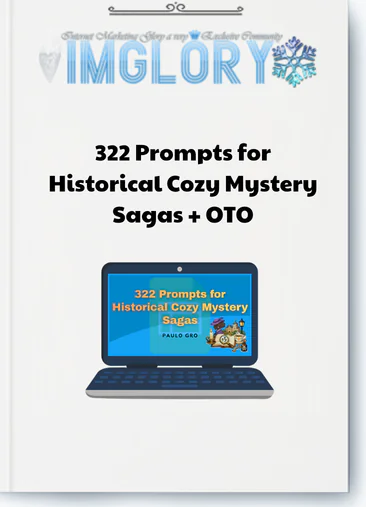
[Group buy] 322 Prompts for Historical Cozy Mystery Sagas + OTO
$19.00
322 Prompts for Historical Cozy Mystery Sagas + OTO: Write binge-worthy historical whodunits on Kindle with ease.
A number that makes many people stop scrolling: 214 — the estimated number of Kindle copies a historical cozy mystery author sells every single day for a single title.
Not a major publisher bestseller, and not a celebrity memoir. It is a gentle mystery novel set in 1920s Cotswolds, self-published on Amazon KDP by Karen Baugh Menuhin — who began writing at age 60, with no agent, no advance, and no marketing budget.
Her debut quickly reached #1 on Amazon US, and her series has since accumulated over 84,000 reviews and sold more than 1 million copies. Her success reflects a clear reality: readers are highly “hungry” for warm, atmospheric mystery series they can follow long-term, rather than standalone books.
This demand is both large and stable, but constrained by one major problem: production. Building a coherent 9-book historical mystery series with accurate period detail, emotional depth, and tight narrative logic requires years of research and advanced storytelling experience.
“322 Prompts for Historical Cozy Mystery Sagas” is designed to remove that barrier — functioning as a structured system for creating and launching scalable, consistent nine-book historical mystery series across 46 different historical settings.
2. What Is 322 Prompts for Historical Cozy Mystery Sagas + OTO?

322 Prompts for Historical Cozy Mystery Sagas is a structured prompt collection combined with a complete production methodology, designed to let you build Custom GPT-powered saga engines — or use desktop AI agents like ChatGPT Codex or Claude Cowork — to generate full nine-book historical cozy mystery series with perfect narrative continuity across every volume.
The key distinction from any generic AI writing prompt pack is what each Universe Seed Prompt actually builds. When you paste one of these 322 prompts into ChatGPT and create a Custom GPT, you are not getting a vague character sketch or a loose story idea. You are getting a fully configured Custom GPT — complete with Name, Description, Instructions, and a dense World Bible uploaded to Knowledge — that functions as your dedicated saga engine for an entire nine-book series.
The engine knows your characters, their nine-book arcs, the period's social constraints, the community ecosystem, the mystery mechanics, the slow-burn romance trajectory, and the series-wide conspiracy threading across all nine volumes. It consults all of this before generating a single word of your next chapter.
This system solves the single hardest problem in AI fiction generation: memory. Standard AI tools forget what they wrote three chapters ago. Billionaires change hair color mid-saga. Clues planted in Book 2 vanish by Book 4. The series conspiracy goes nowhere. The romance skips stages or repeats beats it already resolved. The “Teacup & Treachery Arc” system — the Canon-Vault Technology at the heart of this product — eliminates all of that through three interlocking layers of managed continuity that keep the entire franchise structurally locked from first chapter to final reveal.
3. Who Is Behind 322 Prompts for Historical Cozy Mystery Sagas?
The creator of this system is Paulo Gro, a digital publishing practitioner with deep experience in AI-assisted content production for the fiction market. Rather than building a generic AI writing course, Paulo spent his development time solving a very specific and technically demanding problem: how do you make a large language model behave like a tireless co-author with perfect memory across nine books and hundreds of thousands of words?
The answer he arrived at is the Canon-Vault Technology embedded in these prompts — a three-layer continuity management system consisting of the World Bible (installed in the GPT's permanent memory), the Rolling Canon Lock (a structured memory update after each completed book), and the Generation Protocol (hard-coded behavioral rules enforcing quality and consistency across all chapters).
Together, these three layers mean that when you open your Custom GPT on a Tuesday and ask for Chapter 7 of Book 6, the engine picks up exactly where Book 5 ended — same characters, same hidden truths, same unresolved conspiracy threads, same romantic tension calibrated to its precise saga position.
Paulo also designed the system to accommodate two distinct working methods: the Custom GPT approach for chapter-by-chapter generation within ChatGPT, and the Desktop Agent Method for publishers who want complete formatted novels delivered as .docx files with zero manual chapter prompting. Both paths are fully documented in the included training materials.
4. What Does 322 Prompts for Historical Cozy Mystery Sagas + OTO Provide?

The system is organized as six precision instruments designed to work together as a complete saga production pipeline. Here is a full breakdown of every component.
4.1 The Architect — 322 Universe Seed Prompts
- You get 322 Universe Seed Prompts spanning 46 distinct historical cozy mystery categories — from 1920s Village Tea Shop Mystery to Medieval Monastery Mystery, Victorian Spiritualist Fraud Investigation, WWII Homefront Village Sleuth, Edwardian Suffragette Detective, and 42 more.
- Each prompt generates the complete Custom GPT configuration — Name, Description, Instructions, and a dense World Bible — that becomes your dedicated saga engine for an entire nine-book series.
- Every generated saga includes a full cast of characters with mapped arcs across all nine books, including physical descriptions, emotional wounds, hidden motives, and evolving relationships.
- You get a historically accurate period constraint system that dictates what your sleuth can and cannot do — social propriety, available technology, class barriers, gender restrictions, and the legal framework of the era.
- You get a community ecosystem of recurring villagers, merchants, servants, and suspects, each with their own secrets, loyalties, and reasons to help or hinder the investigation.
- You get fair-play mystery mechanics built in — murder timing, clue placement, red herring count, and unmasking position all shift from book to book so no two investigations feel structurally alike.
- You get a nine-book macro outline with a series-wide conspiracy or cold case that advances book to book and reaches its climax in Book 9.
4.2 The Outliner — The Book Prompt
- You get a Book Prompt that turns your saga universe into a complete publishing package for any book in the series — ready to generate and ready to sell.
- You get a refined title and subtitle optimized for Amazon's historical cozy mystery category.
- You get an Amazon KDP sales description written to hook the genre's target reader.
- You get 7 SEO keywords chosen for discoverability in the cozy mystery search landscape.
- You get a detailed 13-chapter outline with the standalone mystery arc, series-wide conspiracy thread, and romance beats mapped chapter by chapter.
- You get a publish-ready cover prompt derived from the actual plot and setting of that specific book — not a generic genre image, but a scene pulled from the story you are about to generate.
4.3 The Writer — The Chapter Prompt
- You get a Chapter Prompt that writes each chapter at 1,500 to 3,000 words using a five-movement structure engineered specifically for historical cozy mystery — Grounding, Character Interaction, Period Constraint Complication, Emotional Shift, and Hook Ending.
- Every chapter includes period-specific sensory grounding — sights, sounds, textures, and social rituals that immerse the reader in the historical era from the first paragraph.
- You get layered dialogue with subtext — what characters say and what they mean diverge, rewarding attentive readers who catch the double meanings.
- You get historical constraint complications built into every scene — the era's social rules, technological limitations, and class barriers create genuine investigative obstacles.
- You get slow-burn romantic progression calibrated to the saga position — proximity in early books, tension in the middle, vulnerability and advancement in later volumes.
- You get hook endings that alternate between cozy warmth and mystery tension, keeping readers turning pages while preserving the genre's signature comfort.
4.4 The Memory — The Canon Lock Prompt
- You get a Canon Lock Prompt that generates a structured summary after each completed book, capturing everything the next book needs to remember — then plugs it back into the GPT as binding reference material.
- The Canon Lock tracks mystery resolution, character evolution, romance subplot status, and unresolved threads separated into next-book hooks versus long-arc conspiracy threads.
- You get information asymmetry tracking — who knows what about whom — so the engine never has a character act on information they should not yet possess.
4.5 The Shortcut — Step-by-Step Saga Setup Guide
- You get a zero-guesswork walkthrough from pasting your first prompt to publishing your first saga — no technical background required.
- Every click is documented with screenshots — from creating the Custom GPT to uploading the World Bible to publishing on KDP.
- Written in plain English for people who have never built a Custom GPT or published a book on Amazon KDP.
- Every common mistake is flagged before you make it — so you never have to troubleshoot blind.
4.6 The Desktop Agent — The Codex / Cowork Method
- You get an alternative creation method that skips the Custom GPT setup entirely — paste one mega-prompt into OpenAI Codex or Claude Cowork and the agent builds your entire saga automatically.
- Complete novels are delivered as formatted .docx files — two versions per book: paperback-ready and Kindle-ready — both optimized for direct KDP upload.
- No chapter-by-chapter prompting — the agent writes all 13 chapters in sequence and compiles them into finished Word documents.
- Automatic canon management — the agent saves the Canon Vault and every Book Canon Summary to your folder without any manual file handling.
- An interactive mega-prompt generator is included — paste your Universe Seed Prompt and get the complete desktop agent instruction in one click.
- Each completed saga generates approximately 135,000 words of continuity-locked fiction. You get 322 of them.
322 Prompts for Historical Cozy Mystery Sagas (FE)
Based on the product sales page, here is what you get from 322 Prompts for Historical Cozy Mystery Sagas formatted in bullet points:
- The Architect — 322 Universe Seed Prompts: Custom GPT configuration prompts (Name, Description, Instructions, and a dense World Bible) that serve as your dedicated saga engine for a 9-book series, featuring:
- A full cast of characters with mapped arcs across all 9 books.
- A historically accurate period constraint system (social propriety, available technology, class barriers, etc.).
- A community ecosystem of recurring villagers, merchants, servants, and suspects.
- Fair-play mystery mechanics that shift structurally from book to book.
- A 9-book macro outline with an underlying series-wide conspiracy thread.
- The Outliner — The Book Prompt: A prompt that turns your saga universe into a complete publishing package for any individual book in the series, providing:
- A refined title and subtitle optimized for Amazon's historical cozy mystery category.
- An Amazon KDP sales description written to hook target readers.
- 7 SEO keywords chosen for high discoverability.
- A detailed 13-chapter outline mapping the mystery, conspiracy, and romance beats chapter by chapter.
- A publish-ready AI cover art prompt derived directly from the specific book's plot.
- The Writer — The Chapter Prompt: A prompt engineered to write each chapter at 1,500–3,000 words using a specialized 5-movement structure that delivers:
- Period-specific sensory grounding.
- Layered dialogue with deep subtext.
- Historical constraint complications that challenge the investigation.
- A calibrated slow-burn romantic progression matching the saga's timeline.
- Alternating hook endings between cozy warmth and mystery tension.
- The Memory — The Canon Lock Prompt: A prompt that generates a structured continuity summary after each completed book to feed back into the GPT as reference material, tracking:
- The final mystery resolution (culprit, evidence, community aftermath).
- Character evolution, unlocked secrets, and new loyalties/enmities.
- The exact status of the slow-burn romance subplot.
- Unresolved threads separated into next-book hooks and long-arc conspiracy secrets.
- The Shortcut — Step-by-Step Saga Setup Guide: A plain-English, zero-guesswork walkthrough with screenshots documenting every click—from creating the Custom GPT and uploading the World Bible to publishing on Amazon KDP.
- The Desktop Agent — The Codex / Cowork Method: An alternative setup-free creation method designed for OpenAI Codex or Claude Cowork that automatically:
- Writes all 13 chapters in sequence and compiles them into finished Word documents without chapter-by-chapter prompting.
- Delivers two formatted .docx files per book: paperback-ready and Kindle-ready.
- Handles automated canon management and file saving to your computer without manual file handling.
- 46 Historical Cozy Mystery Sub-Niches: Access to hand-built universes across 46 popular themes where readers are actively searching (e.g., 1920s Village Tea Shop, Victorian London Lady Detective, WWII Codebreaker Village, Medieval Monastery Mystery, etc.).
- A Scalable Publishing Strategy: A blueprint detailing how to turn these prompts into a digital asset production line, including the “Weekly Release” schedule, the “Pilot Episode” testing method, the Kindle Unlimited “Flywheel” system, impulse-buy pricing strategies, saga bundles/box sets, and print-on-demand paperback optimization.
732 Prompts for Historical Cozy Mystery Sagas (OTO1)
732 Additional Universe Seed Prompts: A massive expansion pack designed to triple your franchise inventory by providing multiple, completely distinct saga universes within the same 46 historical categories.
Full Canon-Vault Compatibility: Every prompt seamlessly integrates with the core system's architecture, automatically generating:
- A dedicated Custom GPT configuration and a dense World Bible.
- Complete 9-book character arcs, period constraint frameworks, and custom mystery mechanics.
- A 9-book macro outline with a built-in, series-wide conspiracy thread.
Extended Trope Depth: Multiple unique saga engines for all 46 historical niches (e.g., Medieval Monastery Mystery, 1920s Jazz Club Murder, Victorian Servants Hall Sleuth, Edwardian Suffragette Detective, Ancient Rome Tavern Keeper, WWII Codebreaker Village, etc.).
Calibrated Market Optimization: Each of the 732 prompts automatically outputs Amazon KDP sales descriptions and SEO keywords specifically targeted to historical cozy mystery search trends.
Tailored Visual Direction: Built-in capabilities to generate period-accurate AI cover art prompts for every newly created saga, avoiding generic imagery or anachronistic details.
Catalog Scaling & Market Dominance Blueprint: Strategies to leverage this massive prompt expansion to:
- Dominate Specific Sub-Niches: Own specific Amazon search terms by launching multiple different sagas under the exact same trope.
- Create Mega-Bundles: Combine different sagas from the same era into massive box sets (e.g., The Complete 1920s Mystery Collection).
- Test and Pivot Faster: Launch “pilot episodes” across five different tropes simultaneously to let reader data guide your catalog growth.
- Maximize Readthrough: Feed binge-consumers an endless supply of inventory to keep Amazon's algorithm promoting your entire backlist.
5. The Four Structural Pillars That Make These Sagas Irresistible to Readers
Most AI-generated mystery fiction fails because it ignores what actually makes readers obsessed with a series. These Universe Seed Prompts are built around four structural pillars hard-coded into every saga the system generates.
- Pillar 1 — A Standalone Mystery Resolved in Every Book. Every book delivers a complete, satisfying whodunit. No cliffhanger mysteries that cheat the reader. The murder happens before Chapter 3, giving readers an immediate hook. The culprit is introduced before Chapter 7. Three genuine clues are planted where attentive readers can catch them. Two red herrings are woven in to deceive without cheating. The unmasking happens in Chapters 12 and 13 — surprising, inevitable, and fair.
- Pillar 2 — A Series-Wide Conspiracy Across All Nine Books. Beneath each standalone case lies a deeper mystery — a series-wide conspiracy or cold case that advances book to book and reaches its climax in Book 9. The Canon Lock system tracks which threads are next-book hooks and which are long-arc secrets, ensuring the conspiracy escalates naturally without dropping threads or repeating revelations. This is the engine that makes readers buy the next book before they finish the current one.
- Pillar 3 — Slow-Burn Investigation Romance. The romantic subplot grows organically from the investigation itself — never bolted on, never rushed, never stalling. In early books, proximity and shared danger create the spark. In the middle books, tension and vulnerability deepen the connection. In later volumes, setbacks and advancements push the relationship toward resolution. Every chapter carries a calibrated romance beat that matches the saga's position.
-

Visual asset orchestration: Generate premium, period-accurate book cover graphics matching specific narrative timelines.
Pillar 4 — Period-Accurate Historical Constraints That Shape Every Investigation. The historical era is not wallpaper — it is a narrative engine. Social propriety dictates who the sleuth can question. Absent forensic science forces reliance on observation, wit, and social maneuvering. Class barriers determine who cooperates and who stonewalls. The constraints of the era become the plot itself, forcing creative investigative solutions that feel authentic and earned.
6. Pros & Cons of 322 Prompts for Historical Cozy Mystery Sagas + OTO
6.1. Pros of 322 Prompts for Historical Cozy Mystery Sagas
- Franchise Architecture Built Into Every Prompt: This is not a writing assistant — it is a franchise engine. Every Universe Seed Prompt produces a complete nine-book universe with character arcs, period constraints, community ecosystems, mystery mechanics, and a series-wide conspiracy already mapped from Book 1 to Book 9. A professional mystery author spends three to six months building a series bible this detailed. The system generates one in under 30 seconds.
- Iron Continuity Across All Nine Books: The Canon-Vault Technology — World Bible plus Rolling Canon Lock plus Generation Protocol — solves the single hardest problem in AI fiction: memory. No character inconsistencies, no dropped clue chains, no romance beats that skip or repeat, no conspiracy threads that vanish between volumes. The engine behaves less like a chatbot and more like a co-author with perfect recall.
- 46 Historical Settings, 322 Completely Unique Universes: The range of historical categories — from 1920s Jazz Club Murder to Medieval Herbalist Nun Sleuth, from Edwardian Garden Party Poisoning to WWII Land Girls Mystery — ensures no two generated saga universes are alike. Every category produces entirely different characters, period constraints, community dynamics, and mystery architectures. No template fatigue, no repetitive output.
- Two Flexible Working Methods: The Custom GPT approach and the Desktop Agent Method (via Codex or Claude Cowork) serve two different working styles. Chapter-by-chapter GPT users retain maximum editorial control. Desktop agent users receive complete formatted novels as .docx files with zero manual prompting. Both paths produce the same saga quality and canon integrity.
- Complete Publishing Package Per Book: The Book Prompt output includes not just a 13-chapter outline but also a refined Amazon title and subtitle, a KDP-ready sales description, 7 SEO keywords, and a detailed cover generation prompt built from the actual plot — not a generic genre image. Every book arrives pre-equipped for professional launch.
6.2. Cons of 322 Prompts for Historical Cozy Mystery Sagas
- Requires ChatGPT Plus or Anthropic API Access: Building Custom GPTs requires a ChatGPT Plus subscription ($20/month), and using the Desktop Agent Method via Claude Cowork requires an active Anthropic account. These are modest costs relative to the production value delivered, but they are real prerequisites that first-time users need to budget for before their first generation run.
- Custom GPT Setup Has a Short Learning Curve: Creating a Custom GPT for the first time — filling in the Name, Description, Instructions, and uploading the World Bible to Knowledge — takes approximately five minutes and is fully documented in the included screenshot guide. That said, users who have never opened the ChatGPT interface before will need to allow 30 to 60 minutes for their first full setup, not five minutes. The guide is thorough, but first-timer patience is still required.
- Chapter Prompt Output Requires Light Editorial Polish Before Publishing: The Chapter Prompt generates 1,500 to 3,000 words of structurally sound, period-aware prose per chapter. However, AI-generated fiction — even at this quality level — benefits from a light human editorial pass before KDP upload, particularly for dialogue naturalization and sensory specificity. Imglory's Advice: Do not skip the editing step, but do not over-engineer it either. Budget 20 to 30 minutes per chapter for a targeted read-through focusing on dialogue distinctiveness and period vocabulary. That time investment is the difference between a publishable asset and a truly competitive one that earns organic reviews.
7. Who Should Buy — And Who Should Skip — 322 Prompts for Historical Cozy Mystery Sagas + OTO?
322 Prompts for Historical Cozy Mystery Sagas + OTO is built for:
- Amazon KDP Publishers Seeking a High-Readthrough Genre: Historical cozy mystery has among the highest readthrough rates of any fiction genre — once a reader falls in love with a sleuth, they follow her through the entire series. Publishers who understand catalog depth and series compounding will recognize immediately what 322 nine-book saga engines represent as a portfolio asset.
- Aspiring Authors With a Love of the Genre But No Technical Writing Background: You do not need to have studied Agatha Christie for a decade or mastered the social hierarchies of Regency England. The genre expertise is built into the prompt architecture. Your role is editorial direction, not technical craft mastery.
- Digital Entrepreneurs Testing Multiple Publishing Niches: The 46 historical categories provide an ideal A/B testing framework — launch Book 1 of three different categories simultaneously, identify which readership responds, and scale the winner. The system is built for exactly this kind of data-driven niche discovery.
- Existing Fiction Authors Looking to Add a Series Vertical: Writers who are already publishing in other genres but want to diversify into a high-demand, loyalty-driven category without starting from scratch on research, worldbuilding, and series architecture.
322 Prompts for Historical Cozy Mystery Sagas + OTO is not right for:
- Publishers Looking for a Single-Book Solution: This system is architected around nine-book series franchises. The Canon-Vault Technology, the series-wide conspiracy structure, and the slow-burn romance across multiple volumes are all optimized for serial readership. Publishers interested only in standalone novels will not extract full value from the franchise-level infrastructure.
- Anyone Expecting Zero Learning Time: The Saga Setup Guide is thorough and screenshot-documented, but there is a first-session learning investment. Users who expect to be publishing within 15 minutes of purchase will be disappointed. Users who invest one focused session into setup will be generating full novel outlines within the hour.
8. Imglory Special Insights: Monetization Strategies with 322 Prompts for Historical Cozy Mystery Sagas
Owning 322 Prompts for Historical Cozy Mystery Sagas means you’re working with a scalable saga-generation system. The key is not volume alone, but strategic deployment to maximize catalog ROI.
8.1. Pilot Episode Testing
Use 322 Prompts for Historical Cozy Mystery Sagas to create three different Book 1s from distinct historical settings (e.g., 1920s village mystery, Victorian sleuth, WWII homefront case).
Publish all within 30 days at $2.99 via KDP Select, then compare page reads, reviews, and readthrough after 30 days. The strongest performer becomes your core saga.
Once identified, use 322 Prompts for Historical Cozy Mystery Sagas to rapidly expand that universe into a full 9-book series while demand is active.
8.2. Kindle Unlimited Flywheel
Readers in this niche binge entire series. With 322 Prompts for Historical Cozy Mystery Sagas, each book is structured for strong continuity and ongoing mystery arcs that drive readthrough.
Regular releases (weekly or bi-weekly) in KDP Select increase visibility across the entire series. Each new book boosts performance of previous titles through algorithmic compounding and KU page-read accumulation.
8.3. Bundle & Omnibus Strategy
After completing a 9-book saga built with 322 Prompts for Historical Cozy Mystery Sagas, repurpose it into higher-value bundles:
- Box Set Vol. 1 (Books 1–3) — entry product
- Box Set Vol. 2 (Books 4–6)
- Box Set Vol. 3 (Books 7–9)
- Complete Omnibus — premium binge/gift edition
Add a paperback omnibus via KDP Print-on-Demand for evergreen Q4 gift sales, with no inventory risk and higher margin per sale.
9. Frequently Asked Questions – 322 Prompts for Historical Cozy Mystery Sagas + OTO
- Q1: Do I need any knowledge of historical periods to use these prompts effectively?
- No. The period-accurate constraint systems — social hierarchies, available technology, gender restrictions, legal frameworks, and investigative limitations — are all hard-coded into the World Bible that each Universe Seed Prompt generates. The system encodes the genre expertise that traditionally requires years of research and reading. Your role is editorial direction, not historical scholarship.
- Q2: How does the system maintain continuity across nine books if AI has no natural memory?
- Through the Canon-Vault Technology: a three-layer continuity system consisting of the World Bible installed in the GPT's permanent memory, the Rolling Canon Lock updated and re-uploaded after each completed book, and the Generation Protocol's hard-coded behavioral rules. Together, these three layers mean the engine tracks every clue, every character evolution, every romance beat, and every conspiracy thread — and consults all of it before generating any new content.
- Q3: Can I publish books generated with this system on Amazon KDP?
- Yes. Amazon's current policy permits AI-generated and AI-assisted content, requiring only a disclosure checkbox during the upload process. The system generates structurally original saga universes — no two Universe Seed Prompts produce the same characters, setting, community ecosystem, or mystery architecture, ensuring your content is fully non-duplicative.
- Q4: What is the Desktop Agent Method and when should I use it instead of Custom GPTs?
- The Desktop Agent Method uses ChatGPT Codex or Claude Cowork — desktop AI agents that read files, write documents, and manage complex projects directly on your computer. Instead of creating a Custom GPT and prompting chapter by chapter, you paste one mega-prompt and the agent writes all 13 chapters automatically, then compiles them into two formatted .docx files (paperback and Kindle) ready for KDP upload. Use the Desktop Agent Method if you prefer receiving complete, formatted novels rather than managing the chapter-by-chapter generation process yourself.
- Q5: How many books can I realistically publish per month using this system?
- Realistically, one to two complete saga books per week on a part-time schedule, depending on your editorial review pace. Each book runs 19,500 to 39,000 words in the novella sweet spot for the genre. A complete nine-book saga can be live on Amazon in under ten weeks of part-time work. With the Desktop Agent Method, production speed increases further since full novels are delivered as formatted documents without chapter-by-chapter prompting sessions.
- Q6: Are the 322 prompts truly different from each other, or do they generate similar sagas?
- Each of the 46 historical categories produces completely different saga universes — different eras, different social constraint systems, different character archetypes, different community ecosystems, and different mystery architectures. Within each category, individual prompts vary in protagonist profession, emotional backstory, geographic specificity, and community composition. No two Custom GPTs built from these prompts will generate the same story.
- Q7: What is the OTO and is it worth adding to the front-end purchase?
- The OTO (One-Time Offer) expands the core system with additional resources for scaling your publishing operation — typically including expanded prompt libraries, additional category frameworks, or advanced monetization training. Whether it is worth adding depends on your publishing ambitions: publishers planning to build multiple active saga series simultaneously will extract more value from the expanded resources, while those starting with a single series will find the front-end system more than sufficient for their first 12 months of publishing.
Conclusion – 322 Prompts for Historical Cozy Mystery Sagas
322 Prompts for Historical Cozy Mystery Sagas is not a shortcut around craft — it is a structural solution to the most technically demanding challenge in AI-assisted fiction publishing: maintaining iron continuity, authentic period detail, fair-play mystery mechanics, and emotionally calibrated romance across nine books and 135,000 words of continuity-locked fiction. The Canon-Vault Technology at its core is the difference between an AI tool that writes inconsistent chapters and a franchise engine that builds worlds readers want to live in for months.
The historical cozy mystery market has documented demand, extraordinary reader loyalty, and a readthrough rate that compounds royalties across every book in a series.
The publishers who move into this niche with a systematic, franchise-minded production approach — building saga universes, testing categories with pilot episodes, deploying the Kindle Unlimited flywheel, and stacking bundles after series completion — are the ones who will build the kind of backlists that earn consistently for years rather than spikes that fade after launch week.
At 322 universe engines across 46 historical settings, this system offers more publishing potential than most authors can realistically execute in a decade. The constraint is not the tool — it is the time and intent you bring to deploying it.
Click here to access 322 Prompts for Historical Cozy Mystery Sagas + OTO and start building your historical mystery franchise portfolio today.
Be the first to review “322 Prompts for Historical Cozy Mystery Sagas + OTO”
You must be logged in to post a review.
Related products
GB Graphic-Stock
Price range: $2.00 through $21.00
GB Graphic-Stock
$2.00

GB Graphic-Stock
Original price was: $120.00.$12.00Current price is: $12.00.

GB Graphic-Stock
Original price was: $245.00.$26.50Current price is: $26.50.

GB Graphic-Stock
Original price was: $50.00.$11.00Current price is: $11.00.
Reviews
There are no reviews yet.