


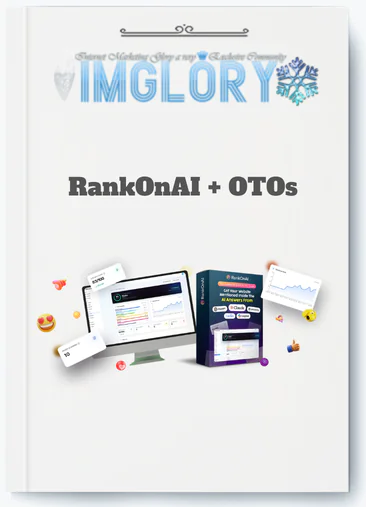
[Group buy] RankOnAI + OTOs
$21.00
RankOnAI is a cloud-based Generative Engine Optimization platform that helps websites improve visibility in AI search engines through audits, optimization tools, GEO scoring, and AI-focused SEO analysis.
There is a question that most website owners have never thought to ask, and the answer to it is reshaping the economics of organic traffic in ways that traditional SEO metrics completely fail to capture. The question is: when someone asks ChatGPT, Perplexity, Claude, Gemini, or Copilot a question that your website answers, do they ever see your name? Not in a search results list. Not in an ad. In the actual generated answer, as a named source, as a recommended option, as a cited reference that drives direct, high-intent traffic to your pages.
For the vast majority of website owners, the honest answer is that they have no idea. They do not have the tools to find out. And if the answer is no, they have no framework for understanding why or what to do about it. RankOnAI, developed by Himanshu Mehta of Pixalab and launched in 2026, is the platform that makes this question answerable and the answer improvable. It is a Generative Engine Optimization suite that measures AI search readiness, diagnoses structural gaps, and generates the specific technical improvements that move a website from AI-invisible to AI-cited. This review is a practical guide to how it works and what it delivers.
What Is RankOnAI?
RankOnAI is a cloud-based Generative Engine Optimization platform that helps websites become discoverable, quotable, and trustworthy for AI search engines including ChatGPT, Claude, Perplexity, Gemini, Microsoft Copilot, and Apple AI, through a 0-100 GEO Score, 7-pillar structural audit, AI engine crawl and citation tracking, one-click code generation for structural fixes, brand-voice-preserving AI content rewriting, automated 15-type schema building, llms.txt file generation, conversational content gap analysis, AI-vs-Google keyword research, competitor GEO benchmarking, citation authority tracking, a white-label agency suite, and a native WordPress plugin.
Rather than repeating the GEO concept from scratch, this article takes a different approach. It starts with what the platform actually produces in a typical user session and works backward from those outputs to explain why each one matters commercially.
In a standard first session, a user submits their domain, receives a GEO Score between 0 and 100, gets a breakdown of which of seven structural pillars are passing or failing on their key pages, receives a prioritized list of specific fixes ranked by commercial impact, and has access to tools that generate the schema code, Answer Capsule text, FAQ structures, and llms.txt file needed to address those fixes immediately. That is the practical output of the initial workflow. Everything else in the platform, the crawler tracking, the competitor benchmarking, the content gap analysis, the agency reporting, builds from and enhances this core diagnostic and remediation cycle.
The front-end Starter plan is priced at $19 as a one-time payment with coupon code SAVE2 available for an additional $2 discount. A 14-day money-back guarantee covers the purchase.
Starting From the Output: What Does a Typical RankOnAI Session Produce?
Rather than describing features in isolation, this section walks through what users actually receive from the platform and what they can do with each output.
Output One: The GEO Score and What It Tells You
The GEO Score is a number between 0 and 100 that represents the aggregate AI citation readiness of a page or domain. A score below 40 indicates significant structural barriers to AI visibility that are likely causing the site to be consistently bypassed in AI-generated answers. A score between 40 and 70 represents partial compliance with AI retrieval requirements, where some structural elements are in place but important gaps remain. A score above 70 indicates strong structural alignment with AI extraction preferences, where the remaining optimization opportunities are incremental rather than foundational.
The score is useful as a diagnostic starting point, a competitive benchmark, and a progress metric. It tells you where you stand, how you compare to competitors who have been through the same analysis, and whether the changes you have implemented are producing measurable improvement. Without this score, AI visibility optimization is directionally blind.
Output Two: The 7-Pillar Audit Breakdown
The 7-pillar breakdown shows exactly which structural elements are passing and which are failing, with the explanation of why each failure matters and what specifically needs to change. The seven pillars cover schema markup, FAQ distribution, Answer Capsule density, heading hierarchy, bot access permissions, llms.txt compliance, and content quality signals.
The pass/fail structure of each pillar converts a complex technical analysis into a practical work list. Users do not need to understand JSON-LD specifications to know that the schema markup pillar is failing and that the fix involves deploying the schema code the platform generates. They do not need to understand robots.txt syntax to know that the bot access pillar is failing and that the fix involves modifying a specific directive. The technical complexity is handled by the platform. The user's job is to implement the output.
Output Three: Implementation-Ready Code and Content
For each failing pillar, the one-click optimization engine generates the specific code or content structure needed to address the issue. Schema failures produce ready-to-deploy JSON-LD code. Heading hierarchy failures produce a recommended structural reorganization. Answer Capsule gaps produce concise, precisely worded text blocks sized for AI extraction windows. FAQ gaps produce question-and-answer content formatted for FAQPage schema deployment. llms.txt failures produce a properly formatted file ready for root directory placement.
The practical value of this output is that it closes the gap between diagnosis and action. Most website owners who encounter technical optimization guidance know what needs to be done but cannot do it because they lack the technical skills to produce the required code or structured content themselves. RankOnAI eliminates this execution barrier.
Output Four: AI Crawler Activity Data
The crawler monitoring tracks which AI user-agents have visited which pages and when. This data answers the foundational question that must be answered before any other optimization work is meaningful: can AI engines actually access the site? A positive answer confirms that structural improvements will be seen by AI crawlers. A negative answer reveals a bot access problem that is the single highest-priority fix regardless of all other audit findings.
Beyond the access confirmation, crawler activity data tracks which pages are receiving AI attention over time, which is useful for understanding which content areas the AI engines find most relevant to their indexing priorities.
Output Five: Content Gap Intelligence
The conversational content gap analysis produces a list of specific questions that users are directing to AI assistants within the site's topic area that the site currently fails to answer adequately. Each entry comes with the question, intent classification, priority level, and suggested content approach. This intelligence feeds directly into content planning, providing a research-backed list of AI-specific content opportunities that competitors using only traditional keyword tools cannot see.
Features Beyond the Core Audit

AI-vs-Google Keyword Research
The keyword research module produces a three-way segmentation of keyword opportunities into pure AI search targets, pure Google search targets, and hybrid intersection keywords. This segmentation is commercially valuable because it changes how content creation resources should be allocated. A topic that drives primarily typed Google searches should be optimized differently from a topic that users predominantly explore through AI assistant conversations. RankOnAI is the only accessible tool that makes this distinction visible rather than treating all keyword opportunities as equivalent regardless of which channel dominates their traffic.
Competitor GEO Benchmarking
Submitting competitor URLs produces a side-by-side 7-pillar comparison that shows exactly where competitors are structurally ahead and where they have exploitable weaknesses. The competitive intelligence from this comparison is more commercially actionable than traditional SEO competitor analysis because it reveals specific structural gaps rather than aggregate domain authority differences that are difficult to close in the short term. A competitor with strong schema but failed bot access, or strong FAQ structure but weak Answer Capsule density, reveals specific parity opportunities that can be addressed within a single optimization session.
Citation and Authority Tracking
This feature monitors the off-page digital footprint, tracking representation consistency across external directories and citation sources. AI retrieval systems assess source trustworthiness partly by cross-referencing entity information across the web. Inconsistent Name, Address, and Phone Number data across different external directories sends weaker trust signals to AI systems than consistent, accurate representation everywhere. The citation tracking feature provides the data needed to identify and correct these inconsistencies.
The White-Label Agency Suite
The agency infrastructure transforms RankOnAI from a personal optimization tool into a complete service delivery platform. White-labeled PDF audit reports with custom branding create the prospecting tool that makes GEO services easy to sell. A lightweight client CRM tracks project status and engagement. Integrated invoicing handles billing. Structured outreach templates provide the conversation starters for approaching potential clients with a compelling, data-backed service proposition.
The prospecting workflow enabled by the agency suite is among the most commercially direct in the digital marketing services space. Running a free white-labeled GEO audit for a prospective client, showing them their current GEO Score and the specific structural issues preventing their website from appearing in AI answers, and proposing a service to address those issues creates a sales conversation grounded in evidence rather than abstract service descriptions.
Pricing Plans and OTOs detailed
FE – RankOnAI Starter ($19)
- RankOnAI Starter access
- AI crawl tracking system included
- 7-pillar GEO audit framework
- GEO Score (0–100) analysis
- AI content rewriter included
- Content gap analysis tools
- Schema generator and llms.txt creator
- WordPress plugin access
- 8 bonuses included
- One-time payment with 14-day guarantee
OTO 1 – RankOnAI Pro ($67)
- Unlimited website management
- Unlimited bulk AI rewrites
- Competitor benchmarking tools
- CSV export functionality
- Citation and authority tracking
- NAP profile management
- AI-generated content briefs
- Keyword target tracking
- Custom AI rewriter prompts
- 365-day audit history
OTO 2 – RankOnAI AutoPilot ($37/month or $297/year)
- Automated GEO audits
- Scheduled AI rewrite suggestions
- Automatic llms.txt updates
- GEO score drop alerts
- AI bot activity tracking
- Weekly performance reports
- Optional WordPress auto-apply mode
- Hands-off optimization workflow
OTO 3 – RankOnAI Agency ($197)
- White-label PDF reports
- Up to 25 client workspaces
- Built-in client CRM
- Branded invoicing system
- Proposal and outreach templates
- Cold email and social templates
- Agency branding features
- Priority support included
OTO 4 – RankOnAI Reseller ($297)
- 100% commissions across the funnel
- Personal reseller license included
- Proven sales pages provided
- Email swipe campaigns included
- Social media promotional assets
- Graphics and banner packs included
- Vendor handles hosting and support
- Complete reseller marketing toolkit
- One-time payment with 14-day guarantee
How RankOnAI Works
Step 1: Submit Domain, Review Initial Diagnosis
Enter any domain URL in the RankOnAI dashboard. Within three to six minutes, receive the GEO Score, AI crawler activity summary, and full 7-pillar structural audit. No technical configuration required for this step. Review the findings to understand the current AI readiness baseline and identify the highest-priority structural gaps.
Step 2: Generate and Deploy Fixes in Priority Order
Work through the prioritized fix list beginning with bot access corrections, which must be resolved before any other optimization has effect. Progress through schema deployment, llms.txt file placement, FAQ structure additions, heading hierarchy corrections, and Answer Capsule content generation. For WordPress users, apply fixes through the native plugin within the WordPress admin. For other platforms, deploy the generated code directly into the CMS.
Step 3: Recheck Scores, Expand Coverage, and Monitor Ongoing Performance
After implementing each batch of fixes, re-run the page audit and track GEO Score improvement. Once key commercial pages achieve strong GEO Scores, expand optimization to additional pages across the site. Use the content gap analysis output to guide new content creation targeting AI-specific demand. Monitor AI crawler activity data to track how structural improvements affect AI engine engagement over time.
Who RankOnAI Is For
- Website owners who have noticed traffic stagnation despite consistent SEO effort. Traffic plateaus in 2026 often reflect the growing share of high-intent search queries being redirected to AI-generated answers rather than traditional search results. For these site owners, additional traditional SEO investment may produce diminishing returns while the real problem, AI visibility absence, goes unaddressed. RankOnAI provides the diagnostic clarity to identify whether AI visibility gaps are contributing to traffic performance issues and the optimization tools to address them.
- Affiliate marketers and niche site publishers protecting the commercial value of their content assets. Affiliate content that directly answers product comparison and recommendation queries is the category most commercially vulnerable to AI citation displacement. RankOnAI helps these publishers transform their review and comparison content from AI-invisible to AI-cited, recovering the commercial value that AI-generated answer displacement would otherwise strip from their content investments.
- SaaS and software companies who need to appear in AI tool comparison answers. When a potential software buyer asks an AI assistant to recommend the best option in a specific software category, the platforms cited in that answer capture consideration that bypasses all traditional marketing channels. RankOnAI helps software companies structure their content to satisfy the specific retrieval requirements of these high-intent comparison queries.
- Digital marketing agencies building a differentiated GEO service offering. The GEO service category is currently uncontested in most agency markets. Agencies that develop RankOnAI-powered GEO audit and optimization services create a new revenue stream that competitors offering only traditional SEO cannot replicate without building similar capability. The white-label infrastructure makes launch immediate rather than requiring months of service framework development.
- Local business owners and practitioners who need AI to recommend them for local queries. The shift from Google local search to AI local recommendation is particularly significant for service businesses where a single confident AI recommendation can produce multiple direct bookings. RankOnAI's LocalBusiness schema automation, NAP tracking, and local content gap analysis directly address the structural requirements for local AI recommendation visibility.
Who RankOnAI Is Not For
- Users without an existing web presence. RankOnAI audits and optimizes live web pages. The platform has no applicable function for users who have not established a website with content to analyze.
- Users who expect immediate guaranteed citation results with no implementation work. Structural improvements increase AI citation likelihood as AI crawlers re-index updated pages, but results are not instantaneous and require active implementation of the platform's recommendations. The platform provides the diagnostic and generation tools but does not deploy improvements autonomously to live pages without user action.
- Users whose entire digital marketing strategy is built around backlink acquisition. RankOnAI does not provide traditional SEO backlink metrics and is designed as a complementary GEO layer alongside conventional SEO rather than as a replacement for it.
Pros and Cons of RankOnAI
Advantages
- Makes an invisible commercial problem measurable and fixable for the first time. Before RankOnAI, AI visibility was completely unquantifiable for non-technical website owners. The GEO Score and 7-pillar audit convert an abstract concern into a specific, actionable optimization agenda.
- Closes the gap between diagnosis and implementation with one-click code generation. Most website owners who understand that they need better schema or FAQ structure cannot produce that content themselves. RankOnAI generates implementation-ready outputs that eliminate the execution barrier between knowing what needs to change and being able to change it.
- Content gap analysis provides a research input that competitors using only traditional tools cannot access. AI-specific query patterns are structurally different from typed search queries and are not captured by any traditional keyword research tool. RankOnAI's content gap analysis creates an information advantage for users willing to act on its output.
- The agency white-label infrastructure makes GEO a deployable service, not just a personal tool. The combination of branded reporting, client management, invoicing, and outreach templates creates a complete service launch platform from a single purchase.
- One-time pricing at $19 provides access to a new optimization discipline at negligible financial risk. The financial barrier to evaluating RankOnAI against real website use cases is essentially zero relative to the commercial value of the AI visibility channel it addresses.
- Complements rather than conflicts with existing traditional SEO investment. GEO optimization improves structural elements that Google also recognizes as quality signals, meaning the improvements RankOnAI recommends support rather than undermine existing SERP performance.
Limitations
- BYOK API configuration adds a setup step that requires following documentation for users unfamiliar with developer platforms. This is a manageable but non-trivial onboarding step for users without API experience, and the platform's AI content features are inaccessible until the configuration is completed.
- Non-WordPress users must manually deploy generated code rather than applying fixes through a plugin interface. The workflow involves more steps for non-WordPress sites than the one-click optimization framing might suggest to first-time users.
- Fourteen-day refund window is tight for users who delay initial platform testing. Users should begin evaluation immediately after purchase to ensure sufficient time remains in the refund window to form an informed assessment.
- GEO optimization requires ongoing monitoring and adaptation as AI retrieval models evolve. The structural improvements that produce strong GEO Scores today may need to be updated as AI systems develop, which means the platform's value comes from sustained engagement rather than a single optimization session producing permanent results.
RankOnAI Against Its Closest Alternatives
| Feature | RankOnAI | AlliAI | Surfer SEO | Frase | NeuronWriter |
| GEO Score and AI readiness audit | Yes | No | No | No | No |
| AI crawler and citation tracking | Yes | No | No | No | No |
| llms.txt file generation | Yes | No | No | No | No |
| Answer Capsule optimization | Yes | No | No | No | No |
| AI-vs-Google keyword segmentation | Yes | No | Partial | No | No |
| Competitor GEO benchmarking | Yes | No | No | No | No |
| Brand-voice AI rewriter for GEO | Yes | No | Partial | Yes | Yes |
| Automated schema builder | Yes | Yes | No | No | No |
| White-label agency reports | Yes | No | No | No | No |
| WordPress plugin | Yes | Yes | Yes | No | Yes |
| Traditional content scoring | No | No | Yes | Yes | Yes |
| One-time pricing | Yes | No | No | No | Partial |
Comparing against AlliAI, Surfer SEO, Frase, and NeuronWriter provides a different angle on the competitive landscape. These tools all occupy the content optimization space in different ways but none of them address AI-specific structural requirements. AlliAI automates on-page SEO but focuses on Google ranking factors. Surfer SEO and Frase are content optimization platforms for Google search relevance. NeuronWriter provides content scoring for search visibility. None of them track AI crawler activity, generate GEO Scores, create llms.txt files, or audit bot access permissions for AI crawlers. The GEO optimization capability that RankOnAI provides is absent from all four alternatives regardless of how sophisticated their Google-oriented content optimization features are.
Frequently Asked Questions
- How does RankOnAI determine the priority order of fixes in the audit results?
The prioritization algorithm weights fixes based on their documented impact on AI citation likelihood. Bot access corrections rank highest because they are binary prerequisites, a page that AI crawlers cannot access cannot be cited regardless of any other structural quality. Schema markup and llms.txt deployment rank next because they produce the largest structural improvement in AI extraction readiness per implementation effort.
FAQ structure and Answer Capsule density rank third because they address the content format preferences that directly affect extraction window matching. Heading hierarchy and content quality signals rank fourth because they improve AI comprehension of the page structure but have a more incremental relationship with citation outcomes. This priority ordering ensures that users who address the first three categories of fixes will capture the majority of available GEO Score improvement before moving to the more incremental fourth category.
- Can RankOnAI be used to optimize landing pages and sales funnels as well as informational content?
Yes. Landing pages and sales funnels represent a particularly valuable GEO optimization target because they are the pages most directly connected to conversion outcomes. When a potential buyer asks an AI assistant for a recommendation in a specific product or service category, the pages that get cited are not always the informational review pages. Increasingly, product landing pages and sales pages that are well-structured for AI extraction also receive citation traffic from users who have been directed to evaluate specific options. Applying RankOnAI's schema generation, FAQ structure, and Answer Capsule optimization to landing pages creates the structural conditions for these high-intent referral visits from AI-directed buyers at the product consideration stage of their journey.
- What is the relationship between the GEO Score and Google's AI Overviews feature?
Google's AI Overviews, previously known as Search Generative Experience, generates AI-synthesized answers directly on the Google search results page and selects source content using retrieval mechanisms that share significant overlap with the preferences of external AI search platforms. Pages with strong GEO Scores, characterized by clear FAQ structures, explicit Answer Capsules, proper schema, and logical heading hierarchies, are the same pages that Google's AI Overview tends to pull from when generating its synthesized answer summaries. Optimizing for GEO therefore directly supports visibility in Google AI Overviews as well as in external AI search platforms, creating compounding visibility benefits across both Google's own AI features and the growing ecosystem of AI assistants that users turn to for direct recommendations.
- How does RankOnAI handle sites built on platforms other than WordPress?
For sites built on platforms other than WordPress including Shopify, Wix, Squarespace, Webflow, custom-built sites, and other CMS platforms, RankOnAI generates all optimization outputs through the cloud dashboard in formats appropriate for each platform. Schema code is provided as clean JSON-LD that can be inserted through each platform's HTML head editor or custom code injection fields. llms.txt files are provided as downloadable text files for FTP or file manager upload to the server root.
Content restructuring recommendations including FAQ additions and heading hierarchy changes are provided as specific edits that can be applied through each platform's content editor. The WordPress plugin accelerates this workflow for WordPress users but the core outputs are platform-agnostic and applicable to any web property where the user has sufficient access to implement the recommended changes.
- What does the conversational content gap analysis output look like in practice?
The content gap analysis produces a structured table of opportunities organized by priority level. Each row includes the specific buyer question being directed to AI assistants in the topic area, the intent classification describing whether the query is informational, comparative, or transactional in nature, the priority level indicating the relative commercial value of addressing the gap, the reasoning explaining why current content on the site fails to adequately answer the question, and a suggested page title and content approach for creating an optimized piece that addresses the gap. Users typically receive between ten and thirty identified gaps per analysis session, providing several months of AI-targeted content planning material from a single content gap analysis run.
- How should agencies approach pricing a GEO optimization service built around RankOnAI?
GEO optimization services are most effectively priced as ongoing monthly retainers rather than one-time project fees because AI search is an evolving channel requiring continuous monitoring and adaptation. A basic GEO service package might include initial audit and fix implementation for five key pages, monthly GEO Score monitoring across the client's priority pages, quarterly content gap analysis and content brief generation, and monthly reporting on AI crawler activity trends.
Positioning the initial audit as a free or low-cost discovery deliverable using the white-label report feature creates a low-friction entry point that demonstrates immediate value before proposing ongoing retainer engagement. Monthly retainer pricing for GEO services typically ranges from a few hundred dollars for local businesses to several thousand for enterprise clients depending on site size, competitive intensity, and the breadth of ongoing optimization work included.
- Does RankOnAI provide any training or educational resources for users unfamiliar with GEO concepts?
Yes. The platform includes training and educational resources covering GEO fundamentals, the platform workflow, and optimization best practices. These resources are accessible within the member area and provide contextual explanation of why each 7-pillar audit element matters and how it relates to AI retrieval mechanics. For users who are completely new to GEO and approaching the platform without prior technical SEO background, working through the available training before beginning the first audit helps establish the conceptual framework needed to interpret audit findings accurately and implement fixes with full understanding of their purpose.
- How does the platform handle websites with both strong informational content and weak commercial pages?
The page-level GEO Score means that different sections of a site can have very different AI readiness levels, and RankOnAI's audit makes these differences visible and addressable independently. A common pattern is that informational blog content scores relatively well because it naturally contains question-and-answer structures while commercial product and service pages score poorly because they were written primarily for human persuasion rather than AI extraction. For this pattern, the optimization priority should be the commercial pages rather than the already-performing informational content, because improving the AI citation readiness of the pages most directly connected to conversion outcomes produces the greatest commercial return per optimization hour invested.
- Can RankOnAI audit and optimize competitor pages on behalf of users?
Yes, the competitor benchmarking feature allows users to submit competitor URLs and run the same 7-pillar GEO audit against those pages. The resulting analysis shows the competitor's GEO Score and structural audit findings in the same format as the user's own page audits. This is purely an analytical function that reads publicly available page information in the same way that any web analytics tool reads publicly accessible data. The purpose is competitive intelligence rather than modification of competitor pages, helping users understand the structural GEO gap between their own pages and their best-performing competitors across each of the seven structural pillars.
- What is the best way to use RankOnAI alongside an existing Ahrefs or Semrush subscription?
RankOnAI and traditional SEO platforms serve complementary rather than competing functions and work best when used together. Traditional SEO tools provide backlink analysis, keyword rank tracking, domain authority measurement, technical crawl error detection, and competitive SERP analysis, all of which remain relevant for Google traffic optimization. RankOnAI provides GEO Score measurement, AI crawler tracking, llms.txt generation, Answer Capsule optimization, and AI-specific content gap analysis, all of which traditional SEO tools completely ignore. The recommended workflow uses traditional SEO tools for Google visibility optimization and RankOnAI for AI visibility optimization, treating both as required components of a complete organic traffic strategy rather than choosing between them.
- How does implementing llms.txt improve AI crawler behavior on the site?
The llms.txt file provides AI crawlers with a structured, machine-readable orientation to the site's information architecture at the moment they first encounter the domain. Without llms.txt, an AI crawler arriving at a site must discover its content structure through recursive link following and page-by-page analysis, which is less efficient and may result in important content areas being missed or deprioritized.
With a properly formatted llms.txt file at the root directory, the AI crawler immediately has access to a curated summary of the site's most important pages, topical focus areas, and content organization. This reduces the friction in AI indexing, improves the likelihood that the most commercially important pages are discovered and assessed early in the crawl process, and signals to the AI system that the site owner is actively maintaining machine-readability standards.
- What results can a local business realistically expect from implementing RankOnAI's recommendations?
Realistic outcome expectations for a local business depend on competitive intensity, content quality, implementation thoroughness, and the pace at which AI crawlers re-index the updated pages. A local business that starts with a GEO Score in the 30-to-50 range, implements all bot access corrections and schema improvements in the first week, adds FAQ structures and Answer Capsules to the main service pages in the second week, and deploys a properly formatted llms.txt file can realistically expect to reach a GEO Score in the 75-to-90 range within three to four weeks of active optimization.
Whether that structural improvement translates into increased AI citation frequency depends on query volume in the local market, the strength of competitor content, and the specificity of local queries that the AI systems are processing. The structural improvement removes the barriers to AI citation and creates the conditions for local recommendation visibility, but the pace at which AI crawlers recognize and act on those improvements varies by platform and by site.
Be the first to review “RankOnAI + OTOs”
You must be logged in to post a review.
Related products
GB SAAS Tools

GB SAAS Tools

GB SAAS Tools
GB SAAS Tools
GB SAAS Tools
Reviews
There are no reviews yet.