
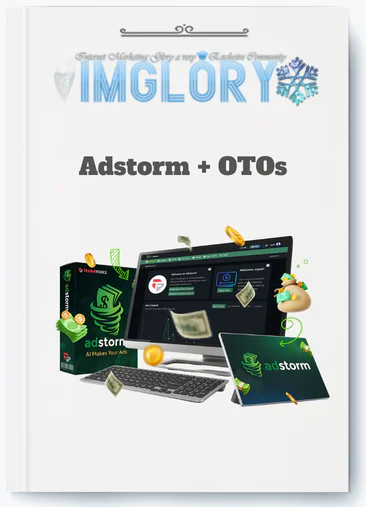
[Group buy] Adstorm + OTOs
$41.00
Adstorm is an AI-powered ad creative platform that generates campaign-ready copy, visuals, video scripts, and UGC-style content from a single marketing brief.
The AI ad creative tool category in 2026 is one of the most aggressively marketed software segments in the digital advertising space. Every platform promises to eliminate your creative bottleneck, generate winning ads instantly, and scale your campaigns to new heights without the traditional investment in designers and copywriters. Evaluating any specific tool in that environment requires separating what the platform genuinely delivers from what the promotional ecosystem surrounding it implies.
Adstorm arrives in that context with claims about multi-platform creative generation, direct response copywriting frameworks, and video creative capabilities that deserve careful scrutiny before purchase. One naming confusion worth resolving before the evaluation begins: the name Adstorm and AdStorm are used by multiple entities in the advertising space including digital agencies and ad management platforms. This review covers Adstorm AI, the ad creative generation software product specifically. Confirming that the Adstorm you are evaluating is the same software reviewed here prevents the mismatch between expectations and product that naming confusion creates.
What follows is an honest, evidence-based evaluation of what Adstorm actually does, where its outputs meet professional advertising standards, where they require significant human investment to become useful, and how the platform compares to the alternatives most prospective buyers are already considering.
What Is Adstorm?
Adstorm is an AI-powered ad creative SaaS platform that generates advertising assets, including copy variants, visual concepts, video scripts, and UGC-style outlines, from campaign briefs, formatted to the technical specifications of advertising platforms including Meta, Google, TikTok, YouTube, Pinterest, X, and LinkedIn.
The precise positioning before any feature evaluation: Adstorm is a creative production efficiency tool that handles the mechanical generation of initial and creative variants. It does not replace media buying expertise, audience strategy, bid management, campaign structure planning, or performance analytics. It does not guarantee that any generated creative will perform well in live campaigns. And it does not eliminate the human review, editing, and compliance verification that every generated asset requires before professional deployment. Evaluating it against those accurate parameters produces useful purchase decisions; evaluating it against the most ambitious promotional claims produces disappointment.
How Adstorm Works: A Step-by-Step Walkthrough
Step 1: Brand and Offer Configuration
Brand identity parameters are established through a brand kit, and the specific offer is configured through URL input or manual brief entry. The extraction quality from vendor or product pages determines how much the generation draws from actual offer specifics versus general category language.
Step 2: Platform and Angle Selection
Target platforms are selected and the angle direction is specified, providing the hypothesis orientation that improves generated variant relevance for systematic testing rather than general promotional use.
Step 3: Asset Generation and Initial Review
Multiple creative variants are generated across selected formats and platforms simultaneously. Initial review identifies which generated candidates have genuine testing potential versus which reflect AI generation limitations that require more substantial intervention than editing can efficiently address.
Step 4: Editing, Compliance Check, and Deployment
Selected variants are edited for brand voice alignment, factual accuracy, and regulatory compliance before export and deployment into ad accounts through available integration or manual upload.
Key Features of Adstorm

Multi-Platform Ad Creative Generation
The multi-platform generation capability is the feature that Adstorm's marketing most prominently highlights, and it delivers genuine value in the specific dimension it promises while requiring honest qualification about what that value actually consists of. The platform automatically applies platform-specific format requirements, character limits, and copy field structures during generation, which removes the manual specification and reformatting work that producing correctly formatted assets for multiple platforms traditionally requires.
What this practically means for an advertiser is that a single campaign brief produces Google Search headline variants within the thirty-character limit alongside Facebook primary text blocks in the more generous format that social feed placements use alongside TikTok hooks calibrated for the three-second attention capture that in-feed placement demands, all in one generation session. The format automation is real and saves meaningful time for advertisers who currently produce for each platform in separate sessions.
The honest qualification is that format correctness is the minimum requirement for ad creative, not the primary determinant of performance. An ad that fits within Google's character limits perfectly but contains a generic benefit statement that every competitor in the auction is also running will not perform well regardless of how correctly formatted it is. The format automation removes a technical friction point. The creative quality that drives actual campaign performance depends on the angle specificity, the copy depth, and the brand voice alignment that human judgment and editing investment provide on top of the generated structure.
AI Copywriting with Direct Response Frameworks
The copywriting capability generates ad copy through direct response frameworks, producing variations across curiosity-based hooks, benefit-focused leads, social proof openings, problem-focused entries, and urgency framings. The framework depth reflects genuine understanding of direct response principles rather than generic marketing language, which is a meaningful quality distinction from general AI writing tools applied to advertising use cases without ad-specific structural knowledge.
The honest quality assessment requires stating directly what AI copywriting at this level of sophistication reliably produces and what it does not. It reliably produces structurally appropriate copy that follows the intended framework, maintains roughly appropriate length for the target platform, and covers the primary benefit categories extractable from the offer information provided. It does not reliably produce the specific phrasing precision that distinguishes a headline that stops scrolling from one that blends into the feed, the nuanced brand voice calibration that an established audience recognizes as authentic, or the deep audience empathy that comes from genuine understanding of how a specific person experiences the problem the product solves.
The practical implication is that AI-generated copy functions as a first draft that experienced advertisers improve rather than a finished deliverable that inexperienced advertisers can deploy without substantial editing. This is not a failure of the platform. It is an accurate description of what current AI copywriting technology produces and what human editorial investment continues to provide on top of it.
Visual and Video Creative Capabilities
The visual and video capabilities extend Adstorm beyond copy generation into a more complete ad creative production environment. Static image concepts for feed and display placements, carousel structures, video scripts organized as scenes with spoken lines and visual direction, UGC-style content outlines, and AI voiceover options where available address the multi-format creative requirements that modern advertising programs involve.
The honest quality range for visual generation covers a significant spectrum depending on how the capability is implemented at the platform level. AI-assisted image generation can produce original visual concepts at one end of the quality spectrum and template-based layouts requiring product image drop-in at the other. Understanding which approach Adstorm uses and testing that output against the visual standards of your specific advertising context during any available evaluation period provides more accurate quality assessment than general capability descriptions convey.
Video script generation produces structured scene outlines that give advertisers a narrative framework to work from without requiring original script development from a blank page. The honest value of this capability for most advertisers is as a structural starting point rather than as finished production-ready scripts. Scripts that accurately represent your specific product's genuine benefits, that incorporate the authentic social proof your customers have actually provided, and that reflect the specific creative direction your brand has established require the human knowledge and editorial investment that scene structure generation initiates but does not complete.
Direct Response Templates and Angle Frameworks
The template and framework library built into Adstorm's generation reflects the persuasion structures that direct response advertising has validated across decades of testing: Problem-Agitate-Solve sequences, AIDA frameworks, testimonial-centered formats, urgency and scarcity structures, and offer stack presentations. For advertisers without copywriting training who do not have intuitive access to these frameworks, having them embedded in the generation process provides structural quality that makes AI-generated copy more useful as a starting point than generation without framework guidance would produce.
The practical limitation of template-based framework application is the characteristic generic quality that emerges when the same structures are applied at scale across many users and many offers. When thousands of advertisers use Problem-Agitate-Solve frameworks through the same tool to promote products in the same categories, the resulting ad copy shares structural patterns that experienced consumers recognize and mentally filter even before consciously engaging with the specific message. The framework provides the correct structure; distinctive, resonant copy requires the specific language, proof, and perspective that only the advertiser's genuine product knowledge and audience understanding can provide.
Brand Kit and Campaign Organization
The brand kit functionality that stores brand assets for reuse across campaigns and the campaign organization structure that maintains creative production organized by client or project are the operational features that determine whether Adstorm functions as a professional tool or a personal utility. For multi-client operations, dedicated brand kits per client and organized workspaces that prevent asset crossover are operational requirements rather than convenient features.
The honest assessment for prospective buyers evaluating these features is to verify the specific collaboration and organization capabilities available at the plan tier they are considering rather than assuming that professional-grade multi-client organization is included at all pricing levels. Organization features that require higher-tier plans to function at professional standards affect the total cost calculation for agency evaluations.
Pricing Plans and OTOs detailed
FE – Adstorm ($39 one-time)
- One-time payment with lifetime access during launch
- AI-powered ad creation platform for text, image, video ads, and UGC creatives
- Create platform-specific ads for Facebook, Google, TikTok, YouTube, Pinterest, Reddit, X, and more
- Includes AI copywriting, mockups, ad variations, and creative automation tools
- Commercial use supported
- Built for marketers, ecommerce sellers, agencies, affiliate marketers, and businesses
- 30-day money-back guarantee included
- Limited-time launch pricing expected to increase later
OTO 1 – Adstorm PRO Upgrade ($67 one-time)
- Removes major platform limitations
- Unlimited campaigns and unlimited ad creation
- Unlimited AI edits and advanced AI models
- 50,000 welcome credits included
- Commercial license included
- Team access and advanced workflow tools
- Supports client work and agency services
- Designed for scaling ad campaigns faster
OTO 2 – Adstorm Reseller Rights ($197 one-time)
- Includes 70 Adstorm licenses to resell
- Keep 100% of profits from license sales
- Sell through websites, email lists, ads, or social media
- Vendor handles technical support and maintenance
- No product creation required
- Built for affiliate marketers, agencies, and software resellers
- Launch your own AI software business quickly
OTO 3 – TubeTarget PRO ($67 one-time)
- Advanced YouTube ad targeting tool
- Place ads directly on targeted videos and channels
- Helps reduce ad spend and improve ROI
- Includes YouTube traffic and targeting training
- Useful for affiliate marketing, ecommerce, agencies, and local business campaigns
- Built for higher-quality buyer traffic from YouTube ads
OTO 4 – Adplify PRO ($67 one-time)
- Facebook ads optimization and targeting suite
- Includes competitor ad tracking and audience research tools
- Behavioral retargeting and ROI calculation features
- Email-to-Facebook retargeting included
- Helps lower ad costs and improve conversions
- Designed for marketers and agencies running Facebook campaigns
- Supports smarter ad scaling and audience discovery
Advantages of Adstorm
- Multi-platform format automation removes a genuine technical friction point from cross-channel creative production. The automatic application of platform specifications, character limits, and copy field structures reduces the manual work that format-correct multi-platform production requires without claiming that format correctness is the primary performance driver.
- Direct response framework depth produces better-structured AI copy than generic writing tools applied to advertising without ad-specific template knowledge. The persuasion architecture embedded in the templates improves starting quality for users without copywriting training compared to blank-canvas generation.
- Creative variant volume from single brief inputs supports the systematic angle testing that optimization-focused advertising requires. Multiple genuine angle directions generated simultaneously rather than sequentially improves the starting quality of the test without claiming that higher volume guarantees better performance.
- Brand kit functionality maintains visual and tonal consistency across campaigns for ongoing advertising operations. The organizational value of shared brand configuration compounds across high-volume production in ways that become more significant as campaign frequency increases.
- Commercial licensing provides clear use rights for professional and client service use. The licensing clarity is a genuine operational benefit compared to the ambiguity that some general AI tools create for commercial content production.
Disadvantages of Adstorm
- AI-generated copy requires systematic human review before responsible publication, and this editing investment is consistently larger than first-time users expect. The gap between generated draft quality and publication-ready professional creative requires factual verification, brand voice alignment, compliance checking, and specificity improvement that together represent meaningful ongoing time investment rather than a quick final polish.
- Output generic quality is a structural characteristic of AI generation that template frameworks reduce but do not eliminate. The characteristic phrasing patterns of AI-generated marketing copy, benefit statements applicable to any competing product, hooks that describe problems without the precision that creates genuine resonance, and call-to-action language that instructs without friction-reducing specificity, consistently appear in Adstorm outputs and require deliberate replacement.
- The platform does not address advertising strategy, audience targeting, bid management, or campaign performance analysis. Advertisers who use Adstorm to solve a creative production problem while strategic and operational advertising competence remains underdeveloped will produce better-formatted creative for ineffectively structured campaigns.
- Visual output quality for distinctive brand identities requires verification against specific brand standards. Template-based visual generation produces functional, consistent creative rather than distinctive brand-specific design, and the gap between these standards varies significantly by brand identity sophistication.
- Performance outcomes depend entirely on factors the tool does not control. Targeting quality, bid efficiency, landing page experience, offer competitiveness, and campaign structure determine whether any creative performs well regardless of how efficiently it was generated.
Who Is Adstorm For?
- Small and medium-sized businesses advertising across multiple channels who need platform-ready creative at testing volume without the budget for dedicated creative team resources find the production speed and format automation directly applicable to their operational constraints.
- Performance marketers and media buyers running systematic creative testing programs who need angle variant volume to support testing discipline and who understand that the tool produces starting material for a testing process rather than finished creative for direct deployment.
- Small agencies managing multiple clients under tight production timelines who need commercial licensing and multi-client organization alongside creative throughput that manual production cannot sustain at their service delivery pace.
- Advertisers entering new platforms who understand their audience and offer but lack creative production infrastructure for channels outside their primary expertise find format automation specifically valuable for removing the platform technical barrier from new channel creative development.
Who Is Adstorm Not For?
- Advertisers expecting AI-generated creative to produce strong campaign performance without systematic testing and optimization. Creative generation is one input into advertising performance. Targeting, bid strategy, offer quality, and funnel structure each affect results as significantly as creative quality, and no creative tool changes that fundamental multi-factor reality.
- Brands with distinctive visual identities and strict brand guideline enforcement where template-based visual output requires more customization to meet brand standards than the production time savings justify.
- Organizations that need holistic paid advertising strategy alongside creative production. Adstorm addresses creative generation specifically. Strategic guidance, audience research, campaign structure planning, and performance interpretation require advertising expertise that a creative tool does not provide.
Adstorm vs. The Alternatives: A Detailed Comparison
| Criteria | Adstorm | AdCreative.ai | Canva | ChatGPT + Custom Prompts | Full-Service Agency | Meta Native Tools |
| Multi-Platform Format Handling | Yes | Partial | Manual | Manual | Yes | Meta only |
| Direct Response Copy Frameworks | Yes | Limited | No | Prompt-dependent | Yes | Limited |
| Video Script Generation | Yes | No | Limited | Yes (with prompts) | Yes | Limited |
| UGC-Style Outlines | Yes | No | No | Yes (with prompts) | Yes | No |
| Brand Kit Functionality | Yes | Yes | Yes | No | Yes | Limited |
| Static Visual Generation | Yes | Yes (high volume) | Yes (design-focused) | Separate tool | Yes | Limited |
| Multi-Client Organization | Yes | Yes | Manual | No | Yes | No |
| Creative Performance Analytics | Limited | Limited | No | No | Yes | Yes (native) |
| Commercial License | Yes | Yes | Yes | Varies | Yes | Yes |
| Best For | Multi-platform SMB and agency | Static display volume | Design flexibility | Custom complex content | Full-service campaigns | Single-platform Meta |
Adstorm occupies a specific and genuine position: it is the most accessible integrated multi-platform ad creative generation tool for advertisers who need cross-channel format automation alongside both copy and visual generation without building a custom stack of specialized tools. It is not the most capable at any individual component, and its value proposition weakens significantly for single-platform advertisers, advertisers with strong in-house creative capacity, and advertisers who need strategic guidance alongside creative production. The evaluation question that produces the most accurate purchase decision is whether your specific advertising program genuinely needs what Adstorm uniquely provides.
Frequently Asked Questions About Adstorm
- Is Adstorm a legitimate product or primarily marketing hype?
Adstorm is a real software platform that delivers the multi-platform ad creative generation capabilities it describes. The appropriate skepticism applies to performance improvement claims that attribute campaign results to creative generation rather than to the full multi-factor advertising workflow that produces results. The platform genuinely produces platform-formatted ad creative faster than manual production for most advertisers. Whether that creative performs well in live campaigns depends on the strategic, targeting, and optimization work that the creative generation tool does not address.
- How does the output quality of Adstorm compare to professionally written ad copy?
AI-generated ad copy from Adstorm produces structurally appropriate, framework-guided copy that serves as a useful first draft for systematic testing. Professional copywriting produces distinctively voiced, audience-specifically calibrated copy with the narrative sophistication and authentic empathy that builds genuine brand relationships. The quality gap between these levels is real and becomes more significant as campaign scale increases, audience sophistication grows, and the copy precision required to convert increasingly competitive audiences rises. Adstorm is most appropriately positioned as an efficient first draft generator that experienced advertisers improve toward professional quality.
- What is the biggest mistake buyers make when evaluating Adstorm?
The most consistent mistake is testing the platform on idealized scenarios rather than on the actual offer types, audience segments, and quality standards that represent the buyer's real advertising work. Testing Adstorm on a well-structured ecommerce product with a comprehensive product page produces better results than testing it on a nuanced B2B service offer with complex audience segmentation. The realistic quality assessment comes from testing against your actual use cases with your actual brand standards applied to the review and editing step.
- Does Adstorm require advertising expertise to use effectively?
Using Adstorm requires no advertising expertise to produce initial creative outputs. Deploying those outputs effectively in live ad accounts that generate positive returns requires the targeting, bidding, campaign structure, and performance analysis knowledge that determines whether any campaign investment generates profitable results. The creative generation accessibility the platform provides does not transfer to advertising expertise that the underlying advertising platforms require for effective campaign management.
- How does the multi-platform capability actually work and is it as comprehensive as described?
The multi-platform capability automatically applies platform-specific format requirements, character limits, and copy field structures during generation rather than requiring manual specification per platform. The comprehensiveness of platform coverage and the depth of format support for each platform should be verified against current documentation for the specific channels critical to your advertising program. Platform support evolves with product updates and platform API changes, making current documentation a more reliable reference than historical reviews or comparison articles.
- What compliance review workflow is necessary before deploying Adstorm-generated creative?
Every generated asset requires at minimum a platform advertising policy review that checks claim types, imagery, and language against the specific policies of each target platform. For advertised categories with specific regulatory requirements, including health supplements, financial products, legal services, and similar categories, qualified professional review of specific claims before publication is a non-negotiable requirement that no creative generation tool satisfies on the advertiser's behalf.
- How does Adstorm's pricing compare to the alternatives for the volume of creative it produces?
At the creative variant volumes that systematic advertising testing requires, Adstorm's subscription cost compares favorably to equivalent freelance or agency creative production cost per asset. The cost comparison is less favorable against free-tier access to Canva or general AI writing tools for advertisers with low creative volume requirements who can produce sufficient variant sets within free tool parameters. The cost justification strengthens proportionally with advertising scale, number of active platforms, and testing frequency.
- What happens to the quality of Adstorm outputs in non-English advertising markets?
AI-generated copy quality in non-English languages varies significantly and generally declines as you move from major world languages toward less commonly supported ones. Beyond linguistic accuracy, cultural nuance in advertising copy, the specific idioms, social references, and emotional framings that resonate authentically within a specific cultural context, is where AI generation is most likely to produce technically correct but culturally flat content. Native speaker review before deployment is the quality gate that addresses this limitation for international advertising programs.
- How should advertisers evaluate Adstorm during a trial period?
A productive trial evaluation tests Adstorm against representative examples of the advertiser's actual use cases using real product information and real audience parameters rather than idealized test scenarios. The quality assessment should apply the advertiser's actual professional standards to generated outputs, estimating the editing investment each requires to reach deployment quality. The trial period is the opportunity to determine whether the gap between generated draft quality and your quality standards is bridgeable within a reasonable editing investment or whether it requires more substantial human contribution than the production efficiency gains justify.
- Is the one-time pricing model common in this product category sustainable for long-term platform access?
One-time pricing models for AI-heavy SaaS tools with significant ongoing infrastructure costs raise legitimate sustainability questions that prospective buyers should evaluate before building critical advertising workflows on the platform. Investigating the vendor's development activity, update history, and business model beyond the initial sale provides more reliable information about long-term platform viability than the pricing structure alone. Maintaining downloaded copies of all generated assets in platform-independent storage protects your creative library from platform availability changes regardless of the pricing model.
- How does Adstorm compare for advertisers who already use ChatGPT effectively for ad copy?
For advertisers who have invested in building detailed ad-specific prompt libraries in ChatGPT and who consistently produce affiliate-formatted, platform-appropriate copy through that workflow, Adstorm's primary marginal value is the multi-platform format automation and visual generation capabilities rather than the copy generation itself. If the copy quality from your existing ChatGPT workflow meets your standards, the decision to add Adstorm depends on whether the format automation and visual capabilities address genuine operational friction in your specific workflow.
- What is the honest bottom-line assessment of Adstorm for a prospective buyer?
Adstorm is a genuinely useful production efficiency tool for the specific advertiser profile it was designed to serve: multi-platform advertisers without dedicated creative teams who need platform-ready creative at testing volume faster than traditional production allows. It requires meaningful editing investment before responsible deployment, does not address the strategic and analytical dimensions of advertising that determine whether campaigns generate profitable results, and produces outputs that reflect AI generation's characteristic quality ceiling until human editorial investment elevates specific assets toward professional standards. Evaluated against those accurate parameters rather than against peak promotional claims, it is a practical tool for its target audience and a poor fit for audiences outside that profile.
Be the first to review “Adstorm + OTOs”
You must be logged in to post a review.
Related products
GB SAAS Tools
GB SAAS Tools
GB SAAS Tools
GB SAAS Tools
GB SAAS Tools
Reviews
There are no reviews yet.