

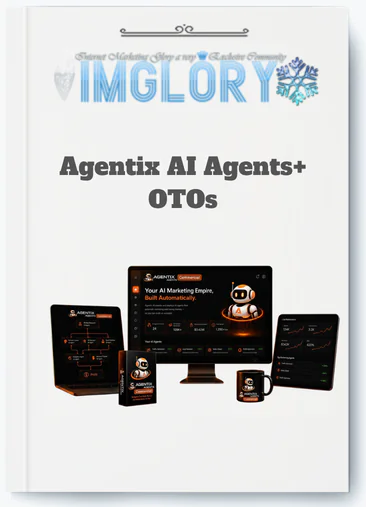
[Group buy] Agentix AI Agents+ OTOs
$39.00
Agentix AI Agents is a cloud-based automation platform that deploys autonomous AI agents to plan, execute, and manage tasks across thousands of integrated tools.
Experienced marketers and technology professionals approach automation platform decisions with a different evaluation framework than users who are new to workflow automation. You understand how the coordination overhead between tools accumulates into real operational costs. You recognize the difference between rule-based trigger-action automation and goal-driven AI execution, and why that difference matters for specific workflow categories. You have likely encountered platforms that promised adaptive intelligent automation and delivered fragile rule systems that required constant maintenance whenever an API changed or a workflow encountered a condition its rules did not anticipate.
If you are evaluating Agentix AI Agents from that position, with established workflows, operational standards, and real business consequences attached to automation quality decisions, surface-level feature descriptions are inadequate for the evaluation that decision deserves. This deep dive examines the precise mechanics behind each core capability, the strategic implications for experienced marketing and business operations, the honest performance boundaries that determine where Agentix AI Agents creates genuine operational leverage versus where its constraints become the binding factor, and the conditions under which Agentix AI Agents's architecture serves sophisticated automation objectives rather than only simple workflow replacement.
What Is Agentix AI Agents?
Agentix AI Agents is a cloud-based multi-agent automation platform that deploys goal-driven AI agents capable of planning sequential execution paths, connecting to over nine thousand business tools, coordinating across specialized agents through an orchestration layer, and delivering completed workflow outcomes with minimal human input. It includes ready-made agent libraries, pre-built workflow templates, commercial licensing, white-label infrastructure, and a no-code dashboard alongside configuration options for custom workflow development.
The architectural distinction that defines Agentix AI Agents's strategic positioning for experienced operators is the fundamental difference between goal-driven AI execution and rule-based automation. Rule-based automation platforms map explicit conditions to explicit actions in sequences where every execution path must be pre-programmed. Goal-driven AI execution uses a reasoning model to determine the appropriate execution path toward a defined objective based on the specific characteristics of each workflow instance, adapting when intermediate results differ from expectations and handling cases that were not explicitly anticipated during workflow design.
This architectural difference has strategic implications that experienced operators can evaluate against their specific workflow portfolios. Workflows where execution paths are consistent and fully predictable are well-served by rule-based automation, which is more reliable and more straightforward to maintain for those cases. Workflows where input variability, multi-stage complexity, or adaptive response to intermediate results are inherent characteristics benefit from the goal-driven approach in ways that rule-based alternatives cannot replicate without becoming unmanageably complex to maintain at scale.
How Agentix AI Agents Works: A Step-by-Step Walkthrough
Step 1: Objective Architecture and Constraint Specification
For experienced operators, goal specification is the highest-leverage investment in the entire deployment process. A precisely specified objective that defines the intended output, the quality standard it must meet, the scope boundaries that constrain the agent's action space, and the success criteria that verify completion produces execution that closely matches operational intent. The technical mechanism is that the reasoning model uses all of this specification context to construct its execution plan, which means richer specification produces more accurate planning rather than simply constraining what an otherwise unconstrained system would do.
Step 2: Dependency-Aware Plan Construction
The agent constructs a workflow plan that sequences subtasks in dependency order, identifying which steps must complete before others can begin and which can execute in parallel where the orchestration layer supports concurrent execution. For experienced workflow designers, understanding the planning logic well enough to specify goal inputs that guide the plan toward the intended execution structure produces better first-generation plans with less iteration.
Step 3: Permissioned Cross-System Execution with Audit Logging
Execution proceeds across connected systems within the permission boundaries established during setup, with comprehensive audit logging at every step. For experienced operators, the audit log is the primary quality assurance tool: reviewing execution logs for unexpected planning decisions, inefficient tool call sequences, and systematic error patterns produces the specific configuration improvements that iterative quality refinement requires.
Step 4: Verification, Exception Handling, and Performance Accumulation
Outcome verification, exception handling, and the accumulation of performance data across workflow runs create the operational intelligence that informed configuration refinement depends on over time.
Key Features of Agentix AI Agents

Goal-Driven AI Planning: Architecture and Strategic Implications
The planning model's reasoning quality depends on two distinct input dimensions that experienced operators control directly. The first is goal specification richness: the more context the model has about the intended output, the quality standard it must meet, the constraints it must respect, and the success criteria that define completion, the more accurately it can construct a plan that matches operational intent. The second is tool context quality: the model's ability to select appropriate tools for each step depends on having accurate, current information about the capabilities and appropriate use cases of available tools. Operators who invest in both dimensions consistently produce better planning quality than those who invest in only one.
The planning capability's characteristic failure mode for experienced operators is goal drift in complex multi-stage workflows where each planning step introduces small interpretation variations that compound into meaningful deviation from the original intent by the time late-stage steps execute. Mitigating this failure mode involves specifying explicit connections between workflow stages in the goal input, reviewing the plan at intermediate checkpoints rather than only reviewing the final output, and building correction feedback into the evaluation loop that updates planning parameters when systematic drift patterns are identified across multiple workflow runs.
The strategic deployment implications for experienced marketing operations are most significant for the specific workflow categories where planning quality creates competitive leverage rather than only operational efficiency. A competitive intelligence workflow that requires adaptive research across variable source quality, synthesis that weighs conflicting information appropriately, and output formatting that serves specific strategic decision contexts benefits from planning quality in ways that a simple data export workflow does not. Investing planning quality optimization effort proportionally to the strategic significance of the workflow type produces better returns than applying uniform configuration investment across all workflow categories regardless of their strategic importance.
Multi-Agent Orchestration: Operational Mechanics and Design Principles
The orchestration layer's technical function is managing the data flow, execution sequencing, and inter-agent communication that allows specialized agents to collaborate on complex workflows without requiring a single generalist agent to handle every aspect of multi-domain processes. For experienced operators designing complex automation architectures, understanding the orchestration layer's mechanics enables workflow designs that leverage specialization advantages rather than defaulting to single-agent approaches that are simpler to configure but produce compromised execution quality at each stage.
The workflow graph architecture that defines multi-agent execution sequences allows workflow designers to specify the dependency relationships between agent tasks explicitly, enabling the orchestration layer to manage parallel execution where dependencies permit and sequential execution where they require it. For experienced operators, the workflow graph is the design artifact that most directly determines whether a multi-agent workflow produces the coordination efficiency the architecture promises or the coordination overhead that poorly designed multi-agent workflows create.
Integration Architecture: Depth, Governance, and Operational Reliability
The nine-thousand-plus integration library's operational significance for experienced operators extends beyond coverage breadth into the governance and reliability characteristics that determine whether specific integrations can be trusted in production business workflows. For each critical integration in a planned workflow, experienced operators should assess three dimensions independently rather than assuming uniform quality across the library.
Integration depth, meaning the breadth of actions the integration supports beyond basic read operations, determines whether the automation can complete the intended workflow or encounters capability gaps that require manual workarounds for specific steps. Integration reliability, meaning how consistently the integration handles API responses, rate limits, schema changes, and authentication token renewal, determines whether workflows execute consistently or require frequent manual intervention for integration-layer failures. Integration maintenance currency, meaning how promptly integration definitions are updated when tool APIs change their specifications, determines whether integrations that work correctly today continue working after the connected tool's next major update.
For experienced operators deploying automations on critical business workflows, verifying these three dimensions for the specific integrations most central to those workflows during any trial period provides the production-readiness assessment that the integration count statistic does not convey. An integration library with nine thousand entries where the twenty integrations critical to a specific business's automation strategy are all well-maintained, deep, and reliable is operationally superior to a library where those twenty specific integrations have the characteristic weaknesses of less-invested integrations in a broad but shallow library.
Memory Architecture: Context Persistence and Its Operational Value
The memory architecture that enables Agentix AI Agents to maintain context within workflow executions and accumulate learning across workflow runs has strategic implications that experienced operators should understand precisely to leverage rather than treat as automatic background capability.
Short-term memory maintaining context within a workflow execution is the mechanism that makes multi-stage workflows coherent rather than requiring each step to re-establish context from scratch. The operational implication is that goal specifications that explicitly establish the context the agent should maintain across workflow stages produce more coherent execution than specifications that provide rich context at the initial step and assume it carries forward without reinforcement.
Long-term memory persisting across workflow runs, storing user preferences, customer interaction history, and patterns from previous workflow executions, enables the performance improvement over time that distinguishes deployed agents from static automation scripts. The operational investment that realizes this learning value involves consistent feedback quality: agents that receive specific, accurate feedback about output quality gaps learn more efficiently than those receiving only binary success/failure signals. Experienced operators who design structured feedback mechanisms into their evaluation processes extract more compounding value from the long-term memory architecture than those who treat output quality review as terminal rather than as a learning input.
Guardrails and Approval Architecture: Governance Design for Production Workflows
The guardrails and approval architecture is the feature that most directly determines whether Agentix AI Agents can be deployed responsibly for professional workflows where automation errors have real business consequences. For experienced operators who have lived through automation failures in production environments, the governance architecture design is not a compliance exercise but a practical risk management requirement that enables ambitious automation without creating unacceptable exposure.
The three-tier approval framework that experienced operators should design explicitly for each workflow type identifies fully autonomous execution as appropriate for low-stakes, high-confidence, easily reversible actions where the agent's reliability in that specific domain has been verified through sufficient production runs. Human review before execution is appropriate for medium-stakes actions above defined thresholds where the combination of consequence significance and uncertainty about edge case handling justifies the review investment. Human execution with agent preparation support is appropriate for high-stakes actions where errors have significant irreversible consequences and where agent capability provides value in context assembly and draft preparation rather than in the execution decision itself.
The policy constraint architecture that enforces action boundaries at the system level rather than relying solely on the model's judgment provides a second layer of execution control that is more reliable for edge cases than behavioral guidance alone. For production workflows, explicit policy constraints that prevent the agent from taking specific action categories regardless of its planning output provide the predictable boundary enforcement that behavioral guidance, which the model may interpret differently across instances, cannot guarantee with equivalent consistency.
Monitoring and Performance Infrastructure
The monitoring and performance infrastructure is the operational capability that converts deployed automation from a set-and-forget implementation into a continuously improving production system. For experienced operators who approach automation as operational infrastructure requiring ongoing maintenance rather than completed implementation requiring no further attention, the quality of the monitoring tools directly determines the speed at which optimization insights are identified and applied.
The performance dashboard metrics most useful for experienced operators go beyond completion rate and error frequency into execution efficiency patterns that reveal optimization opportunities. Workflows with high completion rates but unusually long execution times may have inefficient tool call sequences that configuration changes could compress. Workflows with low error rates overall but systematic errors on specific input types reveal edge cases that configuration updates should address. Workflows with high human review rates at specific approval gates may have thresholds calibrated too conservatively that adjustment could make more autonomously efficient without meaningful risk increase.
Pricing Plans and OTOs detailed
Front-End – Agentix AI Agents ($37 one-time)
- One-time payment with lifetime access
- AI-powered multi-agent automation platform
- Ready-made AI agents and workflows included
- Supports 9,430+ tool integrations and cloud automation
- Content creation, research, automation, and marketing tools included
- Multi-agent workflow execution from one dashboard
- Commercial rights included
- No coding or VPS setup required
- Built for marketers, freelancers, agencies, creators, and online businesses
- Can automate content, emails, landing pages, campaigns, and business workflows
- Cloud-based platform with beginner-friendly setup
- 30-day money-back guarantee included
OTO 1 – Agentix AI Unlimited ($97 one-time)
- Removes workflow and execution restrictions
- Unlimited AI agent chains and automations
- 800+ hours of autonomous execution included
- Run multiple workflows simultaneously
- 4K AI image generation included
- International AI voiceovers included
- White-label branding removal included
- Priority processing and cloud storage included
- Advanced training and priority support included
- Commercial usage supported
OTO 2 – Agentix DFY AI Multi-Agent Automation ($97 one-time)
- 30+ done-for-you AI campaign workflows included
- Prebuilt prompts, automations, and AI sequences
- Supports email marketing, funnels, TikTok, Pinterest, and social campaigns
- Landing page and web app workflows included
- Designed for beginners and marketers wanting faster results
- Customize campaigns for any niche
- Automation shortcuts for agencies and freelancers
- Commercial-friendly workflows included
OTO 3 – AI Masterclass 2026 ($67 one-time)
- AI business and monetization training included
- 10 modules covering AI automation and affiliate marketing
- Training for AI agents, prompts, traffic, and online business models
- Uses tools like Agentix AI, ChatGPT, and Claude
- Includes PDFs, workflow exports, and coaching resources
- Weekly updates included
- Built for beginners and marketers wanting step-by-step guidance
- One-time payment with no monthly subscription
OTO 4 – Agentix AI Reseller Agency ($197 one-time)
- Full white-label reseller rights included
- Editable source code and branding control included
- Launch your own AI software business
- Sell on JVZoo, ClickBank, WarriorPlus, and similar platforms
- Offer AI automation services to businesses and clients
- Keep 100% of the profits
- Includes vibe-coding and prompt-to-product training
- Feature expansion rights included
- Built for agencies, freelancers, and SaaS entrepreneurs
OTO 5 – Agentix DFY AI Chatbot Business ($97 one-time)
- Done-for-you AI chatbot SaaS business included
- White-label rights and source code access included
- AI chatbot builder for businesses and agencies
- Deployment training and DFY marketing prompts included
- No coding or developers required
- Includes 5-way monetization blueprint
- Generate recurring revenue through SaaS subscriptions and client services
- Built for local businesses, agencies, freelancers, and entrepreneurs
- Commercial rights included
Advantages of Agentix AI Agents
- Goal-driven planning with adaptive execution handles the workflow variability that rule-based automation cannot serve without becoming maintenance-intensive and brittle at scale. For high-frequency workflows with inherent input variability, this adaptive capability provides automation coverage and reliability that the rule-based alternative cannot match without exhaustive condition pre-specification that degrades as the environment changes.
- Multi-agent orchestration with specialized agents produces better per-stage execution quality than single-agent approaches for complex workflows requiring genuinely distinct capabilities at different stages. The quality improvement is proportional to the genuine functional differentiation between stages rather than being uniform across all multi-agent architectures regardless of whether specialization adds material value.
- The integration architecture's breadth enables cross-system workflow automation across the majority of standard business tool combinations without custom connector development. For organizations whose operational complexity spans many connected systems, the coverage depth determines how much of the actual workflow can be automated versus how much requires manual workarounds for gaps.
- The commercial licensing and white-label infrastructure support sophisticated agency and professional service deployment models. Organizations building proprietary AI automation products for clients have both the rights and the product infrastructure that professional service delivery requires.
- The monitoring and performance infrastructure enables continuous improvement through accumulated operational data rather than treating deployed automation as static implementation. Organizations that engage with performance data consistently extract compounding optimization value that organizations treating deployment as complete implementation do not realize.
Disadvantages of Agentix AI Agents
- Planning quality ceiling is bounded by goal specification quality and tool context accuracy in ways that require deliberate investment and iterative refinement to optimize. The performance gap between well-configured and poorly-configured goal specifications is large enough to produce materially different business outcomes, making configuration quality an ongoing operational investment rather than a one-time setup task.
- The governance architecture design that responsible production deployment requires is user responsibility rather than platform default. The three-tier approval framework, least-privilege access configuration, and policy constraint architecture that protect against consequential automation errors require explicit design work that precedes deployment rather than following it.
- Multi-agent orchestration adds workflow design complexity that produces value only when genuine functional specialization between agents justifies the orchestration overhead. Applying multi-agent architecture to workflows where a single agent could execute all stages adequately adds setup and maintenance complexity without proportional quality benefit.
- Platform dependency on cloud infrastructure introduces operational continuity risk that experienced operators managing critical workflows should address through contingency planning rather than assuming service continuity. The specific continuity risks include service availability, API rate limit changes, pricing adjustments, and feature modifications that affect dependent workflows.
- AI planning errors in production workflows can execute consequentially in connected systems before detection if governance architecture does not include appropriate output validation and approval gates for high-stakes action categories.
Who Is Agentix AI Agents For?
- Experienced marketing operators managing multi-channel campaign workflows where the coordination overhead across research, content production, distribution scheduling, and performance reporting consumes disproportionate team time relative to the judgment each step requires, and where the input variability across campaign types makes rule-based automation impractical to maintain without constant rule updates.
- Technology-forward agencies building differentiated AI automation capabilities for clients who want proprietary automation products rather than third-party platform access, and whose competitive positioning depends on demonstrable AI automation capability that they control and can develop rather than resell.
- Operations leaders at growing businesses whose workflow volume is scaling faster than team capacity and whose workflow portfolio includes the variable-input multi-step process types where goal-driven planning provides the automation coverage that rule-based approaches cannot sustain reliably at scale.
- Experienced automation practitioners who have reached the capability ceiling of rule-based platforms for specific workflow categories and who want goal-driven AI planning for those specific categories while maintaining rule-based automation for the simpler deterministic workflows where it remains the appropriate choice.
Who Is Agentix AI Agents Not For?
- Operators whose workflow portfolio consists primarily of simple, consistent trigger-action sequences where rule-based platforms like Zapier provide more reliable and more straightforward automation without the AI planning overhead that adds complexity without proportional benefit for those specific workflow types.
- Organizations with formal enterprise compliance requirements governing automated data processing and system access who have not verified that Agentix AI Agents meets their specific regulatory standards should not deploy it in compliance-sensitive workflows before completing specific requirements verification rather than relying on general security capability descriptions.
- Operators expecting consistent high-quality outputs from first-generation configurations without the iterative refinement investment that AI planning quality optimization requires should plan for a configuration maturation period rather than expecting immediate consistent professional-quality results.
Agentix AI Agents vs. The Alternatives
| Capability | Agentix AI Agents | Zapier | Make.com | n8n | Microsoft Power Automate | Custom Agent Dev |
| Goal-Driven AI Planning | Yes | No | No | No | No | Yes (built) |
| Multi-Agent Orchestration | Yes | No | No | Limited | No | Yes (built) |
| Adaptive Execution | Yes | No | No | No | No | Yes (built) |
| Integration Count | 9,430+ | 6,000+ | 1,500+ | 400+ | 1,000+ | Custom |
| No-Code Interface | Yes | Yes | Moderate | No | Moderate | No |
| White-Label Options | Yes | No | No | No | No | Fully custom |
| Managed Infrastructure | Yes | Yes | Yes | Self-hosted | Yes | Self-managed |
| Human Approval Architecture | Yes | Limited | Limited | Limited | Limited | Custom built |
| Ready-Made Agent Library | Yes | Templates | Templates | No | Templates | None |
| Best For | AI adaptive automation | Reliable triggers | Complex rules | Technical custom | Microsoft stack | Full control |
Frequently Asked Questions About Agentix AI Agents
- How does goal-driven AI planning produce better results than explicit rule specification for variable-input workflows?
Rule specification requires the workflow designer to anticipate every possible input condition and define an appropriate response before deployment. When execution encounters a condition the rules did not anticipate, the workflow either fails or produces an inappropriate response because no rule covers the specific case. Goal-driven AI planning evaluates each workflow instance against the stated objective and determines the most appropriate execution path for that specific input's characteristics within the agent's permitted scope. For workflows with inherent input variability where exhaustive rule specification is impractical, the adaptive planning produces more consistent goal achievement across the full range of actual inputs rather than only the inputs the rules anticipated.
- What configuration investment produces the most reliable multi-agent orchestration quality?
Three configuration investments most directly determine multi-agent orchestration quality. First, agent specialization design that reflects genuine functional differentiation where each agent's focus produces materially better per-stage outcomes than a generalist agent handling all stages would produce. Second, explicit inter-agent data contract specification that defines exactly what format each agent's output must take and what format the next agent's input expects, eliminating the transformation ambiguity that creates data fidelity problems at handoff points. Third, orchestration-level escalation conditions that handle failures at any stage appropriately regardless of which specific agent encounters the failure, rather than leaving failure handling entirely to individual agent configurations that may not account for the workflow-level consequences of stage failures.
- How does the access governance architecture protect against unintended agent actions in connected systems?
Least-privilege configuration limits each agent's authorized access to only the specific systems and data required for its defined tasks, ensuring that planning errors, hallucinations, or unexpected execution paths cannot trigger actions in systems outside the agent's explicit authorization. Policy constraints enforce action boundaries at the system level regardless of what the planning model determines, providing a second layer of control that behavioral guidance alone cannot guarantee with equivalent consistency. Audit logging creates the documentation that enables detection and review of any execution that approaches or tests access boundaries. Together, these mechanisms create defense-in-depth governance rather than relying on any single control to prevent all unintended access patterns.
- What performance metrics are most useful for experienced operators optimizing deployed automation quality?
Beyond completion rate and error frequency, the metrics that most directly enable optimization are execution time distribution across workflow instances, which identifies systematic inefficiency patterns that configuration changes can address. Human review rate at specific approval gates, which identifies thresholds calibrated too conservatively that adjustment could make more autonomously efficient without meaningful risk increase. Exception type frequency distribution, which identifies the specific failure patterns most worth addressing through configuration updates. And output quality rating distribution from human reviewers, which identifies the specific quality dimensions most frequently requiring correction and informs the goal specification improvements that reduce those corrections in future runs.
- How should experienced operators structure goal specifications for complex multi-stage marketing workflows?
Effective goal specifications for complex marketing workflows include six dimensions that experienced operators should document explicitly rather than assuming the model infers them from incomplete context. Output definition describes precisely what the completed workflow should produce. Quality standard specifies the criteria that distinguish acceptable from inadequate output. Scope boundary defines what the workflow should and should not attempt. Constraint specification identifies limitations on tools, formats, sources, or approaches.
Success criteria specify how the agent verifies that the goal has been achieved. Stage connection guidance explicitly links what each stage should carry forward to the next rather than assuming continuity propagates without specification. Goal specifications that address all six dimensions consistently produce better planning quality than those that address only output definition and assume the model fills remaining dimensions appropriately.
- What is the appropriate deployment sequence for organizations adopting Agentix AI Agents for the first time?
The deployment sequence that produces the most reliable adoption outcomes starts with two or three high-frequency workflows that combine significant manual coordination time with consistent execution patterns and defined success criteria, matching closely against available pre-built templates rather than requiring custom workflow design from first principles. Deploying and monitoring these initial workflows until they reach consistent quality, using the accumulated execution data and refinement experience to develop organizational goal specification and governance design capability, then progressively expanding the automation scope to more complex and more variable workflow types as that capability matures, produces better outcomes than attempting ambitious multi-workflow simultaneous deployment before the organizational capability to design and govern them has developed.
- How does Agentix AI Agents's long-term memory architecture create compounding value over deployment time?
Long-term memory persists customer preferences, interaction history, and patterns from previous workflow executions, enabling subsequent workflows to build on accumulated context rather than treating each execution as isolated from prior runs. The compounding value is most significant for customer-facing workflows where accumulated history enables increasingly personalized and contextually appropriate execution, and for recurring workflow types where patterns from previous executions improve planning quality for subsequent runs. The rate at which long-term memory creates compounding value depends on the quality and specificity of feedback provided during evaluation cycles: agents receiving precise feedback about what should be retained and how it should inform future execution accumulate more operationally useful memory than those receiving only completion confirmations.
- What contingency planning should experienced operators establish for platform dependency risk?
Comprehensive contingency planning for Agentix AI Agents platform dependency involves maintaining exportable records of all workflow configurations in platform-independent formats that could be reproduced on alternative platforms if migration becomes necessary, identifying which workflows in the automation portfolio are critical enough to warrant backup execution capability through alternative methods, monitoring vendor communications for pricing changes and feature modifications that could affect dependent workflows before those changes take effect, and building workflow documentation practices that ensure institutional knowledge about deployed automation does not reside exclusively within Agentix AI Agents interface.
- How does the white-label architecture support agencies building proprietary automation products?
White-label licensing provides the rights and infrastructure to rebrand and deploy Agentix AI Agents under the agency's own identity, enabling the development of proprietary AI automation products that clients experience as the agency's own technology rather than as resold third-party platform access. For agencies whose competitive differentiation depends on proprietary AI capability rather than tool access, this architecture provides the product foundation that supports that positioning without requiring custom platform development from scratch. The specific white-label capabilities, technical requirements, and licensing terms at that tier should be verified against current platform documentation before designing client-facing products that depend on those specific capabilities.
- What does long-term strategic success with Agentix AI Agents require from experienced marketing operations?
Long-term strategic success requires four sustained organizational commitments. Systematic goal specification investment that builds and maintains documented template libraries for recurring workflow types, refined continuously through accumulated execution data and quality feedback. Governance architecture evolution that updates approval thresholds and permission boundaries as deployment experience provides better calibration data and as workflow scope expands to include higher-stakes process categories. Monitoring engagement that treats performance data as continuous optimization input rather than exception reporting, extracting the specific configuration improvements that accumulated execution data enables.
And organizational capability development that builds goal specification skill, workflow design competence, and governance design judgment as team capabilities rather than platform-dependent knowledge, ensuring that the automation intelligence created through deployment experience persists as organizational capability regardless of which specific platform continues to host the deployed workflows.
Be the first to review “Agentix AI Agents+ OTOs”
You must be logged in to post a review.
Related products

GB SAAS Tools
GB SAAS Tools
GB SAAS Tools
GB SAAS Tools
GB SAAS Tools
Reviews
There are no reviews yet.