

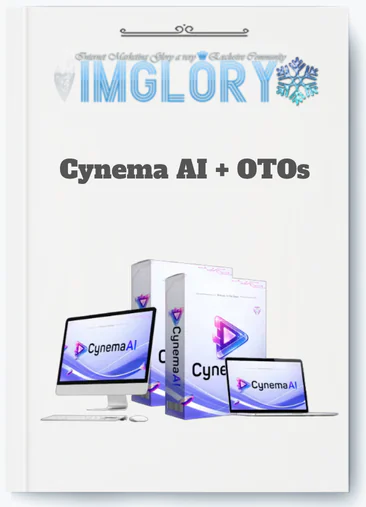
[Group buy] Cynema AI + OTOs
$17.00
Cynema AI is a cloud-based platform that creates cinematic 4K videos from text, images, or prompts using multiple AI engines.
In 2026, the AI video space will be crowded, fast-paced, and, well, bewildering. Dozens of tools offer professional results, but the majority need technical knowledge, pricey hardware, or a separate subscription for each engine you use. Cynema AI takes a different approach, combining 50+ AI video engines into a single cloud-based platform that can convert your text, image, or sketch into a 4K cinematic video in under 60 seconds.
The team behind Cynema AI has over ten years of expertise producing software and technology products, and they designed this platform exclusively for customers who want results rather than a learning curve.
What Is Cynema AI? (Simple Definition & Core Concept)

Cynema AI is a cloud-based multimodal AI platform that creates professional 4K cinematic videos from text prompts, photographs, sketches, or keywords in under 60 seconds utilizing 50+ integrated AI engines. No editing skills are needed. You can create a scene idea, submit a photo for reference, include a rough drawing, or simply input a term. Cynema AI understands all of this to create a structured, cinematic visual output.
It is not a single AI model, nor is it a typical timeline-based video editor. Consider it the orchestration layer that sits above the most competent AI video models available, determining the best engine for your task and automating every production step in between.
Core outputs Cynema AI delivers:
- 4K cinematic video clips
- Auto-generated scripts and scene breakdowns
- Auto voiceover and music soundtrack
- Commercial-use-ready video content
How Does Cynema AI Fit Into the AI Video Landscape in 2026?
Currently, the market is divided into three major kinds of AI video tools. Understanding where each one sits allows you to make better decisions.
The first category includes single-model tools, which are direct access platforms such as Sora, Kling, or Veo that allow you to work with only one model at once. These tools provide basic functionality, but you must also understand each model's prompt logic, strengths, and limits.
The second group includes editing-first solutions, such as Runway, which combine AI generation and a proper video chronology. These are ideal for users who desire post-generation control: exact cuts, multi-layer audio, and visual effects stacks.
Cynema AI belongs to the third group, which includes aggregator and workflow simplification technologies. These platforms combine numerous engines behind a single interface to automate the entire production process, from input to completed video, without requiring the user to make technical decisions along the way.
How Does Cynema AI Work? (Step-by-Step Workflow)
Cynema AI's methodology follows a defined six-stage sequence. Each stage is automated, but you have enough control to shape the product.
Step 1: Input Your Idea
You can enter a descriptive written prompt, upload an image or drawing for visual reference, or simply enter a single keyword or short brief. The more comprehensive your prompt is, including style, subject, and planned duration, the better the platform perceives your goal.
Step 2: AI Parsing and Intent Recognition.
Cynema AI processes your input to determine the subject, graphic style, motion type, and length. It converts natural language to organized creative parameters.
Step 3: Engine Selection and Orchestration.
Cynema intelligently sends the assignment across its pool of 50+ AI engines based on the requirements of the prompt. Complex motion routines may require Sora 2. Photo-realistic product photos may rely on Kling 2.1. Veo 3.1 could be used to create a filmic, colorful narrative scene.
Step 4: Auto-Script and Scene Design
Cynema creates a brief working script and divides it into discrete scenes or shots. Before rendering begins, you can change the scene length and plot flow.
Step 5: Voiceover, Music, and Visual Effects.
The platform chooses and applies a voiceover in your preferred manner, adds a matching music track, and layers in basic effects such as camera movement, scene transitions, and color correction.
Step 6: Cloud Rendering & Export
Your movie is rendered on Cynema's cloud infrastructure, thus your local machine's hardware is irrelevant. Short clips are often completed in under 60 seconds. You export in 4K with predefined formats for YouTube (16:9), TikTok (9:16), and social square (1:1).
| Input Type | Cynema Process | Output |
| Text prompt | Parse, engine routing, scene build | 4K video with audio |
| Image or sketch | Visual extraction, animation | Animated cinematic scene |
| Keyword only | Concept expansion, scripting, render | Full short-form video |
Key Features of Cynema AI (Engines, Tools & Outputs)
Cynema AI's depth is derived from two factors: the number of engines it integrates and the extent to which it automates the processes between input and finished output. The following is a complete overview of its key feature set for 2026.
| Feature | What It Does | Main Benefit |
| Multi-Engine Hub | Routes tasks across 50+ AI video engines | Access best-in-class models (Sora 2, Kling 3.0) |
| Text-to-Video | Converts written prompts into 4K cinematic clips | Turn ideas into footage instantly |
| Multimodal Input | Animates static images, sketches, or videos | Visual concepts to motion without filming |
| Auto Scripting | Writes a working script and breaks it into shots | Eliminates writing time for short content |
| Scene-Based Editing | Adjusts content shot by shot after generation | Control without a full timeline editor |
| AI Voiceover | Applies narration in multiple voice styles | Finished narration without recording |
| AI Sound Design | Syncs soundtracks and native audio (Sfx) | Broadcast-ready audio in one pass |
| VFX & Camera Motion | Adds pans, zooms, and FPV drone movements | Cinematic feel without post-production |
| Cloud Turbo-Render | Processes 4K videos in under 60 seconds | No local hardware requirements |
| Commercial Rights | Grants rights for ads and monetized content | Full Commercial License included |
One of the more useful elements of Cynema AI is its ability to handle multiple inputs. You are not limited to a single mode at a time. Uploading an image alongside a text description gives the engine a visual reference point, resulting in output that is much closer to your desired aesthetic. Cynema's specialized engines, such as Pixverse AI, can transform a rough storyboard frame or hand-drawn drawing into a structured cinematic scene without the need for editing.
Traditional video editors work with timelines, keyframes, and layer stacks. That model implies technical knowledge. Cynema AI completely replaces that structure with a visible automation chain. You explain what you want, and the platform assembles it. This is the key differentiator for people who have never used a video editing application before.
Which AI Engines Does Cynema AI Use Under the Hood?
Cynema AI's engine lineup changes when new models hit the market. As of early 2026, the platform orchestrates multiple high-performance technologies to meet various creative demands.
| Engine | Primary Strengths in 2026 |
| Sora 2 | Complex narrative generation, gravity-defying physics, multi-subject motion |
| Kling 3.0 | Multi-shot consistency, subject stability across angles, realistic physics |
| Veo 3.1 | Native audio generation, lip-sync, Google's flagship cinematic rendering |
| Wan 2.5 | High-speed social production, vivid motion, adaptive lighting |
The platform evaluates your prompt to identify which engine, or mix of engines, is best suited to the task. When you need physically convincing motion, the system prefers Sora-class capabilities. When your prompt specifies native audio and dialogue, Veo 3.1 takes precedence.
Pricing Plans and OTOs detailed
FE – Cynema AI ($16.95)
- Access to full multimodal AI video platform
- Create unlimited 4K cinematic videos
- Built-in video generation engine included
- Photo-to-video and script generation features
- All-in-one solution without monthly fees
- 30-day money-back guarantee included
OTO 1 – Unlimited ($47 – $167)
- Remove all platform limitations
- Unlimited 4K video creation and rendering
- Unlimited scripts, effects, and scene extensions
- Unlimited background music and assets
- Faster processing and priority performance
- Full commercial rights for scaling business
OTO 2 – DFY Setup ($97 – $297)
- Done-for-you account setup and configuration
- Niche selection and campaign preparation
- Optimized system for traffic and conversions
- Skip technical setup and save time
- Ready-to-run system from day one
- Ideal for beginners and busy users
OTO 3 – Automation Pro ($27 – $47)
- Automate content creation and workflows
- Run campaigns on full autopilot
- Generate traffic and sales 24/7
- Reduce manual work and effort
- Build passive income system
- Improve efficiency and consistency
OTO 4 – Swift Profits ($47 – $67)
- Accelerate results and earnings quickly
- Apply proven monetization strategies
- Get faster traction from campaigns
- Reduce time to first profit
- Boost confidence with early wins
- Designed for quick income generation
OTO 5 – Limitless Traffic ($67 – $167)
- Drive targeted traffic to your content
- Increase views, clicks, and engagement
- Boost conversions and lead generation
- Access built-in traffic sources
- Scale campaigns faster
- Improve overall visibility
OTO 6 – Agency License ($67 – $167)
- Create and manage unlimited client accounts
- Sell AI video services to clients
- Build recurring income streams
- Full control over pricing and services
- Commercial and agency rights included
- Scale into a service-based business
OTO 7 – Reseller License ($67 – $167)
- Sell Cynema AI and keep 100% profits
- Done-for-you sales funnels included
- No need to handle support or tech
- Launch your own software business
- Earn from entire funnel
- High-profit business opportunity
OTO 8 – 10X Edition ($27 – $47)
- Access 200+ additional income tools
- Build multiple income streams
- Diversify revenue sources easily
- Minimal setup required
- Expand beyond video creation
- Designed for long-term scaling
Real-User Pros & Cons of Cynema AI (E-E-A-T Synthesis)
Any honest appraisal in 2026 must include real-world experience alongside marketing claims. Cynema AI possesses significant strengths, but it also has evident limitations.
Strengths
| Pro | Why It Matters |
| Hyper-Fast Rendering | Going from idea to 4K clip in 60 seconds is a real productivity gain. |
| One-Click 4K | High-definition rendering powered by Wan 2.5 and Kling 2.6 Pro. |
| No “Monthly Trap” | During the 2026 launch phase, access is a one-time fee (~$17, $27). |
| Agency Ready | The Agency Dashboard allows managing client accounts and reselling services. |
Limitations
| Con | Why It Matters |
| OTO Funnel Structure | Advanced features like Unlimited Rendering or DFY Templates are upsells. |
| Limited Manual Mixing | It is an automation tool, not a replacement for Adobe Premiere or Runway's manual timeline. |
| Queue Sensitivity | While fast, heavy server load can occasionally impact the Turbo-Render speed. |
A marketer who tested Cynema AI reported creating five different ad concept versions in one afternoon, which would have taken days in a typical pipeline. In that instance, the platform delivered on its promise of speed. However, for AI filmmakers who require fine Motion Brush control or frame-level masking, specialized tools such as Runway or Luma Dream Machine remain the industry standard. Cynema AI is intended to be fast, scalable, and accessible to non-technical creators.
Who Is Cynema AI Best For? (And Who Should Avoid It)
Cynema AI is not a tool for everyone, and the only approach to evaluate it in 2026 is to compare it to actual production settings.
The software is ideal for content creators that need to produce YouTube videos, TikTok clips, or anonymous channel intros quickly. It is also suitable for social media marketers and performance ad buyers who want to test many creative versions without hiring an agency. Freelancers who provide video deliverables but lack advanced editing abilities will discover that it broadens their offerings to clients, particularly with the built-in Agency License.
Cynema AI is also especially useful in certain situations. When you need to quickly conceptualize a concept before committing to a complete production, the platform is fast and affordable enough to serve as a cinematic scratchpad. Another example of a true speed advantage is high-volume creative testing, which requires ten variations of a 15-second ad.
| Use Case | Fit | Reason |
| YouTube Shorts & TikTok | High | 9:16 format support, Turbo-Render speed |
| Social Media Ad Testing | High | Multiple variants, Full Commercial License |
| Freelance Video Gigs | High | Agency dashboard included, high-perceived value |
| Small Business Promos | High | No monthly fee, one-click 4K output |
| Client Concept Drafts | Medium | Good for storyboards, final polish may need Premiere |
| Feature Film/VFX | Low | No timeline control, no compositing or masking |
Cynema AI vs Other AI Video Tools (Runway, Sora 2, Kling 3.0)
The question that most potential users ask is practical: why not just use Sora 2 or Kling 3.0 directly? In 2026, the decision boils down to orchestration versus human control.
| Tool | Engine Access | Pricing Model | Best For |
| Cynema AI | 50+ Integrated Engines (Sora 2, Veo 3.1, Wan 2.5) | One-time payment (~$17) | Beginners, Marketers, Agency Scaling |
| Kling 3.0 | Single Model (Kuaishou) | Subscription / Credits | Multi-shot storyboarding, 60fps realism |
| Sora 2 | Single Model (OpenAI) | $200/mo Pro Tier | Physics simulation, “Cameo” face-mapping |
| Veo 3.1 | Single Model (Google) | High Cost per Credit | Enterprise users, Spatial Audio needs |
Reading the trade-offs
The most obvious advantage of Cynema AI is its wide range of access at a fixed cost. You do not pay per model, per month. It automatically routes your prompt to the best available engine (for example, Wan 2.5 for quick action and Kling 2.1 for realism). The drawback is that you cannot enter the engine's “brain”; there is no keyframe control or motion brush, like in Runway.
Many practitioners view the tools as sequential rather than competitive. Cynema AI creates the 4K draft or viral hook. If high-end film requires a final technical polish, a traditional editor or a technology such as Autodesk Maya 2026 is used.
Frequently Asked Questions About Cynema AI
Is Cynema AI really a one-time payment tool?
Yes. During the current 2026 launch period, Cynema AI is offered for a one-time cost (usually between $16.95 and $27). This is a unique paradigm in a field where compute-intensive products such as Sora 2 frequently cost $200 per month. Advanced “Unlimited” features or Agency Dashboards are frequently displayed as One-Time Offers (OTOs) after checkout.
Can I use Cynema AI videos commercially on YouTube and TikTok?
Yes. Your purchase includes a full commercial licence. This gives you full ownership of the 4K cinematic videos you generate. You can use them to monetize YouTube channels, run paid TikTok advertising, or even offer them to clients as a service.
Do I need a powerful GPU or a high-end PC?
No. Cynema AI is entirely cloud-based. All of the hard lifting, including 4K rendering and AI orchestration, takes place on their Turbo-Render server cluster. You can create professional-quality video if you can open a web browser on a Mac, Windows, or tablet.
What types of videos can Cynema AI generate best?
Cynema AI produces its strongest output in the following formats:
- Short cinematic scenes (10, 30 seconds)
- Product promo and reveal videos
- YouTube and social media intros
- Ad creative concepts and hooks
- Concept visualization clips for pitches or approvals
Where it falls short: long-form narrative videos, multi-character dialogue scenes, and anything that requires fine frame control or deep continuity across protracted material.
How is Cynema AI different from tools like Runway or direct Sora access?
Cynema AI serves as an aggregator, sitting above numerous AI video engines and automatically routing your task to the appropriate one. Runway is an editing platform that includes timeline management and its own AI creation capabilities; it offers greater manual control at the expense of a steeper learning curve and a subscription charge. Direct Sora or Kling access provides raw model functionality, but you must maintain those accounts individually and understand each model's unique prompting behavior. Cynema AI trades granular control for speed, simplicity, and multi-engine access with a single price.
Does Cynema AI require a powerful computer or GPU?
No, Cynema AI renders all video on the cloud, using its own server architecture. Your local machine only need a browser and a reliable internet connection. There are no GPU requirements, no program installations, and no local rendering. This makes the platform usable on regular laptops and mid-range hardware, as long as your connection speed is adequate to broadcast and download 4K output files.
What video resolutions and aspect ratios does Cynema AI support?
Based on current platform information, Cynema AI supports:
- 4K (3840×2160) and 1080p resolution
- 16:9, standard widescreen, YouTube
- 9:16, vertical, TikTok and Instagram Reels
- 1:1, square, social media feed
Check the platform's current specification page for any updates to supported formats, as output options may expand over time.
Is there a limit to how many videos I can create with Cynema AI?
Cynema AI's marketing emphasizes “unlimited” video creation access with its one-time plan. In practice, most cloud-based platforms with unlimited claims follow fair-use guidelines, which means that significant commercial use or automated bulk creation at scale may be subject to queue management or usage regulations. Before using the platform for high-volume production, read the current terms of service carefully to understand any caps, rate limits, or restrictions that may apply.
Is Cynema AI suitable for complete beginners with zero editing experience?
Yes, this is one of the platform's most obvious strengths. The method assumes no prior understanding of video editing, prompting, or AI technologies. A first-time user can move from a written idea to a polished 4K video in their first session. However, prompt writing has a rather short learning curve. The more descriptive and specific your input, the better the results. Spending some time studying how to frame prompts, style, tone, subject, and duration will significantly boost your results from the start.
Can professionals or studios use Cynema AI in their pipeline?
Yes, with a clear idea of where it fits. Cynema AI may be used effectively by professionals for concept visualization, pre-production brainstorming, client draft presentations, and rapid creative prototyping. It does not replace a whole post-production pipeline. Studios that require frame-accurate compositing, multi-layer color grading techniques, or complex visual effects will continue to require specialized tools. Cynema AI is most beneficial in the early stages of a professional project, when raw material and concepts are being generated, rather than in the completion or delivery phases.
Cynema AI is a specific solution to a specific problem: getting from a video idea to final footage quickly and without technical hurdles. Within that area, it provides a true and accessible path. Understanding where those limitations lie is what distinguishes a successful buying decision from a failed one.
Be the first to review “Cynema AI + OTOs”
You must be logged in to post a review.
Related products

GB SAAS Tools
Original price was: $65.00.$15.00Current price is: $15.00.

GB SAAS Tools
$67.00
GB SAAS Tools
Original price was: $302.00.$60.00Current price is: $60.00.
Out of stock
GB SAAS Tools
Original price was: $804.00.$55.00Current price is: $55.00.
Out of stock
GB SAAS Tools
Original price was: $230.00.$35.00Current price is: $35.00.
Reviews
There are no reviews yet.