


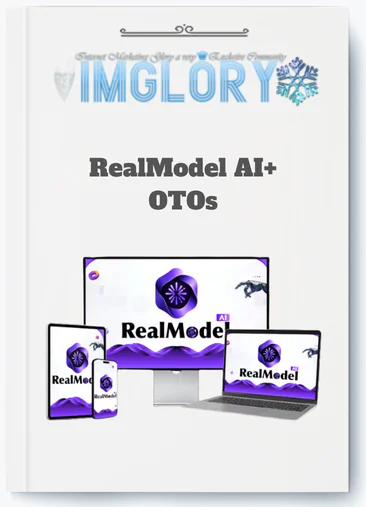
[Group buy] RealModel AI+ OTOs
$15.00
RealModel AI is a cloud-based AI platform that combines advanced text generation with photorealistic AI human image creation in a single browser-based workspace.
Every AI tool that launches in 2026 comes with the same basic promise: save time, save money, produce better content. Most of them deliver on some portion of that promise some of the time. The useful question is not whether the tool works in general. It is whether it works specifically for your use case, at a cost that makes sense, and without requiring you to become a technical specialist to extract the value.
For RealModel AI, four questions cut through the marketing directly.
Is the problem it solves real? Yes. The fragmentation of text and image production across multiple disconnected tools, and the cost of professional photography for lifestyle and model imagery, are genuine daily frustrations for ecommerce brands, content creators, and small agencies. These are not manufactured pain points.
Is the core capability as described? The combination of multi-model text generation and photorealistic human model imagery in a single browser-based platform with no technical setup is a real and meaningful capability combination. The photorealistic human model generator specifically addresses the photoshoot cost problem in a way that generic image generators do not.
With those four questions answered honestly, here is the complete picture.
What Is RealModel AI?
RealModel AI is a cloud-based SaaS platform that centralizes access to premium AI language models for text generation and a specialized engine for creating photorealistic AI human imagery, all from a single browser-based dashboard with no software installation, no GPU setup, and no API configuration required.
Created for content creators, marketers, ecommerce brands, agencies, and solo entrepreneurs, the platform addresses a specific operational reality: getting professional-quality content produced in 2026 typically means maintaining separate subscriptions with separate AI providers, re-entering context in each new tool, and manually assembling outputs that were never designed to work together. RealModel AI collapses that fragmented workflow into one consistent workspace.
The text generation capability covers blog posts, ad copy, product descriptions, email sequences, video scripts, and social captions through multiple language models accessible from a single interface. The human model generator creates photorealistic images of people, styled and placed in environments of the user's choosing, without models, photographers, or production budgets. General image generation for product mockups, banners, thumbnails, and lifestyle scenes rounds out the visual capability.
Front-end access is $14.95 one-time with commercial rights included and a 30-day money-back guarantee.
The Real Financial Case for RealModel AI
The clearest way to understand RealModel AI's value is through the cost comparisons it most directly replaces.
Against professional photography: A half-day product photoshoot with a model, photographer, and studio runs $1,500 to $5,000 before editing and retouching. Brands that run new product launches every quarter are looking at $6,000 to $20,000 per year in photography costs alone. RealModel AI produces comparable lifestyle model imagery in minutes per variant. For brands that currently rely on flat product-on-white-background photography because lifestyle shoots are not in the budget, the quality improvement in product presentation directly correlates with improved conversion rates in ecommerce and social advertising contexts where lifestyle imagery consistently outperforms static product shots.
Against a multi-tool AI subscription stack: Maintaining an AI writing tool at $20 to $50 per month alongside an image generation platform at $10 to $60 per month costs $360 to $1,320 per year. RealModel AI's $14.95 front-end replaces both the text and image generation functions of that stack with a single one-time payment. For users currently maintaining even a minimal two-tool setup, the break-even calculation is measured in the first month.
Against freelance content production: A freelance copywriter for ongoing marketing content production typically charges $50 to $150 per hour. If RealModel AI generates first drafts that reduce the editing time required, the time savings compound meaningfully over months of production. For agencies, faster creative iteration means more campaigns tested, more clients served, and stronger creative proposals.
The honest qualifier on all of these comparisons: RealModel AI augments professional creative work rather than replacing it entirely. The platform produces first drafts and concept imagery that human judgment then selects, refines, and deploys. The ROI is realized in the acceleration of that production cycle, not in the elimination of the human editorial layer.
Main Features of RealModel AI

Multi-Model Text Generation Hub
The text generation hub provides access to multiple large language models through a single interface, eliminating the need for separate subscriptions with individual AI providers and separate API configurations for each. Users switch between models based on task requirements within the same session, using one model for creative narrative copy and another for structured product descriptions or factually grounded content, all within the same project context.
The shared project context and prompt history across sessions means you can iterate on content across multiple working sessions without re-establishing brief information each time. Pre-built templates cover the most common marketing content formats and reduce setup time for recurring campaign types.
AI Human Model Generator
This is RealModel AI's most commercially distinctive feature and the capability that most directly addresses the photoshoot cost problem for ecommerce and fashion brands. The generator creates photorealistic images of people with customizable age range, gender expression, ethnicity, appearance characteristics, outfit and styling, poses, camera angles, and environmental settings from plain-language descriptions.
The output is specifically tuned for marketing-grade realism rather than artistic stylization, which means generated images are directly deployable in product listings, social media advertising, and catalog content without significant post-production adjustment. This is the quality distinction that separates the human model generator from general AI image platforms where output defaults lean toward artistic interpretation rather than commercial photography realism.
Consistent character generation across multiple images within a project enables a cohesive virtual model that carries through an entire campaign or catalog, addressing the continuity challenge that comes from working with multiple generations in isolation.
Content safety filters restrict explicit content and imagery impersonating real identifiable individuals. Users bear responsibility for appropriate ethical and legal deployment of generated imagery in their commercial contexts.
General Visual Content Generation
Product mockups in styled settings, social media visuals in platform-specific formats, blog headers, website hero images, and campaign mood boards are all producible through the same image engine. Resolution and aspect ratio controls allow generating assets for different platform specifications within the same session.
Campaign Templates and Batch Production Tools
Templates covering ad creative packages, ecommerce product page content bundles, social media post suites, and campaign brief-to-asset workflows provide fast-start frameworks for common campaign types. Batch tools allow uploading a product catalog and auto-generating draft descriptions and image variants for multiple SKUs, producing multiple text variants from a single source brief, and maintaining brand context elements across projects.
Asset Organization and Export
Named projects organize outputs by client, campaign, or content type. Standard export in JPEG and PNG at HD and higher resolutions. Cloud-based architecture means no high-end local hardware is required for any generation or review function.
Pricing Plans and OTOs detailed
Front-End – RealModel AI ($14.95 one-time)
- One-time payment with no recurring subscription fees
- Access multiple AI models from a unified dashboard
- Includes content tools and commercial usage rights
- Designed to replace multiple separate AI subscriptions
- Simplifies workflow and AI management in one platform
- Includes a 30-day money-back guarantee
- Launch pricing may increase later
OTO 1 – RealModel AI Unlimited Edition ($97 – $147 one-time)
- Removes standard account limitations
- Higher output capacity and expanded AI access
- Silver and Gold upgrade options available
- Designed for serious AI users and larger workloads
- Better scalability and smoother workflow management
OTO 2 – RealModel AI DFY Suite ($97 one-time)
- Done-for-you content creation system
- Includes structured prompts and ready-made workflows
- Helps users create faster without starting from scratch
- Simplifies AI content production and organization
- Built for speed, convenience, and easier execution
OTO 3 – Creative Studio ($67 one-time)
- Expands the platform beyond text generation
- Create voiceovers, images, files, and creative assets
- All-in-one creative production workflow
- Reduces the need for multiple external creative tools
- Focused on convenience and faster content production
OTO 4 – Agent Mode ($97 one-time)
- Advanced automation and AI workflow system
- Lets users delegate tasks and processes to AI agents
- Reduces manual prompting and repetitive work
- Designed for faster task completion and scaling
- Focused on goal-based AI execution
OTO 5 – Profit Machine ($47 one-time)
- Monetization-focused business system
- Helps users turn AI tools into income opportunities
- Includes offer positioning and monetization guidance
- Designed for freelancers, marketers, and entrepreneurs
- Focused on building AI-powered service businesses
OTO 6 – RealModel Enterprise Edition ($67 one-time)
- Unlocks the highest-tier system access
- Enhanced speed, performance, and platform capabilities
- Designed for agencies, creators, and business users
- Complete access version of the platform
- Built for advanced professional workflows
OTO 7 – AutoFlow Engine ($47 one-time)
- Continuous workflow automation system
- Reduces manual task management and monitoring
- Keeps AI processes running with less hands-on work
- Faster automation and smoother execution
- Designed for users wanting ongoing AI workflows
OTO 8 – RealModel AI Agency ($197 one-time)
- Agency license for selling AI services to clients
- Create and manage client accounts
- Set custom pricing and keep profits
- Launch an AI service business without building software
- Designed for agencies, freelancers, and consultants
OTO 9 – Franchise License ($77 one-time)
- Promote RealModel AI as an official partner
- Earn commissions from platform sales
- No software management or customer support required
- Designed for affiliates and marketers
- Business opportunity focused upgrade
OTO 10 – Whitelabel License ($297 one-time)
- Rebrand and sell the platform under your own name
- Full branding control with custom software identity
- No coding, hosting, or development required
- Launch your own AI software business
- Keep profits while using the existing platform infrastructure
How to Use RealModel AI
Phase 1: Setup and Context Establishment
After logging in, create a named project before generating any assets. Define your brand context including target audience, tone of voice with specific descriptors, primary offer characteristics, and visual style direction. Establishing this at the project level means it informs every generation within that project rather than requiring re-specification per prompt. The 15 minutes invested here pays back across every session that follows.
Phase 2: Text Content Generation
Select the language model most appropriate for your current content type. Write a structured prompt specifying format, audience, tone, length, and key offer details. Use templates for common formats to reduce setup time. Iterate within the same session with follow-up instructions rather than re-prompting from scratch for each refinement.
Phase 3: Visual and Model Imagery Generation
For human model imagery, write a detailed prompt covering the person's characteristics, outfit, setting, lighting style, and camera angle. For general marketing visuals, describe the product, scene, and styling requirements with equivalent specificity. Generate three to five variants per prompt to give yourself selection options and to identify which prompt elements are producing the strongest results before scaling the approach.
Phase 4: Review and Deployment
Review every asset before deployment. For text, verify factual accuracy against your actual product or service details, confirm brand voice consistency, and check that all claims are supportable. For imagery, assess quality against your brand standards and the specific deployment context. Export reviewed assets in the appropriate format and resolution for each platform.
Pros and Cons
Pros
- Photorealistic human model imagery optimized for marketing use is the most commercially differentiated feature in the platform and addresses the professional photography cost problem more directly than any generic image generator.
- Combined text and image production in one workflow eliminates the context fragmentation and tool-switching overhead of maintaining separate platforms for each capability.
- No technical setup required makes the platform immediately accessible to non-technical users from the first session. Browser access is the complete technical requirement.
- Batch production and campaign templates provide scalable content infrastructure rather than just individual asset generation capability.
- One-time lifetime pricing eliminates recurring subscription overhead and creates a favorable financial comparison to multi-tool monthly stacks from the first month.
- Commercial rights included in the base purchase cover advertising, product listings, and client work.
Cons
- Output quality is directly proportional to prompt specificity. Generic descriptions produce generic outputs regardless of the platform's underlying capability. Developing an effective prompting practice is the primary learning investment required.
- Human review before every deployment is non-negotiable. Generated assets require factual accuracy verification, brand voice assessment, and appropriateness review before going live. The platform accelerates production; it does not replace editorial judgment.
- Hosted-only with internet dependency raises data handling considerations for sensitive client or brand information. Reviewing the privacy policy before entering proprietary business assets is appropriate due diligence.
- Less deep customization control than specialized standalone tools for users with advanced technical requirements.
- Ethical and disclosure responsibilities for AI-generated imagery in commercial and advertising contexts remain with the user independently of platform-level content filters.
Who Is RealModel AI For?
- Ecommerce and fashion brands on limited production budgets who need lifestyle and model imagery for their catalog, product pages, and advertising but cannot absorb regular professional photoshoot costs. The human model generator addresses the most expensive line item in most ecommerce visual content budgets directly.
- Content creators and social media managers who produce both written and visual content across multiple platforms and want to reduce the workflow overhead of managing separate tools for each content type.
- Boutique agencies and freelancers who need to produce diverse campaign assets for clients efficiently without increasing monthly subscription costs. Commercial rights in the base purchase make it a viable production backend from day one.
- Solo entrepreneurs and small business owners who need professional-quality website imagery, social media content, and marketing copy without the budget for professional photographers or dedicated copywriters.
- Designers and creative teams who want to explore campaign concepts and generate mood boards quickly before committing to full production investment.
Less suited for: Enterprise teams requiring on-premises deployment or strict data governance, machine learning researchers needing low-level model access, and developers requiring raw API infrastructure.
Frequently Asked Questions
- What is the most honest assessment of what RealModel AI actually delivers?
The core capabilities described, multi-model text generation and photorealistic human model imagery from a single browser-based platform with no technical setup, are substantiated by the platform's architecture and feature set. The photorealistic model generator is specifically tuned for marketing-grade output rather than artistic generation, which is a meaningful distinction for ecommerce and advertising use cases.
The primary honest caveat is that output quality scales directly with prompt specificity and that every generated asset requires human review before deployment. Users who approach the platform with clear creative intent, invest in structured prompting practice, and maintain a consistent editorial review process will experience the value the platform is designed to deliver. Users who expect autonomous high-quality output from minimal input will be disappointed.
- How does the human model generator handle diverse representation across different demographics?
The human model generator supports generating imagery representing diverse demographics including a wide range of ethnicities, age groups, body types, and gender expressions through description in the image prompt. For brands whose customer base spans multiple demographic groups, generating model imagery that reflects that diversity is achievable by specifying the relevant characteristics in each prompt. The quality and accuracy of demographic representation varies across specific combinations and is most reliably produced when the relevant characteristics are described with specificity rather than broad categorical terms.
- What is the most common reason users do not get the expected output quality from RealModel AI?
Insufficient prompt specificity is consistently the most common source of disappointing output quality. A prompt like “professional model in an outfit” produces a generic output because it gives the generation engine minimal direction. A prompt like “A 28-year-old South Asian woman in a cream-colored silk blouse and tailored dark navy trousers, standing in a bright minimal home office, soft window light from the left, three-quarter shot, commercial fashion photography style” produces an output with specific visual direction that is dramatically more useful for commercial deployment. The investment in developing detailed prompt templates for recurring imagery types is the single most impactful practice improvement for users whose initial outputs are not meeting their quality expectations.
- How does RealModel AI compare to hiring a freelance photographer and model for ongoing content needs?
For brands with ongoing content needs across multiple product lines or campaign cycles, RealModel AI's one-time cost and instant generation capability compares favorably to the recurring cost and scheduling overhead of professional photoshoots. A single product photoshoot at $1,500 to $5,000 covers one session's worth of imagery. RealModel AI produces comparable lifestyle imagery in minutes per variant for the cost of the platform's lifetime license.
The honest qualification is that professional photography retains advantages for high-end editorial work, video content, and brand contexts where authentic human storytelling is the creative core of the communication. For the majority of standard ecommerce, social media, and digital advertising content needs, RealModel AI produces commercially sufficient output at a fraction of the ongoing cost.
- Can RealModel AI produce imagery showing products in use by virtual models?
Yes. Generating lifestyle imagery showing products being worn or used by virtual models is one of the most commercially valuable applications of the platform for ecommerce and fashion brands. The most effective approach describes both the product characteristics and the model context with equal specificity in the same prompt, covering what the model looks like, what they are wearing or using, and the lifestyle setting in which the scene takes place. For physical products where exact branding details need to be preserved, AI-generated lifestyle imagery serves best as a concept visualization layer refined in post-production for final brand accuracy rather than a zero-adjustment final output.
- What are the ethical considerations for using AI-generated model imagery in advertising?
The primary ethical considerations cover three areas. First, consumer transparency: as AI-generated imagery becomes more widespread in advertising, disclosure practices are evolving both as regulatory requirements and as brand trust considerations. Reviewing current FTC guidelines and equivalent regulations in your target markets, as well as the specific AI-generated content policies of each advertising platform where imagery will be deployed, is the appropriate compliance step. Second, accurate product representation: AI-generated lifestyle imagery should represent the product accurately enough that consumers are not misled about its appearance or characteristics. Third, appropriate representation: generating imagery that represents diverse audiences authentically and respectfully, rather than stereotypically or inaccurately, reflects both ethical responsibility and brand integrity.
- How does the Creative Studio upgrade complement the core platform for content creators specifically?
The Creative Studio upgrade at $67 expands RealModel AI beyond text and image generation to include voiceover production and a broader range of creative asset types, creating a more complete all-in-one creative production workflow. For content creators who produce multi-format content including videos, podcasts, and audio-visual social content alongside written and visual assets, the Creative Studio adds the audio production layer that the core platform does not cover. For users whose primary content needs are text and imagery without an audio component, the core platform covers the relevant production scope without the upgrade.
- What is the most effective way to use RealModel AI for a product launch from scratch?
For a complete product launch workflow, the most effective sequence starts with the brand context setup and product brief definition, then moves to research-oriented prompts using the text engine to develop the positioning, audience, and messaging framework. From that foundation, drafting the core campaign copy including landing page headline and body, email sequence, and social media captions comes next. Parallel image generation for the product lifestyle imagery and model shots provides the visual assets.
Finally, batch template generation for ad creative variants across different formats produces the paid media assets. Running this sequence within a single named project maintains context consistency across all elements and produces a coordinated launch asset set rather than separately produced pieces that need manual alignment.
- Can the platform handle ongoing content production for a social media manager's weekly workflow?
Yes. Social media content production is one of the most practical recurring use cases for RealModel AI. A weekly content session of two to three hours can produce a week's worth of captions, visual concepts, and supporting copy for multiple platforms in the same session. Establishing platform-specific templates and a standard brand voice prompt framework in the first two weeks of use significantly reduces the per-session setup time for recurring weekly production. The batch tools are particularly valuable for this use case, allowing multiple post variants to be produced from a single briefing rather than prompting each individually.
- How does RealModel AI's Agent Mode upgrade change the workflow for users with repetitive content production needs?
The Agent Mode upgrade at $97 introduces goal-based AI task delegation, allowing users to define a content production objective and have the system work toward it through a sequence of automated steps rather than manually prompting each generation cycle. For users with clearly defined, repeating content workflows, such as weekly social media production or monthly campaign asset packages, Agent Mode reduces the manual execution overhead significantly. For users whose content needs are primarily project-based and varied rather than recurring with consistent structure, the core platform's manual prompting workflow covers the relevant use cases without requiring the additional automation layer.
- What file management practices protect against losing generated assets if platform access changes?
The most important practice is regular export of completed assets to local storage or a cloud backup system outside the platform. Generated assets stored only within RealModel AI are subject to the same dependency on platform access and availability as any cloud-based SaaS tool. Building a habit of exporting reviewed and approved assets to an organized local or cloud folder structure at the end of each working session ensures that your best outputs remain accessible regardless of any platform status changes. For business-critical content, treating the platform as the generation environment and your own storage as the archive layer is the appropriate operational approach.
- What should a user who is new to AI image generation focus on first to get commercially usable outputs quickly?
Three practices produce the fastest progression from first session to consistently usable commercial outputs. First, study three to five examples of the type of photography your outputs need to match before writing your first prompts, noting the specific visual elements including lighting style, camera angle, setting type, and styling direction that make those reference images work for your use case.
Second, write your first prompts with a level of descriptive specificity equivalent to a brief you would give a professional photographer, covering every visual element you want to control. Third, generate three to five variants per prompt before evaluating results, as the variation across generations from the same prompt reveals which elements of your description are producing the most consistent results and which need more specificity to reliably produce what you intend.
Be the first to review “RealModel AI+ OTOs”
You must be logged in to post a review.
Related products
GB SAAS Tools
Original price was: $116.00.$12.00Current price is: $12.00.
Out of stock
GB SAAS Tools
Original price was: $230.00.$35.00Current price is: $35.00.
GB SAAS Tools
Original price was: $53.50.$25.00Current price is: $25.00.
GB SAAS Tools
Original price was: $290.00.$31.50Current price is: $31.50.
Out of stock
GB SAAS Tools
Original price was: $297.00.$33.00Current price is: $33.00.
Reviews
There are no reviews yet.