
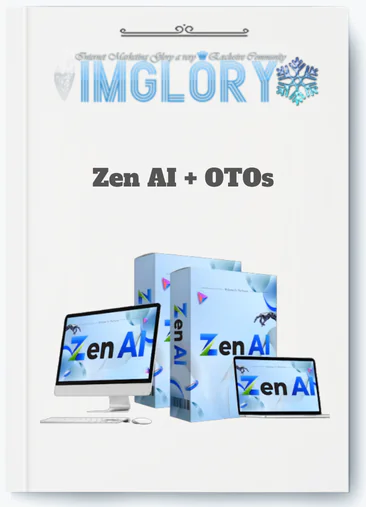
[Group buy] Zen AI + OTOs
$13.00
Zen AI is a cloud-based all-in-one AI platform that combines writing, coding, image generation, automation, and reasoning tools within a single dashboard.
Is Zen AI genuinely different from the dozens of other all-in-one AI tools that have launched in 2026, or is it just another repackaged chatbot wrapper with a flashy sales page and an aggressive funnel?
It is a fair question. The AI tool market has become saturated with products that claim to replace every subscription you own, deliver professional-grade results instantly, and require zero experience to use. Most of them overpromise and underdeliver, and experienced digital marketers have become rightly skeptical of the category.
So let us approach Zen AI the same way a careful buyer should approach any software purchase in this space: with specific questions that need specific answers before any money changes hands.
What AI model actually powers it and how capable is that model? What can the platform genuinely produce and what are the real limitations? Who created it and is there accountability behind the product? How does the pricing model actually work and what is the total cost of getting full value from it? And most importantly, is there a realistic path to generating a return on the investment?
This review answers all of those questions honestly, without hype.
What Is Zen AI?
Zen AI is a cloud-based all-in-one AI platform developed by Venkatesh Kumar that combines AI chat and reasoning, coding assistance, content generation, task automation, text-to-image creation, video production, vision AI analysis, voiceover generation, website building, and data analysis inside a single dashboard, available for a one-time payment with no recurring fees.
The platform is powered by the GLM model family from Zhipu AI, a leading Chinese AI research company. The core models are GLM-5 and GLM-5.1, which serve as the flagship reasoning engines, supported by GLM-4.7 for faster and more cost-efficient tasks, GLM-Image for visual generation, and GLM-5V for vision and multimodal reasoning. The GLM-5 architecture supports context windows of approximately 200,000 tokens, multi-step reasoning chains, agentic task execution, and multimodal input processing covering text, code, images, and documents simultaneously.
Every standard purchase includes a free commercial license, a 30-day money-back guarantee, and access to nine optional upgrades covering unlimited usage, a done-for-you prompt library, agency management tools, a website builder, traffic automation, niche site templates, affiliate campaign resources, a reseller license, and a full white label option.
The front-end price during the current launch window is approximately $13 to $17, making it one of the most affordably priced comprehensive AI platforms in the current market.
The Technical Foundation: Understanding GLM-5

Most AI tool reviews skip over the underlying model and focus entirely on the feature list. That approach leaves buyers without the information they need to assess whether the platform will actually deliver what they need. So let us spend a moment on what GLM-5 actually is and why it matters.
GLM, which stands for General Language Model, is an open-source AI architecture developed by Zhipu AI in collaboration with Tsinghua University in China. The GLM model family has been in continuous development since 2021 and has evolved through multiple generations, with GLM-5 and GLM-5.1 representing the current flagship release.
The key technical characteristics of GLM-5 that are directly relevant to Zen AI users are as follows.
The 200,000-token context window is significantly larger than what most competing AI platforms offer at a comparable price point. In practical terms, this means you can feed Zen AI an entire book, a large codebase, an extensive research compilation, or a lengthy multi-document project and receive responses that reflect the full content rather than just the most recently submitted portion. This matters enormously for complex, document-heavy business work where smaller context windows force constant re-prompting and produce inconsistent results.
The multi-step reasoning engine processes complex problems through logical planning chains before delivering final answers. This is architecturally different from models that generate immediate responses based on pattern matching and produces meaningfully better results for tasks involving strategic analysis, technical problem solving, complex content structuring, and multi-variable business decisions.
The agentic task execution capability allows GLM-5 to plan and carry out sequences of actions autonomously rather than responding to individual prompts. This is the foundation of Zen AI's automation agent feature and is what distinguishes it from AI tools that are fundamentally advanced chatbots rather than genuine workflow automation engines.
The multimodal input handling processes text, code, images, and structured documents in the same reasoning context, which is what enables the Vision AI and document analysis capabilities alongside the text and code features.
GLM-5 is an open-source model, which is what makes Zen AI's one-time pricing model economically viable. Unlike proprietary models from OpenAI, Anthropic, and Google that carry significant per-token licensing costs, GLM-5 can be deployed without the ongoing API costs that force most AI platforms to charge monthly subscription fees. The practical result for Zen AI users is that the economic model that would make a comparable tool from a proprietary API provider expensive on a recurring basis is simply not present here.
Main Features of Zen AI: What Each One Actually Delivers
Advanced AI Chat and Reasoning
The chat and reasoning interface is the primary entry point for most users and the foundation that all other features build on. GLM-5's thinking mode processes complex queries through multi-step logical chains before responding, which produces noticeably better results for analysis, strategy, research synthesis, and structured problem solving compared to models that generate immediate first-pass responses.
The 200,000-token context window means extended working sessions on large projects maintain full awareness of everything discussed, written, or analyzed within that session. Users working on long-form projects, complex client briefs, or extensive research tasks will find this capability directly improves the coherence and accuracy of output compared to working within smaller context constraints.
AI Coding Assistant
The coding assistant serves two distinct user groups with meaningfully different needs, and it handles both effectively.
For users without programming backgrounds, the assistant converts plain language descriptions into working code. Building a custom landing page, creating an automation script, developing a simple application, or integrating a third-party API into a workflow are all achievable through conversational instructions without writing a single line of code manually. The system explains what the generated code does in plain language, which allows non-technical users to verify that the output matches their intent before deploying it.
For developers, the assistant accelerates production through boilerplate generation, automated debugging, code review and optimization suggestions, and handling of repetitive development tasks. The system's compatibility with OpenAI-style API workflows and support for Claude Code and Cline integration patterns means it integrates cleanly into established development toolchains.
Content Creation
The content generation capability covers blog posts, articles, email sequences, product descriptions, sales pages, ad copy, social media content, video scripts, press releases, course material, and business communications. GLM-5's language quality is strong enough for commercial deployment across all of these formats without requiring significant editing in most cases.
The 200,000-token context window is particularly valuable for content work because it allows users to provide extensive briefing material, brand guidelines, competitor examples, and tone specifications as context for each generation request. The more relevant context you provide, the more specifically tailored and immediately deployable the output becomes.
24/7 Automation Agents
The automation agent capability is one of the features that most clearly differentiates Zen AI from platforms that are primarily advanced writing tools with some additional features bolted on.
Zen AI's agents are built on agentic AI architecture, meaning they plan and execute multi-step task sequences autonomously. The practical distinction between an agentic AI and a standard chatbot is significant. A standard chatbot responds to one prompt at a time and waits for the next instruction. An agentic AI receives a goal, breaks it into steps, executes each step using whatever tools are available, processes the results of each step before proceeding to the next, and delivers the completed output without requiring manual supervision of the process.
For business owners, this means that tasks like researching a topic and compiling a structured report, processing a dataset and generating a formatted analysis, managing a content pipeline through multiple production stages, and handling customer inquiry workflows can be assigned to Zen AI agents and completed without ongoing human attention.
Text-to-Image Generation
The image generation module uses CogView and GLM-Image to produce marketing graphics, social media visuals, product illustrations, and advertising creatives from text descriptions. The output quality is calibrated for commercial marketing applications rather than purely artistic generation, which means images consistently reflect practical visual communication requirements.
For users who have worked with MidJourney, the interface and prompt style are comparable. The key difference for Zen AI users is that image generation is integrated into the same platform as every other AI capability rather than requiring a separate subscription and platform login.
Video Production
CogVideo and related models within Zen AI produce AI-generated video content from text descriptions and source images. The capability covers marketing clips, social media reels, explainer videos, product demonstrations, and branded content. When combined with the voiceover generation module, complete video production including animation and narration is achievable without leaving the platform.
Vision AI
The Vision AI module analyzes uploaded images, screenshots, PDFs, and documents for intelligent extraction and interpretation. It reads UI layouts, extracts structured data from visual sources, interprets diagram and chart content, and processes document structures. For businesses dealing with large volumes of visual or document-based information, this feature converts manual review work into automated analysis.
Voiceover Generation
Natural-sounding voiceover output in multiple languages and accents from text input, suitable for direct commercial deployment in video content, online courses, advertising, and client deliverables. Removes the need for professional voice talent for standard commercial audio production.
Website and Application Building
Complete website structures, landing pages, and application interfaces from text descriptions, delivered with both visual design and working code as a single output. Enables rapid deployment of web properties without conventional web development time or cost.
Data Analysis and Reporting
Processes uploaded datasets, generates structured analysis, produces formatted business reports, and creates presentation summaries from raw data. Useful for converting operational metrics, sales data, and market research into actionable insights and presentation-ready formats without dedicated analytics tools.
Pricing Plans and OTOs detailed
FE – Zen AI ($13)
- Zen AI core platform access
- AI chat and conversational assistant tools
- AI content creation capabilities
- AI coding and development assistance
- AI automation agents included
- Vision AI functionality
- AI image generation tools
- Multiple AI utilities within a single dashboard
- One-time payment during launch
- Early-bird pricing available
- Commercial use opportunities
- 30-day money-back guarantee
OTO 1 – Zen AI Unlimited ($37 – $97)
- Unlimited AI chatbot usage
- Unlimited prompts and content generation
- Unlimited AI images and videos
- Unlimited articles, funnels, and websites
- Unlimited client-finding tools
- 100 additional DFY chatbot templates
- Priority processing speeds
- Premium training included
- Priority customer support
OTO 2 – DFY 100K Prompts Pack ($27 – $37)
- 100,000 done-for-you AI prompts
- Ready-made prompts across multiple niches
- Business and marketing prompt library
- Productivity-focused AI resources
- Regular prompt updates
- Faster content creation workflows
OTO 3 – Zen AI Agency ($77 – $167)
- Agency dashboard access
- Create and manage client accounts
- Sell Zen AI access to clients
- Charge recurring or one-time fees
- Keep 100% of client revenue
- Multi-client management system
- Agency business model support
OTO 4 – PageMate AI ($17 – $27)
- AI website builder
- AI funnel builder
- Landing page creation tools
- 1,000+ website templates
- Drag-and-drop editor
- Built-in analytics
- Commercial rights included
OTO 5 – TrafficPilot ($27 – $37)
- Automated traffic generation tools
- Social media traffic strategies
- Traffic automation workflows
- Website and affiliate offer promotion
- Lead generation support
- Traffic scaling features
OTO 6 – Profit Niche Sites ($17 – $27)
- 50 done-for-you niche websites
- Self-updating website system
- Built-in traffic features
- Multiple monetization methods
- Commercial rights included
- Ready-to-launch income assets
OTO 7 – Affiliate Empire ($29 – $39)
- 100+ done-for-you affiliate campaigns
- Multiple income stream opportunities
- Ready-made promotional assets
- Affiliate marketing training
- Fast campaign deployment system
- Commission-focused business resources
OTO 8 – Zen AI Reseller License ($67 – $147)
- Resell Zen AI and keep 100% profits
- Full funnel commissions
- Sales pages included
- Marketing materials provided
- Hosting and platform management included
- Customer support handled by vendor
OTO 9 – Zen AI White Label License ($247 – $497)
- Rebrand Zen AI as your own software
- Custom logo and branding
- Custom pricing structure
- Sell under your own business name
- Keep 100% of profits
- White-label software business model
- Optional setup and support assistance
- Full ownership-style branding opportunity
How to Use Zen AI: The Three-Step Formula
Zen AI's official three-step workflow captures the platform's core simplicity accurately.
Step 1: Access
Log in to Zen AI's cloud-based dashboard from any device with a browser and internet connection. No installation, no configuration, no technical setup. The interface is clean and functional from the first login.
Step 2: Create
Type your task description, upload your file, or enter your project brief into the relevant tool workspace. Zen AI processes your input and generates output within seconds. The platform handles all technical complexity in the background. Your job is to describe what you want clearly. The more specific your description, the more targeted and immediately usable the result.
Step 3: Cash In
Deploy the output in your own business, deliver it to clients, or publish it to your platforms. The commercial license included with every purchase means every output is immediately monetizable from the moment it is generated. There are no additional licensing steps, attribution requirements, or revenue-sharing obligations.
The simplicity of this workflow is genuinely accurate for standard tasks. More complex agentic workflows and multi-step automation setups require slightly more setup and refinement but remain accessible to users without technical backgrounds due to the natural language input model.
Pros and Cons
Pros
- GLM-5 with 200K token context provides genuinely serious AI performance for complex, document-heavy, and multi-step tasks that require sustained reasoning and large-context awareness.
- Agentic automation capability enables autonomous multi-step workflow execution that is fundamentally more operationally powerful than standard chatbot-style AI interaction.
- One-time pricing at approximately $13 to $17 during the launch window creates immediate and sustained cost savings compared to maintaining multiple individual AI subscriptions, with the savings compounding month over month.
- Comprehensive feature breadth across writing, coding, images, video, voice, automation, vision, and web building removes the practical need for multiple separate tools for the majority of online business use cases.
- Free commercial license makes all output immediately and unconditionally monetizable in client work and commercial products.
- Nine structured upgrade options provide a clear path from personal productivity to agency operation to white label software business depending on user goals.
- 30-day money-back guarantee eliminates all financial risk from the purchase.
Cons
- Cloud-based only, requiring a stable internet connection for all functions with no offline capability.
- Open-source model architecture means users who specifically require the latest proprietary model performance from OpenAI, Anthropic, or Google for niche professional applications may encounter output characteristic differences in those specific edge cases.
- Launch pricing is time-limited, requiring action during the promotional window to secure the one-time rate before the platform transitions to a recurring subscription model.
- Enterprise governance features including compliance controls, organizational user management, and regulatory-grade data handling are not part of the standard offering.
Who Is Zen AI For and Who Is It Not For?
Best suited for:
- Independent service providers and freelancers who want to deliver a broad range of professional AI-powered services to clients without managing multiple tool subscriptions or outsourcing production to specialists. The commercial license and breadth of output types make Zen AI a complete single-tool backend for a diversified freelance service business.
- Digital entrepreneurs and product creators who need comprehensive AI support for launching new offers, including website creation, sales copy, promotional video, product imagery, and customer engagement automation, without assembling a multi-tool production stack.
- Content agencies and marketing teams that produce high volumes of diverse content for clients and want to reduce both per-piece production cost and the administrative overhead of managing multiple AI platform subscriptions.
- Developers and technical entrepreneurs who want AI-assisted application development, script building, and automation construction at a price point that makes the tool viable for individual and small-team projects.
- Beginners entering the digital economy who want one platform that covers every AI capability they need to start and grow an online business without requiring a large upfront technology investment or technical expertise.
Not suited for:
Organizations requiring enterprise compliance and governance infrastructure, users with no interest in AI tools, or professionals in regulated industries where AI-generated content must pass formal human review before any commercial deployment.
Frequently Asked Questions
- What distinguishes Zen AI from other all-in-one AI platforms that have launched recently?
Three factors separate Zen AI from the typical all-in-one AI platform released in 2026. First, the underlying model: GLM-5 is a genuinely capable reasoning engine with a 200,000-token context window and agentic execution capability, not a lightweight wrapper around a basic language model. Second, the pricing architecture: the one-time payment model is structurally different from subscription-based multi-tool platforms and creates lasting cost savings rather than just redistributing subscription costs under one invoice. Third, the commercial license: it is unconditional and included at no additional cost, making all output immediately monetizable without licensing restrictions.
- Is Zen AI suitable for someone who currently uses ChatGPT and wants to replace it?
Zen AI can serve as a ChatGPT replacement for most standard use cases including content writing, research, brainstorming, coding assistance, and conversational reasoning. GLM-5's performance in these areas is competitive for commercial and creative applications. Users who have built specific workflows around ChatGPT's unique features such as custom GPTs, certain plugin integrations, or specific API endpoints may find some workflow adjustments necessary during the transition. For users primarily using ChatGPT for writing, research, and content creation tasks, Zen AI delivers comparable quality at a significantly lower total cost while adding capabilities that ChatGPT does not offer, including image generation, video creation, voiceover, and automation agents.
- How does the agentic automation capability compare to dedicated automation platforms like Zapier or Make?
Zen AI's automation agents operate on a fundamentally different principle than workflow automation tools like Zapier or Make. Zapier and Make connect predefined application triggers and actions through fixed logical rules. Zen AI's agents use AI reasoning to interpret goals, plan execution sequences, process intermediate results, and make contextual decisions dynamically. The practical difference is that Zen AI handles unstructured, context-dependent tasks that require reasoning and judgment, while Zapier and Make handle structured, rule-based integration between specific applications. For many business automation needs, the two approaches are complementary rather than competing.
- What is the realistic output volume I can expect from the front-end platform?
The front-end platform has usage limits that represent a practical daily working volume suitable for individual creator and freelancer use cases. For users who need to produce at significantly higher volumes, serve multiple clients simultaneously, or run automated workflows at scale, OTO 1 Unlimited removes all usage restrictions. The specific limits of the front-end tier are not disclosed in detail on the sales page, but the pattern for platforms of this type is that front-end limits are sufficient for moderate individual use and the unlimited upgrade is designed for professional-volume or multi-client operations.
- Can Zen AI generate content that passes plagiarism checks and AI detection tools?
Zen AI generates original content based on your specific prompt inputs rather than reproducing existing text, so plagiarism checks should not flag it as copied content. AI content detection is a separate question. AI detectors analyze statistical patterns in writing to identify content that matches typical AI generation signatures. The detectability of Zen AI output varies by task type, content category, and the specific detection tool used. For contexts where passing AI detection is important, combining Zen AI's generation with the platform's content refinement capabilities and adding personal editing passes produces output that is less consistently detectable by standard AI detection tools.
- What is the most valuable use of the Vision AI module for a typical online business?
The most commonly reported high-value uses of Vision AI in online business contexts include analyzing competitor website screenshots and UI layouts for design and conversion insights, extracting structured data from visual reports and documents to avoid manual transcription, processing customer-provided images and screenshots to understand support requests more accurately, and performing quality review of visual content against brand standards. For businesses that receive, process, or analyze large volumes of visual information as part of their normal operations, the time savings from automated Vision AI analysis can be substantial.
- How does the PageMate website builder complement the core Zen AI platform?
PageMate, available as OTO 4, adds a dedicated AI-driven website and funnel builder with over 1,000 templates, drag-and-drop editing, built-in analytics, and commercial rights. It complements the core platform by providing a specialized interface optimized for website and funnel construction, whereas Zen AI's core website generation capability is part of the general AI workspace rather than a purpose-built web builder interface. For users who specifically want to build and sell websites as a service, PageMate provides a more feature-complete professional environment for that specific task. For users who need occasional website creation as part of a broader workflow, the core platform's website generation capability is sufficient.
- How does Zen AI handle multilingual content for international markets?
GLM-5 supports content generation, translation, and analysis across multiple languages. The voiceover generator supports multiple languages and accents for audio content production. Translation between languages is handled through the AI chat and content creation interfaces using natural language instructions. Content quality in non-English languages is strong for major world languages and may vary for less commonly supported ones. For businesses serving international markets or producing content for non-English-speaking audiences, Zen AI's multilingual capability covers the practical content production needs of most international digital marketing operations.
- What level of customer support is available and how responsive is it?
Zen AI provides 24/7 customer support through the vendor support email at kiai@softagogroup.atlassian.net. Users who purchase OTO 1 Unlimited receive priority support access with faster response times. The platform is actively maintained and updated with model improvements and new features deployed automatically. For users who encounter technical issues or have questions about specific features, the vendor support team is the primary contact point, with the 30-day money-back guarantee serving as the ultimate backstop for users who experience significant platform performance issues within the initial purchase period.
- Is there a risk of the platform being discontinued or significantly changed after purchase?
This is a legitimate risk with any software platform purchase and Zen AI is not immune to it. The one-time pricing model means the platform's long-term viability depends on the vendor's ability to sustain operations from initial sales and upgrade revenue rather than ongoing subscription income. Established vendors with track records across multiple product launches, such as Venkatesh Kumar, generally have the infrastructure and motivation to maintain products over the medium to long term.
The 30-day money-back guarantee provides a short-term risk mitigation window. For users whose business operations would be significantly disrupted by platform discontinuation, maintaining awareness of alternative tools and not becoming exclusively dependent on any single platform is prudent standard practice regardless of which tool is being evaluated.
- How quickly can a complete beginner expect to produce income using Zen AI?
The time to first income depends almost entirely on how quickly the user identifies a service to offer, sets up a way to receive clients, and delivers their first project. The platform itself produces professional-quality output immediately. Users who leverage existing networks or freelance platforms like Fiverr and Upwork to offer AI-powered services can often generate first income within days of purchase. Building a more structured, ongoing income stream from Zen AI-powered services typically requires several weeks of consistent effort to establish a client base, set up a service offering, and develop a reliable production workflow. The platform provides the production capability. The income timeline depends on the user's execution speed and market approach.
- What is the single most important thing to do immediately after purchasing Zen AI?
The most important first action after purchase is to complete one meaningful real-world task using the platform within the first 24 hours rather than spending the initial session exploring features abstractly. Choose a specific, practical task that represents a real business need you have, whether that is writing a piece of content you actually need, generating a visual asset for a current project, or building a script for an automation you have been meaning to set up. Completing one concrete, useful task immediately establishes the platform's practical value in your workflow, identifies any areas where you need to refine your prompting approach, and creates the foundation for the consistent daily habit that produces compounding productivity gains over time.
Be the first to review “Zen AI + OTOs”
You must be logged in to post a review.
Related products
GB SAAS Tools
Original price was: $290.00.$31.50Current price is: $31.50.
Out of stock
GB SAAS Tools
Original price was: $297.00.$33.00Current price is: $33.00.
GB SAAS Tools
Original price was: $335.00.$47.00Current price is: $47.00.
GB SAAS Tools
$39.00
Out of stock
GB SAAS Tools
Original price was: $804.00.$55.00Current price is: $55.00.
Reviews
There are no reviews yet.