
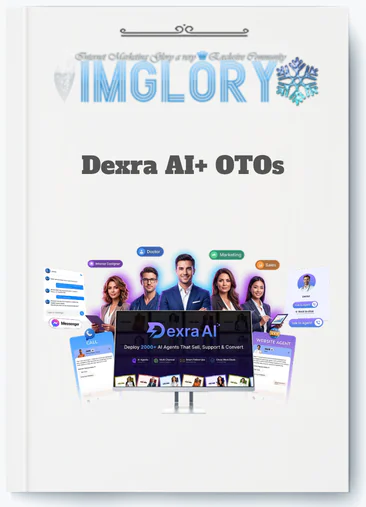
[Group buy] Dexra AI+ OTOs
$17.00
Dexra AI is a no-code AI automation platform that deploys virtual agents to handle sales, customer support, lead qualification, and appointment booking around the clock.
There is a measurable difference between a visitor who fills out a contact form and a visitor who has a conversation. The form submission is passive. The visitor provides information they were asked for, submits it, and waits for someone to get back to them at some undefined future point. The conversion rate from form submission to actual booked appointment or qualified opportunity is limited by the friction of that wait and by the absence of any qualifying interaction before the follow-up happens.
A conversation is active. A visitor who engages with a knowledgeable agent, gets answers to specific questions, feels understood in their situation, and books an appointment at the end of that interaction has made a meaningfully higher commitment than a form submitter. The conversion rate from engaged conversation to qualified opportunity is structurally higher because the qualification and trust-building happen during the interaction rather than afterward.
The reason most small businesses have historically relied on forms rather than conversations is that conversations require people. Staffing a live chat function across business hours is expensive. Staffing it across all hours is impractical for most small businesses. The AI agent category exists to change this constraint by deploying context-aware, goal-oriented agents that conduct qualifying conversations at any hour without staffing costs.
Dexra AI is a no-code platform that makes deploying these agents accessible to small businesses and agencies without development resources, with more than 2,000 pre-configured Super Agent templates covering specific roles and industries as the practical starting point.
What Is Dexra AI?
Dexra AI is a no-code AI agent deployment and management platform that lets small businesses, agencies, and freelancers deploy pre-built Super Agents across websites, Facebook Messenger, voice channels, and CRM without writing code. Each Super Agent is knowledge-based and context-aware, drawing from trained business content to conduct qualifying conversations, capture leads, and book appointments toward defined outcomes rather than simply responding to individual inputs.
Dexra AI handles the underlying AI infrastructure, model connections, conversation processing, and data storage while the business owner focuses on template selection, content training, behavior configuration, channel deployment, and ongoing performance monitoring. The result is a continuously operating customer interaction layer that captures leads and books appointments at 2am with the same consistency as during business hours.
Main Features of Dexra AI

Library of 2,000+ Pre-Built Super Agents
The Super Agent library provides pre-configured templates for specific roles and industries, covering sales closers, lead qualifiers, appointment setters, customer support representatives, customer success agents, upsell and retention specialists, FAQ bots, receptionists, survey collectors, and abandoned-chat follow-up agents across niches including real estate, local healthcare, fitness coaching, legal and financial services, SaaS demo booking, restaurants, education, and e-commerce.
The practical value is reducing blank-page friction at the starting point of every deployment. A template pre-configured for a fitness coaching intake conversation already understands the general shape of that use case and starts the customization process substantially ahead of where a blank configuration would begin. The essential discipline is treating templates as starting points requiring customization rather than finished products ready for immediate deployment. Every template needs adaptation to actual brand voice, current pricing, real policies, and genuine offers before any real customer conversations happen.
Multi-Channel Deployment
Website chat widget deployment installs through a JavaScript snippet with customization options for appearance, positioning, and behavioral triggers including time on page, exit intent, and scroll depth thresholds. Facebook Messenger connects through Meta's OAuth authorization flow. Voice channel support connects through a telephony provider or virtual phone number with configurable routing rules. The built-in CRM centralizes contacts and leads generated across all channels with full conversation history linked to each record.
Lead Capture, Qualification, and Appointment Booking
Agents collect standard and custom contact fields, apply qualification logic asking three to five targeted questions, tag leads by temperature based on responses, and route them to appropriate team members or lists automatically. Appointment scheduling integrates with Google Calendar, Outlook, and dedicated scheduling platforms with configurable business hours, buffer times, and confirmation templates.
Knowledge and Content Ingestion
Website URL crawling, PDF document upload, and manual FAQ entry populate the knowledge base that determines agent response quality. Content quality matters more than volume at the initial training stage. Starting with a focused core covering primary services, current pricing, and frequently asked questions, then expanding gradually after verifying accuracy, consistently produces better early performance than uploading all available content simultaneously.
Analytics and Performance Tracking
Volume metrics cover total conversations, unique visitors, and message counts. Performance metrics cover leads captured, appointments booked, conversion rates, first response time, and containment rate. These metrics guide the iterative improvement process that determines whether agent performance increases or stagnates after initial deployment.
Integrations and Ecosystem Connectivity
Zapier and Make connect Dexra AI to the broader small business software stack through patterns covering CRM contact creation, email and SMS follow-up sequencing, calendar event creation, and team notification workflows. Webhooks and API access support more custom workflows for teams with technical resources.
Pricing Plans and OTOs detailed
Front-End – Dexra AI ($17 one-time)
- One-time payment with no monthly subscriptions
- Access to 2,000+ AI agents
- Voice and chat automation included
- Built-in CRM and lead generation tools
- Multi-platform AI deployment supported
- Commercial rights included
- Supports freelancers, marketers, agencies, and businesses
- Includes 30-day money-back guarantee
OTO 1 – Dexra AI Unlimited ($67 – $147 one-time)
- Removes restrictions from the front-end version
- Unlimited AI agents and embeddings
- Unlimited workspaces and live chat
- Advanced branding and rebranding features
- Global AI conversations in 50+ languages
- Access to 1,500+ AI voices
- Advanced clone styling and training controls
- Priority support included
- Built for agencies, freelancers, and multi-client businesses
OTO 2 – Dexra AI Client Finder ($67 – $97 one-time)
- AI-powered client acquisition system
- Find verified local business leads
- Built-in Google business search tools
- Industry and location-based targeting
- Personalized outreach message templates
- Proposal generators and deal-closing scripts
- Ready-made email, WhatsApp, and DM outreach
- Designed to help users find and close paying clients faster
OTO 3 – Dexra AI AutoCloser ($47 – $57 one-time)
- AI-driven CRM and sales automation system
- Track leads and manage conversations
- Automated follow-up workflows included
- Live chat and multi-channel messaging support
- Lead scoring and pipeline management tools
- Organizes customer interactions in one dashboard
- Built to improve conversions and sales automation
OTO 4 – Dexra AI Traffic ($27 – $37 one-time)
- AI-powered traffic and lead-generation tools
- Unlimited lead capture system
- Voice cloning for personalized AI interactions
- Autoresponder and CRM integrations included
- Appointment booking and smart forms supported
- Visitor tracking and conversion analytics tools
- Affiliate promotion and sales booster features
- Supports Pabbly Connect and external app automation
OTO 5 – Dexra AI DFY ($67 – $97 one-time)
- Done-for-you AI setup service
- AI agent creation and deployment included
- Custom branding and training configuration
- Integrations and optimization handled by the team
- Personalized AI agents based on business data
- 1-on-1 support included
- Commercial license activation included
- Built for beginners and busy entrepreneurs
OTO 6 – Dexra AI Agency ($97 – $147 one-time)
- White-label AI automation business system
- Client account and workspace management
- Replace Dexra branding with custom branding
- Team management and reseller rights included
- DFY agency resources and templates included
- Ready-made proposals, contracts, and invoices
- Supports Fiverr and Upwork client acquisition
- Built for agencies and recurring AI service businesses
OTO 7 – Dexra AI Reseller ($67 – $97 one-time)
- Sell Dexra AI and keep 100% of profits
- Includes reseller rights and sales funnels
- Ready-made marketing materials included
- Backend product delivery and support handled for users
- No coding or software development needed
- Members area and sales system included
- Designed for beginners entering the AI software business
OTO 8 – Dexra AI Mega Suite ($97 – $127 one-time)
- Includes 20 additional VIP AI features
- AI app creation and storybook generation tools
- Automated news site builder included
- Lead extraction and automation systems
- Access to Bizora AI, AI App Empire, and Broadcaster AI
- Premium visual assets and monetization training
- Live coaching and client-closing systems included
- Business-growth blueprints and automation toolkits
- Includes 5 years of premium support and updates
How Dexra AI Works: The Complete Deployment Workflow
Step 1: Account Setup and Dashboard Orientation
After signup, the central dashboard presents the agents list, training and content section, channel configuration, analytics, and built-in CRM view. Taking thirty minutes to explore the dashboard layout before beginning template selection produces a smoother setup experience because every subsequent configuration step is easier to execute when you understand where it lives and how it connects to the other sections. Most platforms include an onboarding checklist or wizard to guide first-time users through the initial setup sequence.
Step 2: Template Selection
Browse the library by role, industry, or use case and select the template that most closely aligns with the primary deployment goal and the monetization model behind it. The template bakes in specific conversational logic, a default tone, and prompts calibrated for its role, which means selecting the template that genuinely matches the conversion objective, whether that is booking a strategy call, qualifying a buyer, handling support inquiries, or capturing leads for a local service business, ensures the entire agent logic works toward the actual outcome rather than fighting a structural misalignment between template design and deployment intent.
Step 3: Content Training
Add the website URL for platform crawling, upload relevant PDFs, and enter key FAQs with specific accurate answers. The quality principle applies here: a focused core corpus of ten to fifteen high-quality entries covering primary services, current pricing, the booking process, and the most frequently asked real questions produces better initial performance than uploading every available document. Conflicting information across multiple documents creates inconsistency because the underlying model may attempt to reconcile contradictions in unintended ways. Review all content for currency and accuracy before ingestion, remove deprecated pricing pages or outdated product descriptions, and maintain a single source-of-truth FAQ document as the foundation.
Step 4: Behavior and Business Rule Configuration
Set tone and communication style to match brand voice, define operating languages, and establish guardrails around topics to avoid or escalate. Configure lead qualification logic specifically: which questions to ask, in which order, when to request contact information, what answer patterns qualify a lead as hot versus warm versus cold, and when to offer appointment booking versus capturing contact details for human follow-up. The specificity of this configuration determines how consistently the agent performs across hundreds of simultaneous conversations without human oversight. A vaguely configured agent produces inconsistent outcomes. A specifically configured one produces reliable, repeatable results that improve with monitoring and iteration.
Step 5: Channel Deployment and Testing
Install the website chat widget and customize appearance, positioning, and behavioral triggers. Test across desktop and mobile device types before directing live traffic because rendering and behavioral differences between device configurations affect the visitor experience in ways that only become visible through actual device testing rather than desktop-only preview. Connect Facebook Messenger through OAuth authorization. Configure voice channel routing if applicable. Run realistic visitor scenario tests through each deployed channel before launch, including edge cases and questions the agent may struggle with, to surface configuration gaps before real customers encounter them.
Step 6: Live Monitoring and Iterative Improvement
Review conversation transcripts consistently during the first four to six weeks of deployment. The transcripts from real visitor interactions reveal the specific questions the agent handles poorly, the conversation patterns that produce drop-off before lead capture, the escalation triggers that fire too frequently or too rarely, and the gaps between what the training content covers and what visitors actually ask. Update training content and adjust configuration based on what the data shows rather than initial assumptions. An agent left unmonitored after launch accumulates inaccuracies as the business evolves, offers change, and new questions emerge that the original training content does not address.
Pros and Cons
Pros
- 2,000+ niche-specific Super Agent templates reduce blank-page friction by providing pre-configured starting points for specific roles and industries, making the gap between having an offer and having a deployed AI agent measurable in hours rather than weeks.
- No-code deployment makes Dexra AI accessible to business owners without development backgrounds, with standard website and Messenger deployments achievable without developer assistance.
- Multi-channel coverage from one dashboard reduces the operational overhead of managing separate tools for each customer touchpoint.
- 24/7 lead capture and qualification without staffing costs provides the scaling leverage that is most financially compelling for solo operators and small teams competing against larger organizations with dedicated staff.
- Built-in CRM with conversation history eliminates data fragmentation by centralizing lead records and interaction context alongside agent management.
- One-time front-end pricing at $17 removes financial barriers for small businesses evaluating AI agent deployment for the first time.
- Commercial license enables agencies and freelancers to build client service offerings from the base purchase.
Cons
- Template customization is non-negotiable before deployment to real customers. Deploying without thorough adaptation creates reputational risk from inaccurate promises and outdated information.
- AI accuracy limitations require ongoing management. Agents generate plausible-sounding responses from their training content, and without monitoring and guardrails, incorrect responses reach real customers.
- Dashboard complexity combining agent management, training, channel configuration, analytics, and CRM creates a learning curve that most new users find challenging in the first few weeks.
- Launch-style product longevity risk requires realistic assessment. Promotional products may not maintain the development cadence of mature SaaS platforms over multi-year periods.
- Compliance verification is the user's responsibility for regulated industries before collecting customer personal information through any AI agent platform.
- Third-party LLM dependency introduces external risk from model provider policy or capability changes affecting agent behavior without notice.
Who Is Dexra AI For?
- Solo entrepreneurs and service businesses whose primary operational bottleneck is the manual overhead of initial lead handling, qualifying conversations, and appointment booking use Dexra AI to deploy 24/7 coverage for these functions without the staffing costs that the same coverage would require from human team members.
- Local service businesses including fitness studios, medical clinics, salons, home services providers, legal and financial consultants, and restaurants use the appointment booking and lead qualification features that align directly with the intake and scheduling workflows these businesses run daily.
- Coaches, consultants, and course creators with defined offers and documented qualification criteria use agents to handle intake conversations at scale, qualifying prospects and booking discovery calls through a consistent process rather than relying on manual back-and-forth communication for each new inquiry.
- Marketing and web agencies building AI agent deployment as a service offering use the commercial license and multi-account management infrastructure to configure and manage agents for client businesses as a recurring billable service.
- E-commerce and SaaS businesses use pre-sales agents for handling repetitive product questions, feature clarification inquiries, and trial or demo booking flows that follow predictable patterns across high volumes of simultaneous visitor interactions.
Less suited for: Regulated industries with HIPAA or financial compliance mandates requiring formal verification, businesses without documented offers or existing content to train agents on, and enterprise operations requiring deep integration with custom internal systems or real-time proprietary data retrieval.
Frequently Asked Questions
- How does the knowledge-based agent model improve conversion rates compared to form-based lead capture?
Form submission is passive and produces no qualifying interaction before follow-up. A visitor who completes a form has provided contact information but has not been engaged, qualified, or moved toward commitment in any way. A visitor who has a conversation with a knowledge-based agent gets specific questions answered, feels understood in their situation, and often books an appointment before the interaction ends. The structural difference is that the qualifying and trust-building that improve conversion rates happen during the conversation rather than during a follow-up call that may never connect. Agents that pursue defined qualification goals across a complete interaction consistently produce higher-quality leads than passive capture mechanisms.
- What is the most important factor in determining whether a Dexra AI agent generates real business results?
Training content quality and customization depth together determine more of the agent's commercial performance than any template selection or channel configuration decision. An agent trained on accurate, current, specific business content that has been configured with precise qualification logic and brand-appropriate tone produces genuinely useful conversations at scale. An agent deployed from a template with minimal customization and generic content produces interactions that feel artificial, make potentially inaccurate claims, and generate unqualified leads that waste follow-up time. The investment in content preparation and configuration quality before launch is what determines whether the agent becomes a genuine business asset or a liability.
- How should a local service business structure its first Dexra AI agent deployment?
Start with the most common and highest-value inquiry type the business receives repeatedly. For a medical clinic this is typically appointment booking for a primary service. For a home services company it is typically an initial inquiry qualification for a service estimate. For a fitness studio it is typically trial class booking or membership inquiry handling. Configure the agent specifically for that single high-value use case first, verify performance through transcript review, then expand to additional use cases once the primary deployment is stable and producing reliable results. Attempting to configure an agent for every possible interaction type simultaneously produces a generically configured agent that handles nothing particularly well.
- How does the AutoCloser upgrade extend Dexra AI's CRM and sales automation capabilities?
The AutoCloser upgrade adds an AI-driven CRM and sales automation system that extends the built-in CRM's basic contact management with lead scoring, pipeline management, automated follow-up workflows, and multi-channel messaging support. For businesses where the initial lead capture through the agent is followed by a defined sales process requiring systematic follow-up at multiple touchpoints, this upgrade provides the automation infrastructure to manage that process without manual orchestration. The most practical application is for businesses with longer consideration cycles where a single conversation rarely produces an immediate commitment and follow-up sequence management determines conversion outcomes.
- What does the Done-For-You upgrade specifically include and who benefits most?
The DFY upgrade has the Dexra team handle agent creation, deployment configuration, custom branding setup, integration connections, and initial optimization on behalf of the user. One-on-one support is included alongside commercial license activation. This upgrade is most valuable for busy entrepreneurs and beginners who want the business benefit of AI agent deployment without personally navigating the configuration process, and for businesses with complex setups where professional configuration reduces the risk of deployment errors that would otherwise affect real customer interactions.
- How does the Unlimited upgrade change the operational scope for an agency?
The Unlimited upgrade removes the restrictions on agent count, workspace count, and live chat volume that apply at the front-end tier. It adds unlimited AI generation credits, advanced branding and rebranding features, global AI conversations across 50+ languages, access to 1,500+ AI voices, and advanced clone styling and training controls. For agencies managing multiple client accounts simultaneously, the workspace and agent count restrictions at the front-end tier become the binding operational constraint relatively quickly. The Unlimited upgrade removes these constraints and adds the multilingual and voice capabilities that client projects in global or diverse markets require.
- How does Dexra AI handle multilingual deployments for businesses serving non-English speaking audiences?
Dexra AI agents inherit multilingual capabilities from the underlying large language models they run on, which provide strong support for major global languages including Spanish, French, German, Portuguese, Japanese, and others with substantial training data representation. Languages with smaller LLM training data representation may produce lower-quality responses. The Unlimited upgrade specifically expands language support to 50+ languages. For businesses deploying agents in non-English primary markets, testing agent performance in the target language through realistic visitor scenarios before full deployment is the essential quality verification step.
- What is the most effective integration pattern for connecting Dexra AI to an existing sales workflow?
The most commonly effective integration pattern for small business sales workflows connects three trigger points through Zapier or Make. First, a new lead captured by Dexra agent triggers CRM contact creation in HubSpot, Pipedrive, or similar with lead temperature tag and conversation summary. Second, a new appointment triggers calendar event creation and confirmation email or SMS through the business's existing communication tools. Third, hot lead identified triggers immediate notification to the assigned team member through Slack, email, or SMS. This three-trigger pattern covers the core handoff points between the AI agent's lead capture function and the human team's follow-up function without requiring custom development.
- What are the specific compliance considerations for a healthcare business considering Dexra AI deployment?
Healthcare businesses in HIPAA-regulated environments face specific compliance requirements around the collection, storage, and processing of protected health information that standard AI agent platforms are not automatically designed to satisfy. Before deploying any AI agent for patient-facing interactions in a HIPAA-covered entity, the business must verify whether Dexra AI vendor offers a Business Associate Agreement, confirm where conversation data containing PHI is stored and processed, and review whether Dexra AI's data handling practices meet HIPAA Security Rule requirements. Collecting medical history, symptoms, diagnoses, or other PHI through an agent without confirmed HIPAA compliance creates significant legal exposure. Healthcare businesses should treat compliance verification as a prerequisite to deployment evaluation rather than a post-purchase consideration.
- How does the Reseller upgrade work for building an AI software income stream?
The Reseller upgrade provides rights to sell Dexra AI and keep 100 percent of profits from each sale, with ready-made sales funnels, marketing materials, and a members area included. Backend product delivery and support are handled by the Dexra team rather than the reseller. For marketers with established audiences in the small business, agency, or entrepreneurship categories, this creates a software product income stream without requiring product development, delivery infrastructure, or ongoing customer support management. The reseller keeps the revenue while the vendor handles the operational backend.
- What is the most common reason a well-configured Dexra AI agent fails to generate expected results after launch?
Insufficient traffic to the agent's deployment points is the most consistent underlying cause of disappointing results from technically well-configured agents. An agent deployed on a low-traffic website page or a Facebook page with limited active following will generate few conversations regardless of how well it is configured or how accurate its training content is. Before attributing poor performance to the agent's configuration, audit whether the deployment points are receiving meaningful visitor traffic. Increasing traffic to agent deployment points through SEO, paid advertising, social media promotion, or email list communication typically produces faster performance improvement than continuing to refine configuration on a well-built agent that simply lacks enough conversations to demonstrate its value.
- What is the most effective long-term practice for compound improvement in Dexra AI agent performance?
Treating the conversation transcript review as a permanent operational practice rather than a temporary setup activity is what most consistently produces compound performance improvement over time. Each review cycle surfaces new questions the agent handles poorly, new qualification scenarios the configuration does not address, and new content gaps that have emerged as the business has evolved since the last training update. Agents that are actively managed through consistent review and update cycles become meaningfully more capable over six to twelve months than the same agent left static after initial deployment. Dexra AI provides the infrastructure for continuous improvement. The operational discipline to act on what the transcript data shows is what converts that infrastructure into compounding business value.
Be the first to review “Dexra AI+ OTOs”
You must be logged in to post a review.
Related products
GB Spy Tools
GB SAAS Tools
GB SAAS Tools
GB SAAS Tools
GB SAAS Tools
Reviews
There are no reviews yet.