
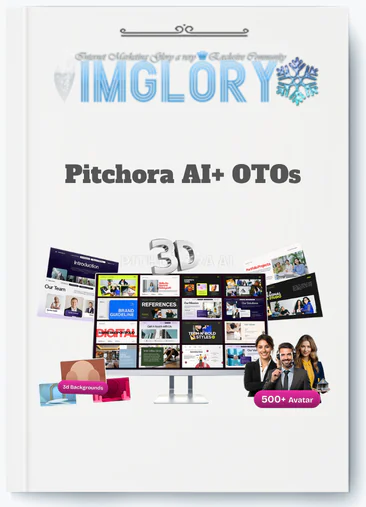
[Group buy] Pitchora AI+ OTOs
$37.00
Pitchora AI is an AI-powered sales agent platform that converts sales materials into interactive AI assistants capable of answering objections, engaging prospects, and driving conversions automatically.
If you have been researching AI sales tools recently, you have likely encountered claims about pitch agents that convert visitors automatically, handle every objection perfectly, and generate sales around the clock without human involvement. Those claims deserve careful scrutiny before any purchase decision, and Pitchora AI is no exception to that standard.
This review takes the approach a careful buyer should: examining what the platform genuinely delivers, where its limitations become operationally relevant, and how it compares honestly to the alternatives most people are already considering. The goal is not to sell you on Pitchora AI or talk you out of it. It is to give you the specific, evidence-based information needed to decide whether it fits your situation, your offer, and your funnel in 2026.
What Is Pitchora AI?
Pitchora AI is an AI pitch agent platform that turns your existing sales materials into interactive, conversational AI agents designed to engage visitors, answer pre-sales questions, handle objections, and guide prospects toward a configured call to action. It belongs to a specialized category of AI sales tools that is fundamentally different from generic chatbots, support tools, or all-purpose AI assistants.
The practical distinction matters for evaluation purposes. A support chatbot is optimized for resolving post-purchase issues and answering account questions. A static sales page delivers one-way information that every visitor receives identically regardless of their specific concerns. Pitchora AI is designed to do something neither of those alternatives does: respond to the individual questions and objections that specific visitors have at the moment they are deciding whether to buy, in a conversational format that reflects the specific details of your offer.
The platform operates through a knowledge base construction process where your sales page URL, uploaded documents, FAQ content, and custom written instructions are processed into a conversational agent that understands your specific offer rather than producing generic AI responses. That agent is deployed via embed code or shareable link across your funnel touchpoints and generates conversation analytics that surface insights about your offer positioning and your audience's conversion barriers.
The honest framing before going further: Pitchora AI is a conversion optimization tool, not a traffic generation tool and not a substitute for a strong offer. It works by improving what happens when visitors who are already on your page interact with your funnel. It cannot create demand where none exists, and it cannot make a weak offer compelling through conversation alone.
How Pitchora AI Works: A Step-by-Step Walkthrough

Step 1: Source Material Input and Knowledge Base Construction
The setup process begins with providing your existing sales content in one or more formats: a sales page URL for the platform to analyze, uploaded PDFs or documents containing offer details and objection responses, written FAQ content, and custom text instructions covering your ideal customer profile, brand voice, and specific selling points. The platform processes these inputs into an internal knowledge model that shapes every subsequent conversation the agent has.
The quality ceiling of this knowledge model is entirely determined by the quality and completeness of what you provide. Rich, specific, well-organized source material produces an agent that handles the full range of visitor questions accurately and on-brand. Vague or incomplete inputs produce an agent that reflects that vagueness in every conversation. This relationship between input quality and output quality is the most important practical reality to understand about the platform before evaluating it.
Step 2: Tone and Behavioral Configuration
With the knowledge base established, you configure how the agent behaves in conversations. Tone settings specify whether the agent is professional, conversational, enthusiastic, or a blend that matches your brand. Behavioral goal settings tell the agent what it is working toward, whether that is qualifying leads, handling objections, driving checkout, or encouraging call bookings.
Custom objection responses can be added for any question where your brand requires a precise, carefully crafted answer rather than AI generation. For objections touching on guarantees, refund terms, competitor comparisons, or any claim with compliance implications, custom configuration is the appropriate approach rather than relying on generative AI output.
Step 3: Deployment Across Funnel Touchpoints
The configured agent is deployed via embed code compatible with most website and funnel building platforms, or via a standalone shareable link for use in email sequences, ad destinations, and social media. One agent covers multiple touchpoints simultaneously, including the primary sales page, opt-in confirmation page, checkout page, and email campaign links, without requiring separate configurations for each location.
Step 4: Monitoring and Optimization
After deployment, the analytics dashboard surfaces conversation performance data including total conversations, engagement rate, conversion events, drop-off points, and the most frequently asked questions and objections. Regular review of this data and corresponding updates to the agent configuration is what produces compounding performance improvement over time rather than a static deployment that gradually drifts from optimal.
Key Features of Pitchora AI
AI Pitch Agent Builder
The agent builder is the core interface where source materials become a functioning conversational agent through a no-code workflow accessible to non-technical users. The honest assessment of this feature is that the interface itself presents no meaningful barrier to setup. The real challenge, and where most users either succeed or struggle, is the quality and organization of the source material they bring to the setup process. An experienced marketer with clear offer positioning and well-documented objection responses will consistently produce a better-performing agent than a user whose offer messaging is still underdeveloped, regardless of how sophisticated the platform's processing capabilities are.
Objection Handling and FAQ Automation
Objection handling is the feature with the clearest direct impact on conversion outcomes, and it is worth examining honestly. The system recognizes question and objection patterns and responds with configured answers that address specific concerns while maintaining brand tone. The combination of AI-powered general question handling and custom-configured responses for high-stakes objections is the approach that produces the most reliable results. Relying entirely on AI generation for objections where precision matters, particularly those touching on refunds, guarantees, or competitive positioning, introduces unnecessary accuracy risk that custom configuration eliminates.
The FAQ automation capability reduces the manual pre-sales communication burden that many businesses underestimate until they measure it. Common questions that a business owner or team currently answers individually through email, DMs, or live chat can be handled consistently and at scale by a well-configured agent, which is a tangible operational benefit beyond the direct conversion impact.
Guided Selling and Call-to-Action Flows
The guided selling capability allows configuration of structured conversation flows that actively move visitors toward a conversion action rather than passively waiting for questions. A well-designed guided flow qualifies the visitor's situation, matches them to the relevant offer or tier, addresses the most likely objection for their profile, and presents a direct CTA link. The honest evaluation of this feature is that tightly scripted flows produce consistent, predictable conversations that can feel less natural to visitors, while more open-ended AI conversation produces more natural interactions but requires more robust source material and guardrails to maintain accuracy and persuasiveness. The right balance depends on your offer complexity and your audience's expectations.
Multi-Channel Sharing and Embeds
A single configured agent deployable across sales pages, checkout pages, email links, and ad destinations is a genuine operational advantage over tools that are locked to a single deployment context. For marketers running traffic from multiple sources to the same offer, consistent conversational pitch quality across all touchpoints is a meaningful standardization benefit. The embed compatibility with mainstream platforms including WordPress, Webflow, and major funnel builders covers the technical environments that the majority of the platform's target users work within.
Lead Capture and CRM Integration
Lead capture within conversations turns the pitch agent into a list-building tool for visitors not yet ready to purchase, capturing contact information and routing it to a nurture sequence. For high-ticket offers where a discovery call is the conversion goal, the agent can pre-qualify prospects and route qualified leads to a booking link. The compliance responsibility for including appropriate consent language in any lead capture configuration rests entirely with the operator, not the platform, which is worth stating explicitly for anyone planning to capture EU or Canadian audience contact information through conversational interfaces.
Analytics, Insights, and Optimization Tools
The analytics dashboard is where Pitchora AI's value extends beyond immediate conversion improvement into ongoing offer and funnel optimization. The data available, specifically the most frequently asked questions and most common objections ranked by volume, provides insights about your market's perception of your offer that no other analytics tool surfaces in the same form. Standard page analytics tells you visitors left. Conversation analytics tells you what they were thinking when they left and what question went unanswered at the moment of decision. That qualitative difference in data quality is genuinely valuable for marketers who commit to using it systematically.
User Management, Workspaces, and Agency Features
The workspace and project structure supports multiple pitch agents within a single account, each with complete separation of source materials, configuration, and analytics data. For users managing multiple offers or client accounts, this architecture makes Pitchora AI operationally practical at scale rather than requiring separate accounts for each project. The agency-tier features including expanded workspace capacity and white-label options support a professional service model built around conversational sales optimization.
Pricing Plans and OTOs detailed
Front-End – Pitchora AI ($37 one-time)
- One-time payment with lifetime access
- AI-powered interactive pitch creation platform
- Create AI sales pitches with lifelike presenters
- Built-in lead capture and visitor engagement tools
- AI-powered question answering and customer interaction
- CRM and prospect management included
- Visitor tracking and analytics tools
- Voice features and interactive 3D-style sales flows
- Commercial license included
- Built for marketers, freelancers, agencies, coaches, SaaS businesses, and affiliates
- Includes 30-day money-back guarantee
- Early-bird launch pricing available
OTO 1 – Pitchora AI Unlimited ($67 one-time)
- Removes core platform limitations
- More workspaces, pitch agents, and lead capacity
- Build unlimited client campaigns and experiences
- Duplicate and scale pitch funnels faster
- Better suited for agencies and service providers
- Designed for scaling AI pitch businesses
OTO 2 – Pitchora AI Enterprise ($47 one-time)
- Build complete customer journey funnels
- Lead capture and appointment booking tools
- Webinar registration and behavior tracking
- Email integrations and smart offer triggers
- Feedback collection and advanced funnel flows
- Unlimited client license included
- Built for agencies and advanced campaigns
OTO 3 – Pitchora AI Leads ($67 one-time)
- Built-in lead discovery and outreach system
- Find businesses and collect contact information
- Outreach and CRM tools included
- Campaign scaling and lead management features
- Saves time on manual prospecting
- Great for freelancers, agencies, and client outreach
OTO 4 – Pitchora AI Automation ($47 one-time)
- Smart CRM and follow-up automation system
- Lead scoring and conversation memory
- Behavior-based triggers and smart replies
- Organize conversations and campaigns from one dashboard
- Team collaboration and lead assignment features
- Built for agencies and multi-client workflows
OTO 5 – Pitchora AI Agency ($67 – $97 one-time)
- White-label AI pitch agency setup
- Create and manage client accounts
- Custom branding, domains, and dashboard setup
- Done-for-you agency materials included
- Client outreach templates, proposals, and contracts
- Supports Fiverr, Upwork, and agency services
- Built for freelancers and agencies
OTO 6 – Pitchora AI DFY ($97 one-time)
- Done-for-you AI pitch setup service
- AI presenter and brand setup handled for you
- CRM and pitch flow configuration included
- Connect forms and automate lead systems
- Saves setup time and avoids technical work
Advantages of Pitchora AI
- Visitor objections are addressed in real time rather than left unanswered. The core conversion problem Pitchora AI solves is real: visitors who leave with unanswered questions represent lost revenue that better information delivery could have prevented. A well-configured agent that handles those questions accurately and persuasively produces a measurably different outcome than a static page that cannot respond to individual visitor concerns.
- Setup uses existing content rather than requiring new assets. The primary inputs are materials most offer owners already have: sales page copy, FAQ documents, and objection responses. Converting existing assets into a new sales capability without significant additional content creation is a genuine efficiency advantage over tools that require purpose-built knowledge bases.
- Conversation analytics reveal position gaps invisible in standard metrics. The qualitative data about what visitors are asking and what is preventing conversion is a category of marketing intelligence that standard traffic and page analytics simply does not provide, and it informs improvements that benefit the entire funnel rather than just the pitch agent.
- 24/7 availability without staffing costs is a straightforward operational benefit. Pre-sales questions answered at any hour in any time zone without live chat staffing is a clear cost and coverage advantage for any business currently handling those questions manually.
- One agent across multiple touchpoints multiplies the configuration investment. The reusability of a single agent across the full funnel means the time invested in thorough setup produces value at every deployment location simultaneously rather than a single isolated conversion point.
Disadvantages of Pitchora AI
- The platform cannot fix weak offer positioning. This is the most important limitation to state clearly for anyone considering Pitchora AI as a solution to poor conversion rates caused by fundamental offer or messaging problems. An agent built on unclear, unconvincing source material produces unclear, unconvincing conversations. The technology amplifies existing sales content quality rather than substituting for it.
- AI response accuracy requires ongoing monitoring. Occasional imprecise, overconfident, or off-brand responses are an inherent characteristic of AI generation that configuration reduces but does not eliminate. Regular conversation log review and configuration updates are genuine ongoing responsibilities rather than optional maintenance for anyone deploying Pitchora AI on a revenue-generating funnel.
- Low-traffic funnels will not demonstrate measurable impact quickly. A pitch agent that handles a small number of conversations per month produces insufficient data for meaningful optimization and insufficient conversion volume for the impact to be measurable against revenue outcomes. The platform delivers its clearest ROI for funnels with meaningful, consistent visitor traffic.
- Complex high-ticket sales still require human judgment at the closing stage. For four-figure and five-figure offers where buyer commitment is significant and relationship trust is a primary purchase driver, Pitchora AI functions best as a pre-qualification and preparation tool rather than a complete sales conversation replacement. Positioning it otherwise sets incorrect expectations.
- YMYL content requires explicit guardrails and human oversight without exception. Medical, legal, financial, and mental health topics carry real liability risks when handled by AI agents without qualified human review. No configuration sophistication changes that fundamental risk category.
Who Is Pitchora AI For?
- Course creators and consultants with complex offers that generate frequent pre-sales questions benefit most clearly from the platform. The more nuanced the offer and the more individual the buying decision, the more a conversational agent that adapts to each visitor's specific situation adds value over a static page that treats every visitor identically.
- Digital marketers and funnel builders with consistent traffic driving meaningful visitor volumes to conversion-focused pages are the profile where conversion rate improvements translate most directly into revenue differences. A two percent improvement on a high-traffic funnel produces a categorically different revenue impact than the same improvement on a low-traffic one.
- SaaS businesses with multi-tier pricing can use Pitchora AI to reduce the decision paralysis and pre-sales support burden that multi-option pricing pages generate, guiding visitors toward the tier that fits their situation before they hit the pricing page or the sign-up flow.
- Agencies managing multiple client funnels benefit from the workspace structure, multi-project management, and analytics reporting features that make Pitchora AI operationally practical as a scalable client service rather than just a faster way to handle individual offer configurations.
Who Is Pitchora AI Not For?
- Impulse-purchase, low-ticket offers where the buying decision requires minimal explanation or persuasion do not generate enough conversational complexity or conversion leverage to justify the setup and maintenance investment. Simple offers with straightforward value propositions are better served by clear static page copy than a conversational agent.
- Businesses with no capacity for ongoing agent maintenance will not benefit from Pitchora AI in practice. An unmonitored, never-updated pitch agent that provides occasional inaccurate or off-brand responses creates negative brand impressions that outweigh any conversion benefit the tool might otherwise deliver.
- Operators expecting traffic generation or audience building from the platform will be disappointed. Pitchora AI improves what happens with existing funnel traffic. It has no mechanism for generating new traffic or building an audience from scratch.
Pitchora AI vs. The Alternatives: A Detailed Comparison
| Criteria | Pitchora AI | Generic Chatbot | Static Sales Page | Custom GPT Build | Live Chat |
| Primary Purpose | Pre-sales conversion | Customer support | One-way information | General use | Real-time support |
| Knowledge Source | Your pitch materials | FAQ database | Fixed copy | Broad AI training | Human agent |
| Objection Handling | Yes, configurable | Minimal | None | Possible, not native | Yes, human |
| Funnel Integration | Native embed | Often add-on | Not applicable | Custom dev required | Add-on tool |
| Non-Technical Setup | Yes | Yes | Yes | No | Yes |
| Sales Analytics | Built-in | No | Page metrics only | None built-in | Limited |
| 24/7 Availability | Yes | Yes | Yes | Depends | No |
| Cost at Scale | Low | Low to medium | None | Variable | High |
| Lead Capture | Yes | Sometimes | Form only | Custom build | Manual |
Against a static sales page alone, the conversational engagement and real-time objection handling represent a categorically different visitor experience rather than a marginal improvement. Against a generic chatbot, the sales-specific design philosophy, offer-specific knowledge base, and dedicated conversion analytics produce fundamentally better pre-sales performance for the specific use case of converting undecided visitors. Against a custom GPT build, the non-technical setup, built-in funnel integration, and dedicated sales analytics provide meaningfully more practical value for the target audience of non-technical marketers and small teams without developer resources.
Against live human salespeople for complex, high-ticket offers where relationship trust and nuanced judgment are primary purchase drivers, Pitchora AI is a complement rather than a replacement. Against a custom GPT build for large teams with developer resources and deep proprietary system integration requirements, the flexibility advantage of a custom build becomes meaningful. Against doing nothing for very simple, low-ticket offers where the purchase decision requires minimal deliberation, the setup and maintenance investment does not justify the marginal impact.
Frequently Asked Questions About Pitchora AI
- Is Pitchora AI legitimate or just another overhyped launch product?
Pitchora AI is a real software product delivering genuine AI-powered pitch agent functionality. The appropriate caution is around third-party affiliate promotions that sometimes attach exaggerated income claims or guaranteed conversion improvements to the product that the platform itself does not promise. Evaluating the product on its documented feature set and the realistic use cases it serves rather than on affiliate marketing claims is the correct approach for any serious buyer.
- How does Pitchora AI actually improve conversion rates?
Conversion improvement comes through three specific mechanisms. First, visitors who have objections answered in real time are more likely to proceed than those who leave with unresolved concerns. Second, guided selling flows that match visitors to the right offer tier or next step reduce decision paralysis that static pricing pages commonly create. Third, the conversation data reveals specific offer positioning gaps that can be corrected in both the agent and the broader sales copy, producing funnel-wide improvement beyond the direct agent interaction.
- What is the biggest mistake new Pitchora AI users make?
The most common mistake is deploying the agent with insufficient source material and then attributing poor performance to the platform rather than the input quality. Users who spend thirty minutes gathering whatever documents are closest at hand and configure a basic agent before their sales materials are properly organized consistently underperform compared to users who invest two to three hours in thorough source material preparation before opening the configuration interface. Input quality is the primary performance variable, and shortcutting it produces predictably poor results.
- Can Pitchora AI handle competitors being mentioned in conversations?
Yes, with appropriate configuration. Adding custom responses for competitor comparison objections ensures that the agent handles those conversations with the precise positioning your brand requires rather than generating an AI approximation of a competitive response. For any business operating in a competitive market where visitors regularly compare alternatives, configuring explicit competitive positioning responses is one of the highest-leverage configuration investments available.
- How does Pitchora AI perform on mobile devices?
The conversational interface is designed to display correctly on mobile devices, which matters because a significant proportion of funnel traffic arrives from mobile ad clicks and social media. Verifying the mobile rendering of the embedded agent on your specific page and funnel builder configuration during the pre-launch QA process is recommended rather than assuming correct display without testing.
- Is the conversation data private and secure?
Standard SaaS security practices including data encryption in transit and at rest apply to conversation data within the platform. Users deploying Pitchora AI on funnels that capture personal information through conversations should verify the vendor's current data retention, access, and deletion policies against their applicable privacy regulation requirements before deployment, particularly for audiences in GDPR-regulated territories.
- How does Pitchora AI compare to simply improving the sales page copy?
These are complementary rather than competing approaches. A stronger sales page addresses the concerns of every visitor through better copy. A pitch agent addresses the concerns of individual visitors through personalized conversation. Both improvements compound each other: a stronger page reduces the volume of visitors who need conversational engagement to convert, while the pitch agent handles the remaining objections that even excellent copy cannot anticipate for every individual visitor. The conversation data from the agent also directly informs which copy improvements to prioritize, making the two approaches mutually reinforcing rather than alternative investments.
- What conversion improvement should I realistically expect?
Realistic expectations depend on three factors: your current conversion rate baseline, your offer complexity, and your traffic volume. Offers with complex buying decisions and high visitor question rates will see the largest relative improvement because there is more conversion friction for the agent to address. Simple offers with low question rates will see more modest improvement. Specific percentage improvements vary too widely across different offers and traffic quality levels to quote meaningfully as a general benchmark. The honest framing is that Pitchora AI addresses a specific conversion barrier through conversational engagement, and the size of that barrier in your specific funnel determines the size of the improvement you will see.
- How long should I give Pitchora AI before evaluating whether it is working?
A minimum of thirty days of active deployment on a funnel with meaningful traffic provides enough data for an initial performance evaluation. The first two weeks primarily serve to accumulate conversation data and identify early configuration improvements. The second two weeks reflect the performance of the refined configuration. For lower-traffic funnels, extending the evaluation window to sixty or ninety days before drawing conclusions is appropriate to allow sufficient data accumulation.
- Can Pitchora AI be used for physical product sales as well as digital offers?
Yes. The platform is not limited to digital products or services. Physical product funnels where pre-sales questions about specifications, shipping, fit, or use cases are common can benefit from pitch agent deployment just as course and SaaS funnels do. The configuration approach is the same: provide comprehensive source material about the product, configure responses for the most common pre-purchase questions, and deploy at the point in the funnel where visitor questions are most likely to arise.
- What is the honest risk of using Pitchora AI on a live revenue-generating funnel?
The primary risks are occasional AI response inaccuracy, tone inconsistency on questions not covered by custom configuration, and the potential for the agent to provide information that is technically plausible but not precisely aligned with your current offer details if source materials are not kept current. All of these risks are manageable through thorough initial configuration, regular conversation log review, and timely source material updates when offer details change. The risk of deploying Pitchora AI on a live funnel is lower than commonly assumed when a structured monitoring and maintenance practice is in place from day one.
- Is Pitchora AI worth it for a business with moderate traffic but a high-ticket offer?
Yes, provided the conversion goal is a discovery call or consultation booking rather than a direct purchase. For high-ticket offers where the agent's role is to pre-qualify prospects, handle initial questions, and route qualified leads to a human sales conversation, even modest traffic volumes can produce meaningful ROI because the value of each converted lead is high. The agent does not need to handle the complete sales conversation on a high-ticket offer to justify its cost. It needs to improve the quality and quantity of leads who arrive at the human sales stage pre-informed and pre-qualified, which it can do effectively even at lower traffic volumes.
Be the first to review “Pitchora AI+ OTOs”
You must be logged in to post a review.
Related products
GB SAAS Tools
GB SAAS Tools
GB SAAS Tools
GB SAAS Tools
GB SAAS Tools
Reviews
There are no reviews yet.